Pakistan’s leadership has repeatedly promoted the country’s mineral wealth as a multi-trillion-dollar opportunity capable of transforming the economy, with officials citing figures ranging from $6 trillion to as high as $8 trillion. Yet independent reviewers and geological data suggest much of this headline number remains theoretical rather than proven, extractable reserves.
Background
Pakistan’s mineral wealth narrative gained global attention after Army Chief Field Marshal Asim Munir displayed rare earth mineral samples during a White House meeting with US President Donald Trump in 2025. The moment triggered a wave of government statements positioning Pakistan as a major untapped source of critical minerals needed for smartphones, electric vehicles, wind turbines, and defense systems.
Prime Minister Shehbaz Sharif has told investors that harvesting the country’s mineral reserves, valued in the trillions of dollars, could eventually let Pakistan move away from reliance on institutions like the IMF. Government assessments reference geological surveys spanning roughly 600,000 square kilometres, close to three-quarters of Pakistan’s total landmass, identifying 92 known minerals, of which 52 are commercially extracted today.
Details
How Big Is Pakistan’s Mineral Wealth, Really?
Estimates of Pakistan’s mineral wealth vary dramatically depending on the source. Official government figures and business chambers have cited numbers between $6 trillion and $8 trillion, while some independent analysts have gone even further, suggesting in-situ resource values as high as $50 trillion to $68 trillion when factoring in the full range of copper, gold, lithium, and rare earth deposits across the Tethyan metallogenic belt.
Critics, however, note a major gap between these figures and documented production data. According to the US Geological Survey, Pakistan’s rare earth element production currently registers as effectively zero, meaning the country has yet to convert its geological potential into verified, mineable reserves at scale. Analysts have described the $6 trillion figure as more of a promotional estimate than a technically verified reserve figure, since classifying a deposit as a true “reserve” requires detailed studies proving it can be extracted profitably.
What’s Actually Being Mined Right Now
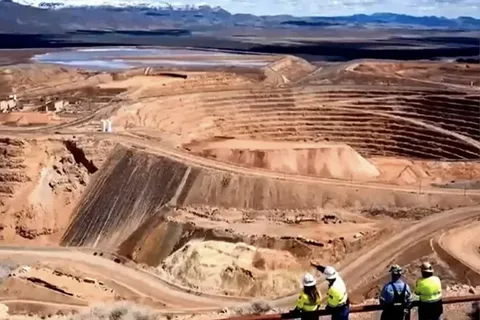
Despite the skepticism around headline valuations, Pakistan does have real, active mining operations. The Reko Diq copper-gold project in Balochistan remains the centerpiece of the country’s mining sector, alongside the Saindak copper-gold mine and the massive Thar coalfield in Sindh, which contains an estimated 175 billion tons of lignite and currently supplies around 10 percent of Pakistan’s electricity generation.
In October 2025, Pakistan sent its first shipment of enriched rare earth elements and critical minerals to Missouri-based US Strategic Metals under a $500 million agreement. The consignment included antimony, copper concentrate, and rare earth elements such as neodymium and praseodymium, marking Pakistan’s first real entry into the global critical minerals supply chain rather than just talking about future potential.
Despite this progress, mining currently contributes less than 3 percent to Pakistan’s GDP and under 0.1 percent to global mineral exports, a sharp contrast to the scale of wealth being publicly promoted.
10 Minerals Found in Pakistan
Pakistan’s diverse geology has produced a wide range of commercially significant minerals across its four provinces, Gilgit-Baltistan, and Azad Kashmir. Ten of the most notable include:
- Copper – concentrated heavily in the Reko Diq and Saindak deposits in Balochistan
- Gold – found alongside copper in Tethyan belt deposits and in Gilgit-Baltistan
- Coal (lignite) – primarily from the vast Thar coalfield in Sindh
- Chromite – mined in Balochistan and parts of Khyber Pakhtunkhwa
- Rare earth elements – including neodymium and praseodymium, found in Balochistan and Gilgit-Baltistan
- Lithium – early-stage occurrences identified in Gilgit-Baltistan
- Antimony – part of Pakistan’s recent critical minerals export shipments
- Gemstones – including peridot and emerald, primarily from the northern regions
- Marble and granite – widely quarried across Khyber Pakhtunkhwa and Balochistan
- Gypsum – used extensively in Pakistan’s cement and construction industries
Quotes
Prime Minister Shehbaz Sharif, addressing the Pakistan Minerals Investment Forum, said the country’s mineral reserves could help Pakistan eventually move past dependence on global financial institutions if the sector’s full potential were realized.
Business chambers, including the Islamabad Chamber of Commerce and Agriculture, have argued that Pakistan’s estimated $8 trillion mineral wealth could drive sustainable long-term economic growth, provided the country shifts toward value-added processing rather than exporting raw, unrefined ore.
Independent analysts have pushed back on the scale of these claims, with one commentary describing the widely cited $6 trillion figure as sounding more like a promotional sales pitch than a technically substantiated reserve estimate backed by the kind of detailed studies international mining standards require.
Impact
If even a fraction of Pakistan’s projected mineral wealth is eventually converted into active, exportable reserves, the economic impact could be significant for a country that has struggled with persistent balance-of-payments pressure and reliance on IMF support. The recent rare earth shipment to the United States also signals a potential shift in global supply chains, as Western countries look for alternatives to China’s dominance in critical mineral processing.
However, analysts caution that the timeline for meaningful impact is long. Industry research suggests any real economic transformation from Pakistan’s mineral sector would likely unfold gradually, starting with a 2-3 year demonstration phase, followed by 5-7 years of moderate scaling, with substantial impact not expected for a decade or more.
Regionally, Pakistan’s mineral push also carries geopolitical weight, given growing US interest in securing rare earth supplies outside China and Pakistan’s stated willingness to offer port access, including at Pasni on the Arabian Sea, to facilitate mineral exports to American buyers.
Conclusion
Pakistan’s mineral wealth remains a story of significant geological promise weighed against a long history of underdelivery. The country’s first real rare earth export shipment marks a meaningful, if modest, step forward. Turning trillion-dollar estimates into a functioning, GDP-moving mining sector will still take years of sustained investment in exploration, processing technology, and infrastructure, areas Pakistan has historically struggled to deliver on.
Frequently Asked Questions
Which mineral is costlier than gold?
Several minerals and elements are more expensive than gold by weight, including rhodium, which has at times traded for several times the price of gold due to its extreme rarity and heavy use in catalytic converters, and californium, a synthetic radioactive element considered one of the most expensive materials on Earth at an estimated tens of millions of dollars per gram. Among naturally occurring minerals relevant to Pakistan’s resource base, certain rare earth elements like dysprosium and terbium also command significantly higher prices per kilogram than gold, due to their critical role in magnets used in electric vehicles and wind turbines and their limited global supply.
What is the king of all minerals?
Gold is often informally referred to as the “king of minerals” due to its historical role as a global store of value, its use in currency systems for centuries, and its continued importance in jewelry, electronics, and central bank reserves worldwide. Some geologists and industry figures also apply the title to diamond, given its status as the hardest known natural mineral, or increasingly to rare earth elements, which have earned the nickname “industrial gold” because of how essential they’ve become to modern technology, defense systems, and the global clean energy transition.
What are the top 3 strongest minerals?
By hardness on the Mohs scale, diamond ranks as the strongest natural mineral, scoring a perfect 10, followed by corundum, which includes ruby and sapphire, at 9, and topaz at 8. These rankings measure scratch resistance rather than overall durability, meaning a mineral’s practical strength in industrial applications can depend on additional factors like toughness and fracture resistance. Pakistan itself is home to notable deposits of corundum-family gemstones, including rubies mined in Hunza and other parts of Gilgit-Baltistan, placing the country among the sources of some of the world’s harder natural minerals.