

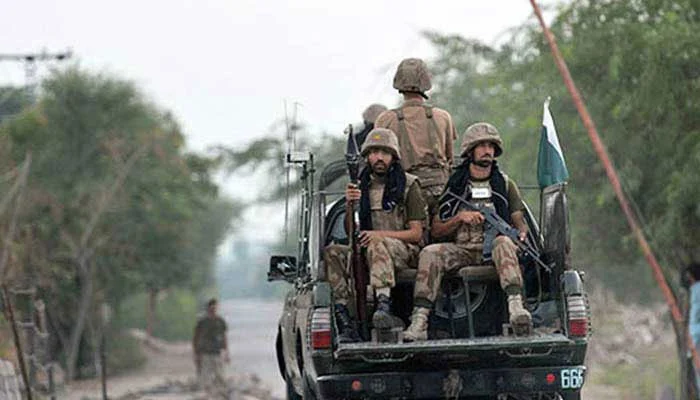

The latest ISPR press release today confirms that security forces killed 10 terrorists in intelligence-based operations across Balochistan over the past 48 hours, while two female suicide bombers and their facilitator were apprehended in Mastung district before they could strike.
Background
Balochistan has remained the epicenter of Pakistan’s counter-terrorism operations for months, with the military’s media wing, Inter-Services Public Relations (ISPR), issuing near-daily updates on operations against militant networks. The province has seen a sharp rise in attacks linked to groups Pakistan’s government refers to as Fitna al-Hindustan and Fitna al-Khawarij, which officials say are backed by India.
According to ISPR Pakistan’s official website and statements, security forces have intensified intelligence-based operations, or IBOs, across multiple Balochistan districts in recent weeks. These operations typically follow specific intelligence tips about militant hideouts, movement, or planned attacks, allowing troops to act before violence occurs rather than only responding after the fact.
Today’s ISPR press release follows that same pattern, describing coordinated action in two separate districts within a 48-hour window, a scale of operation that has become increasingly common as security forces try to stay ahead of evolving militant tactics, including the use of suicide bombers disguised to avoid detection.
Details
Per the ISPR press release today, seven terrorists were killed in District Surab after security forces engaged militant positions during an intelligence-based operation. Troops moved on intelligence about the group’s location and exchanged fire before neutralizing all seven fighters at the site.
In a separate operation in District Mastung, three additional terrorists were killed. During the same operation, security forces apprehended two female suicide bombers along with a facilitator linked to Fitna al-Hindustan, the militant network Pakistani authorities say receives backing from India. Officials said the interception prevented what could have been a significant attack on civilians or security personnel.
ISPR’s statement noted that weapons, ammunition, and improvised explosive devices used by the terrorists were recovered from both operation sites. The use of female suicide bombers has become a growing concern for security forces in Balochistan, with militant groups increasingly relying on disguise and misdirection to bypass checkpoints and security screening.
This latest update follows a string of intense operations disclosed through recent ISPR press conferences. Earlier this month, DG ISPR Lieutenant General Ahmed Sharif Chaudhry addressed reporters in Rawalpindi, detailing how 54 terrorists were killed while 42 security personnel and civilians were martyred following three coordinated attacks in Balochistan over four days. Anyone checking ISPR press release today live updates has likely noticed how often these operations are being reported.
Quotes
ISPR’s statement on the Surab and Mastung operations reaffirmed that security forces and law enforcement agencies would continue acting against terrorism at full pace to eliminate what it called foreign-sponsored terrorism from the country, language that has become standard in nearly every ISPR press release covering Balochistan operations.
At an earlier ISPR press conference today addressing the broader security situation, DG ISPR Lt Gen Ahmed Sharif Chaudhry directly accused India of orchestrating the wave of attacks, saying hostile forces aligned with India could not tolerate Pakistan’s stability and were supporting groups responsible for recent violence in the province.
Federal leadership has echoed this framing as well. Prime Minister Shehbaz Sharif has previously praised security forces for their operations against what officials describe as India-backed terrorism, calling the campaign a reflection of the professionalism and resolve of Pakistan’s armed forces.
Impact
The disruption of a planned suicide attack involving two female bombers carries particular weight given the rising trend of militant groups in Balochistan using women as attackers to evade security checkpoints. Security analysts have noted this shift places new pressure on law enforcement to adapt screening protocols across the province.
Regionally, the continued operations reflect the scale of the security challenge Pakistan faces in Balochistan, where mineral resources, the Gwadar port, and China-Pakistan Economic Corridor infrastructure make stability a strategic priority for Islamabad. Repeated attacks and counter-operations in the province also affect investor confidence and daily life for residents caught between militant violence and military response.
Nationally, each new ISPR press release contributes to an already sobering count for the year. Data cited in earlier ISPR briefings shows terrorism incidents nationwide have risen sharply since 2022, with Balochistan and Khyber Pakhtunkhwa bearing the brunt of the violence. The steady cadence of operations, and the ISPR press releases documenting them, has become a near-daily fixture of Pakistan’s security landscape.
Conclusion
With sanitisation operations reportedly still underway in both Surab and Mastung, further details are expected in coming days as security forces continue searching for any remaining militants connected to the group. Given the pace of recent months, another ISPR press conference addressing Balochistan’s security situation is likely before long, as the military continues to frame its operations as part of a sustained campaign against India-backed terrorism in the province.
Frequently Asked Questions
How is current DG ISPR?
The current Director General of Inter-Services Public Relations (ISPR) is Lieutenant General Ahmed Sharif Chaudhry, who serves as the Pakistan military’s chief spokesperson. He has been the primary official addressing ISPR press conferences on major security developments, including the recent surge in Balochistan operations, and regularly briefs journalists in Rawalpindi on casualty figures, operational details, and the government’s assessment of who is responsible for attacks across the country.
What is the salary of Asim Munir?
Pakistan Army Chief and Field Marshal Asim Munir reportedly receives a monthly salary of around 250,000 Pakistani rupees in his official capacity, according to widely cited reports on senior military compensation. Beyond this base salary, he receives a range of additional benefits typical of the country’s top military post, including an official residence, a designated vehicle and driver, club memberships, and comprehensive medical coverage. Munir was promoted to Field Marshal in May 2025, becoming only the second officer in Pakistan’s history to hold that rank, and in November 2025 he was also appointed as the country’s first Chief of Defence Forces, a newly created position overseeing all three branches of the armed forces for a five-year term.
Who is the current ISPR?
Inter-Services Public Relations, commonly known as ISPR, is Pakistan’s military media and public relations wing, responsible for issuing official statements, casualty updates, and holding press conferences on behalf of the armed forces. The current Director General of ISPR is Lieutenant General Ahmed Sharif Chaudhry, who took over the role and has since become the primary public face of Pakistan’s military communications, particularly regarding the ongoing counter-terrorism operations in Balochistan and Khyber Pakhtunkhwa.