

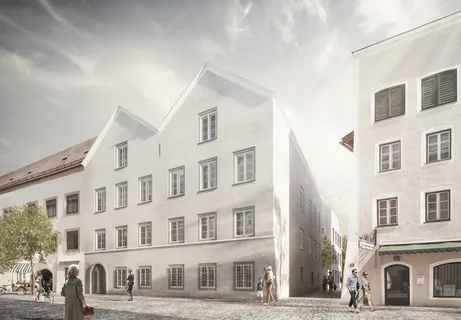

Austria has officially opened a police station inside the house where Adolf Hitler was born in 1889, ending decades of debate over what to do with a building that has long drawn far-right pilgrims. The Hitler’s house police station in Braunau am Inn began operating this week after a renovation lasting several years and costing around 20 million euros.
Background
The yellow, three-story building sits on a narrow, shop-lined street in the center of Braunau am Inn, a small Austrian town on the border with Germany. Hitler was born there on April 20, 1889, and lived in the house only briefly before his family moved away.
For decades, the building remained in private hands, and Austrian officials struggled to agree on its future. The site repeatedly drew neo-Nazis and far-right sympathizers, turning what should have been an ordinary residential building into an unwanted symbol.
In 2016, the Austrian government passed a law to take control of the property, and the building was formally expropriated from its private owner in 2017 following a legal dispute. An expert commission later ruled out both demolition and conversion into a museum, recommending instead a redesign that would make the building as difficult to recognize as possible.
Details
The renovation took three years longer than originally planned and finished at a cost of roughly 20 million euros, or about $22.8 million. The finished complex includes the main building along with outbuildings and an inner courtyard, and it will now house officers from the district police command as well as the local Braunau police inspectorate.
Austria’s Interior Ministry said the goal was to send an unmistakable signal that the building would never again be used to commemorate National Socialism. Interior Minister Gerhard Karner formally opened the station this week, following through on a plan first announced by his predecessors nearly a decade earlier.
A memorial stone still stands in front of the building, reading: “For Peace, Freedom and Democracy. Never Again Fascism. Millions of Dead Warn.” Officials have kept the stone in place even as the surrounding facade has been reworked to strip away any features that once made the house recognizable as Hitler’s birthplace.
The move fits into a broader pattern of Austria confronting sites linked to its Nazi-era history. Last year, two streets in Braunau am Inn that had commemorated Nazi figures were renamed following years of complaints from local activists and Holocaust survivor groups.
Quotes
Austria’s Interior Ministry stated that the house’s future use by police should make clear that the building will never again serve as a place to commemorate Nazism, framing the police station as a deliberate break from the site’s past.
Not everyone in Braunau am Inn agrees the plan goes far enough. Local resident Sibylle Treiblmaier, a 53-year-old office assistant, told AFP the decision was “a double-edged sword,” suggesting the space could have been used better or differently even if it discourages far-right gatherings.
Robert Eiter, spokesman for the Mauthausen Committee Austria, an organization representing former concentration camp prisoners, was more blunt, arguing that humanity will never forget where history’s most notorious mass murderer was born and that the renovation “will not prevent a single neo-Nazi from making the pilgrimage to Braunau.”
Author Ludwig Laher, also a member of the Mauthausen Committee, raised a different concern, noting that a police station is “problematic” because police forces are, in his view, obligated in every political system to protect what the state wants, regardless of the symbolism involved.
Impact
The decision carries weight well beyond one small Austrian town. Austria was annexed by Hitler’s Germany in 1938, and the country has faced repeated criticism over the years for not fully acknowledging its own citizens’ role in Nazi crimes and the Holocaust that followed.
An estimated 65,000 Austrian Jews were killed and another 130,000 forced into exile after the annexation, a history that continues to shape how the country handles sites connected to Hitler and the Nazi era. Turning his birthplace into a functioning police station fits into Austria’s broader, ongoing effort to reckon with that legacy rather than simply erase it.
The timing also carries political weight domestically. Austria’s far-right Freedom Party, founded by former Nazis, won the most votes in a national election for the first time in 2024, though it ultimately failed to form a government. Against that backdrop, officials have framed the police station as a firm statement against any resurgence of far-right extremism tied to the country’s past.
Conclusion
With the police station now open, Austrian officials hope the long-running debate over Hitler’s birthplace is finally settled. Whether the redesign actually stops determined far-right visitors from seeking out the site, as critics like Eiter and Laher doubt, remains to be seen in the months and years ahead.
For now, the building stands as a working police facility, with the memorial stone out front serving as the only visible reminder of the site’s dark history and the country’s stated commitment to never letting it be forgotten.
Frequently Asked Questions
Does Hitler’s bunker still exist?
Parts of the Führerbunker in Berlin, where Hitler spent his final days and died in April 1945, still exist beneath the ground, though the site has never been developed into a memorial or museum. After German reunification, the German government deliberately left the location largely unmarked to avoid creating a pilgrimage site for neo-Nazis, similar to the reasoning behind Austria’s approach to Hitler’s birthplace. Today, a small, understated information board placed by the German Federal Agency for Civic Education is the only marker at the site, located near an apartment complex and parking area in central Berlin, with no public access to the remaining underground structure itself.
Where was Hitler’s house located?
The house where Adolf Hitler was born is located in Braunau am Inn, a small Austrian town sitting directly on the border with Germany, roughly 50 kilometers north of Salzburg. The building is a modest, yellow, multi-story structure situated on a narrow, shop-lined street in the town’s center, and it has now been redesigned and converted into a police station following years of legal and political debate over its future use. Hitler was born in the house on April 20, 1889, and lived there only briefly before his family relocated.
Where is Hitler’s left testicle?
This question is based on a decades-old rumor and a wartime mockery song rather than any verified historical or medical record. No credible historical, medical, or forensic documentation supports any specific claim about this detail, and it is not something reputable news organizations or historians treat as an established fact. Readers interested in the verified aspects of Hitler’s life, death, and remains are better served by looking at documented historical accounts of his death in the Führerbunker in April 1945, rather than unverified rumors that have circulated for decades without credible evidence.