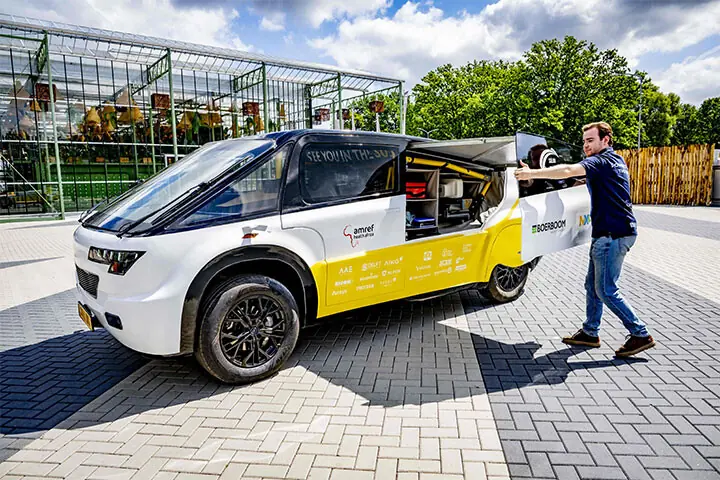
EINDHOVEN: A team of students from the Eindhoven University of Technology has introduced what they believe is the world’s first solar-powered ambulance, an innovative vehicle designed to deliver essential medical care to people living in some of the world’s most remote and underserved regions.
Named Stella Juva, the futuristic white-and-yellow ambulance is equipped with roof-mounted solar panels that generate electricity to power both the vehicle and its onboard medical equipment, offering a sustainable solution for healthcare delivery where conventional ambulances struggle to operate.
Solar Energy Powers Both Vehicle and Medical Equipment
Unlike traditional ambulances, Stella Juva uses renewable solar energy not only to drive the vehicle but also to operate a wide range of life-saving medical devices, including portable X-ray machines, defibrillators, ultrasound equipment, diagnostic testing kits, and vaccine refrigeration units.
The ambulance can travel at speeds of up to 120 kilometres per hour (75 mph) and has been specially engineered to navigate rough off-road terrain, making it suitable for isolated communities with limited infrastructure.
On sunny days, the vehicle offers an impressive driving range of 715 kilometres (444 miles). It also features a rechargeable battery system that stores solar energy, ensuring uninterrupted operation during nighttime or cloudy weather.
Bringing Healthcare Directly to Patients
Project leader Mathijs van Gerven, a 21-year-old biomedical engineering student, said the concept aims to reverse the traditional healthcare model by bringing medical services directly to patients instead of transporting patients over long distances to hospitals.
“Stella Juva is fully equipped to deliver medical healthcare in hard-to-reach areas,” Van Gerven said.
The mobile medical unit includes tuberculosis testing kits, refrigerated storage for vaccines, and portable ultrasound equipment for maternal healthcare, allowing healthcare workers to diagnose and treat patients in remote communities.
Real-World Testing Planned in Kenya
The student team plans to take Stella Juva to Kenya next month for field testing to evaluate its performance in real-world conditions and gather feedback from healthcare professionals working in remote areas.
The project has attracted support from humanitarian organisations that see significant potential for improving healthcare access across developing countries.
Addressing Africa’s Healthcare Access Challenge
Femke Maurits, Partnerships Manager at Amref Health Africa, said the innovation addresses one of the biggest healthcare challenges facing many African nations.
“The issue that many African countries have is that the distance between very remote villages and healthcare facilities is really big,” Maurits explained.
She said mobile, solar-powered healthcare solutions like Stella Juva could help bridge that gap by enabling medical teams to reach communities that currently have limited or no access to essential healthcare services.
If successful, the project could pave the way for a new generation of environmentally friendly emergency and mobile healthcare vehicles capable of serving remote populations around the world.