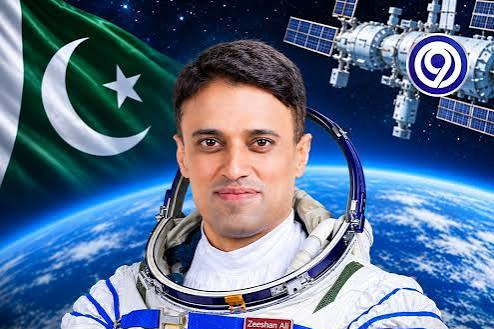
Pakistan has achieved a historic milestone in space exploration as Muhammad Zeeshan Ali became the first Pakistani astronaut to travel into orbit aboard China’s Shenzhou-24 spacecraft. The mission lifted off from the Jiuquan Satellite Launch Centre on November 25, 2026, carrying Ali alongside two Chinese astronauts.
The spacecraft successfully reached China’s Tiangong space station just three hours and 38 minutes after launch. The achievement marks an important moment for Pakistan’s space programme and represents a new chapter in scientific cooperation between Islamabad and Beijing.
For Pakistan, the mission is more than a symbolic achievement. It offers an opportunity to gain practical experience in human spaceflight, scientific research and international space operations.
Shenzhou-24 Successfully Carries Pakistani Astronaut Into Orbit
The Shenzhou-24 mission launched at 8:18am Beijing time, equivalent to 5:18am Pakistan time, from the Jiuquan Satellite Launch Centre in northwestern China.
A Long March-2F rocket carried the spacecraft into orbit. The launch took place under a clear morning sky, with officials and spectators gathered at the centre to witness the historic event.
The three-member crew included Chinese astronauts Tang Hongbo and Wu Yi, alongside Pakistani astronaut Muhammad Zeeshan Ali.
Tang Hongbo commanded the mission, while Wu Yi served as mission pilot. Ali joined the crew as a payload specialist, responsible for supporting scientific experiments and other mission activities.
Around ten minutes after liftoff, the spacecraft separated from its launch vehicle and entered its planned orbit, according to the China Manned Space Agency.
The successful docking with Tiangong later confirmed that the spacecraft had completed another major stage of the mission.
Zeeshan Ali Becomes Pakistan’s First Astronaut in Orbit
At 40 years old, Muhammad Zeeshan Ali has become the first Pakistani astronaut to enter orbit, creating a milestone for the country’s participation in human space exploration.
His achievement also makes him the first foreign national to board China’s Tiangong space station, according to Chinese space authorities.
Ali’s selection followed a cooperation agreement signed between Pakistan’s Space and Upper Atmosphere Research Commission, commonly known as SUPARCO, and the China Manned Space Agency in February 2025.
Under the agreement, two Pakistani candidates were selected to begin astronaut training in China. Muhammad Zeeshan Ali and Khurram Daud were chosen in April 2026.
After completing the selection and training process, Ali was assigned to the Shenzhou-24 mission.
His journey demonstrates the importance of international cooperation in developing the technical knowledge and experience required for human spaceflight.
Pakistan-China Space Cooperation Reaches a New Level
The mission reflects growing cooperation between Pakistan and China in science, technology and space research.
China has developed an extensive space programme that includes satellite launches, lunar exploration, scientific research and the construction of its own space station. Pakistan’s participation in a crewed Chinese mission provides an opportunity to learn from this experience.
Planning Minister Ahsan Iqbal travelled to China to witness the launch. He described the event as the beginning of a new era for Pakistan’s space programme and celebrated Ali’s achievement as a moment of national pride.
The cooperation agreement between SUPARCO and the China Manned Space Agency has provided a practical framework for Pakistani participation in human spaceflight.
It also creates opportunities for Pakistani scientists and engineers to gain experience in mission preparation, astronaut training and scientific experimentation.
The development fits into the wider relationship between the two countries, which extends beyond infrastructure and trade. Their cooperation in science and technology is becoming another important part of bilateral ties. Pakistan Chronicle has also examined this relationship in its report on China and Pakistan’s strategic partnership in South Asia.
Around 90 Scientific Experiments Planned During the Mission
The Shenzhou-24 mission is not limited to transporting astronauts to the Tiangong space station. It also includes a substantial scientific programme.
According to the China Manned Space Agency, the crew is expected to participate in around 90 experiments and technology tests.
These activities include space science research, station operations, equipment maintenance and experiments involving scientific payloads.
Pakistan also has its own research objectives for Ali’s participation. SUPARCO has highlighted experiments involving microalgae and quinoa seeds.
Microalgae research is particularly interesting because these organisms may have potential applications in future space missions. Scientists are exploring their possible use as sources of food and oxygen, which could become valuable during long-duration journeys.
The quinoa seed experiment will help researchers examine how exposure to the space environment affects plant development.
Such research may contribute to future studies on growing food in space and understanding how living organisms respond to conditions beyond Earth.
Pakistan’s involvement in these experiments gives its scientific community an opportunity to contribute to international research rather than simply observe developments from the ground.
Ali’s Mission Includes a Short Stay in Space
Unlike missions designed for astronauts to spend several months in orbit, Ali’s participation is expected to last approximately one week.
During this period, he will work with the Chinese crew and take part in the mission’s scientific activities.
The spacecraft will also support an orbital crew rotation involving the astronauts already aboard Tiangong. The Shenzhou-23 spacecraft, which docked with the station in May, is expected to serve as the return vehicle for Ali.
This arrangement allows the mission to support both scientific research and routine station operations.
For Pakistan, even a relatively short mission represents an important learning opportunity. Human spaceflight requires specialised training, technical coordination and a detailed understanding of how astronauts operate in microgravity.
The experience gained by Ali could help strengthen the country’s future participation in international space programmes.
What the Mission Means for Pakistan’s Space Programme
Pakistan has been involved in space research for decades through SUPARCO, particularly in satellite technology, communications, remote sensing and scientific development.
However, sending an astronaut into orbit represents a different level of participation.
The mission provides Pakistani researchers with exposure to human spaceflight operations and the scientific challenges associated with living and working in orbit.
It may also encourage greater interest in science, technology, engineering and mathematics among students.
For young Pakistanis interested in astronomy, engineering and scientific research, Ali’s achievement offers a powerful example of what international training and cooperation can make possible.
The country will need sustained investment in research institutions, technical education and advanced engineering if it wants to build on this achievement.
International partnerships can provide valuable support, but long-term progress will also depend on developing local expertise and creating opportunities for Pakistani scientists.
Readers interested in international space developments can explore Pakistan Chronicle’s coverage of SpaceX and global space exploration.
The Future of Human Space Exploration
China’s Tiangong space station is an important part of its long-term plans for scientific research and human spaceflight.
The station provides an environment for conducting experiments that cannot easily be carried out on Earth. Research in microgravity can help scientists understand biological processes, materials, medicine and the behaviour of physical systems.
International participation also allows China to strengthen its position in global space research and develop partnerships with other countries.
Pakistan’s involvement in Shenzhou-24 could provide a foundation for further cooperation, including astronaut training, scientific experiments and future missions.
The wider study of space continues to expand as countries and private companies invest in new spacecraft, telescopes and exploration technologies. Pakistan Chronicle has also discussed the scientific questions surrounding the universe in its article on quantum mechanics and the mysteries of the universe.
Conclusion
Muhammad Zeeshan Ali’s successful journey aboard Shenzhou-24 marks a historic achievement for Pakistan. His arrival at China’s Tiangong space station makes him the first Pakistani astronaut to enter orbit and the first foreign national to board the Chinese station.
Beyond national pride, the mission offers practical scientific opportunities through experiments involving microalgae, quinoa seeds and other research activities.
The achievement also demonstrates the value of Pakistan-China cooperation in advanced technology and space exploration.
The next challenge for Pakistan will be to build on this milestone through continued investment in education, research and technical development. Ali’s journey may be a first step, but it has opened an important door for the country’s future ambitions in space.
Frequently Asked Questions
1. Who is Pakistan’s first astronaut to travel into space?
Muhammad Zeeshan Ali is the first Pakistani astronaut to enter orbit. He travelled aboard China’s Shenzhou-24 spacecraft on November 25, 2026, alongside Chinese astronauts Tang Hongbo and Wu Yi.
2. What is the Shenzhou-24 mission?
Shenzhou-24 is a Chinese crewed space mission that transported three astronauts to the Tiangong space station. The crew includes two Chinese astronauts and Pakistan’s Muhammad Zeeshan Ali.
3. When did Zeeshan Ali reach the Tiangong space station?
The Shenzhou-24 spacecraft successfully docked with China’s Tiangong space station three hours and 38 minutes after its launch on November 25, 2026.
4. What scientific experiments will Pakistan’s astronaut conduct?
Ali is expected to participate in scientific activities, including research involving microalgae and quinoa seeds. These experiments could contribute to future studies of food production and biological processes in space.