


India’s Dilemmas in South Asian Power Politics and the Strategies of China and Pakistan
By Mian Iftikhar Ahmad
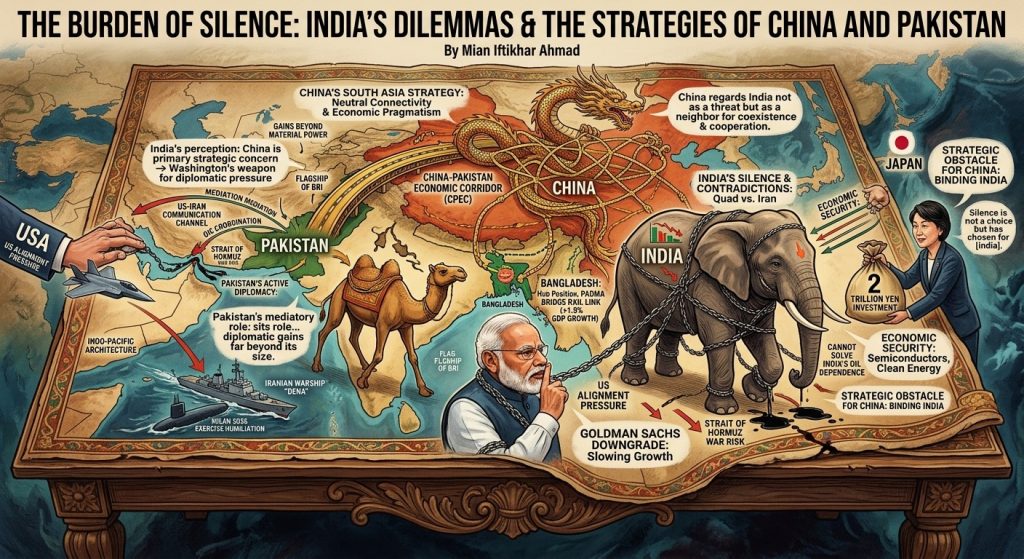
When the US-Israeli military action against Iran ignited the fires of war in the waters of the Indian Ocean, a striking phenomenon emerged on the surface of South Asian geopolitics: Pakistan seized the opportunity to become the center of regional attention through mediation and diplomatic initiative, while India maintained an unusual silence. This silence was not accidental tongue-tiedness but the inevitable consequence of the structural complexities in which the Modi government finds itself entangled in the US-Iran conflict. India’s dependence on Gulf energy, the conflicting interests between the United States and Iran, and the web of economic corridors being built by China through Pakistan, Myanmar, and Bangladesh—all these factors have created a complex scenario of power transition in South Asia. In this scenario, silence itself is paying a heavy price, while Pakistan’s active diplomacy has secured geopolitical gains far beyond its material power.
The first reason for India’s silence is the fundamental contradiction hidden within its system of alliances. In recent years, the Modi government has paved two paths that appear parallel on the surface but collide internally: on one hand, India deepened defense and strategic cooperation with the United States through the Quad security dialogue and firmly anchored itself in the US-led Indo-Pacific architecture; on the other hand, India maintained historical energy and geopolitical ties with Iran and regarded the Chabahar Port project as a key route to Central Asia bypassing Pakistan. But when a US submarine sank the Iranian warship Dena in international waters of the Indian Ocean—and this ship was returning after participating in the Milan 2026 multinational joint exercises hosted by India—New Delhi faced not just an ordinary diplomatic difficulty but a double challenge of open humiliation and strategic pressure. India could neither condemn the US military action, which was in the fundamental interest of its key defense partner, nor could it turn a blind eye to the sinking of an Iranian warship in its own backyard, because this silence gave rise to accusations in India of stabbing a guest in the back. The root of this silence lies in a rigid perception long established in India’s strategic circles: China is India’s primary strategic concern. This perception provides Washington with an effective weapon for exerting continuous diplomatic pressure on India. When India confines its diplomatic space to a single dimension of alliance with the US against China, its bargaining power inevitably evaporates when the US takes actions that harm India’s other interests. The observation of Shi Chao, a researcher at Fudan University, is profoundly insightful: the mode of India-US interaction has transformed from India extracting strategic benefits from US-China competition to the US using India’s rigid perception of China to shape India’s foreign policy. India’s silence is not a choice but has been chosen for it.

The economic cost of silence emerged more rapidly and in more concrete terms. Just weeks before the US-Israeli military action against Iran, India’s economy had been declared by international investment banks like Goldman Sachs as the world’s fastest-growing major economy, having just overtaken the United Kingdom to become the world’s fifth-largest economy and expected soon to surpass Japan as well. But this optimistic narrative rested on a vulnerability that had long been ignored: approximately forty percent of India’s oil imports and eighty percent of its gas imports come from the Middle East, with a large portion passing through the Strait of Hormuz. Approximately ten million Indian citizens work in Gulf countries and send home annual remittances of one hundred thirty billion dollars, of which about forty percent come from the Middle East. Every ten-dollar increase in oil prices adds twelve to fifteen billion dollars to India’s import costs. When war disrupted air and sea transport and Dubai—an important transit hub for Indian business—came to a halt, India’s economy suffered a severe blow to its flank. Goldman warned that India would face the triple pressures of slowing economic growth, rising inflation, and currency depreciation, and within one month of the war’s outbreak, the Indian stock market fell by approximately ten percent. More ironically, India had stopped buying Russian oil under US pressure, but after the war began, the US allowed India to accept Russian oil to fill the global supply gap. The announcement by US Treasury Secretary Bessent that “we have allowed them to accept Russian oil” created a deep sense of humiliation in Indian public opinion. India’s tradition of self-styled strategic autonomy was exposed in its weak reality before the hard constraints of energy security.
This was precisely the moment when India was trapped in the double quagmire of strategic paralysis and economic turmoil, and Pakistan’s mediatory role secured diplomatic gains far beyond its size. As a neighbor of Iran and an important member of the Islamic world, Pakistan—through its all-weather strategic cooperative partnership with China—achieved a unique position to play the role of a communication channel in the US-Iran conflict. This contrast between Pakistan’s active diplomacy and India’s passive silence is itself reshaping the perception of power in South Asia. For a long time, India regarded South Asia as its natural sphere of influence and Pakistan as a problem to be managed rather than an equal regional player. But when Pakistan can convey messages between the US and Iran, harmonize positions in the Organization of Islamic Cooperation, and ensure regional connectivity within the China-Pakistan Economic Corridor framework, its regional influence cannot be measured by GDP or military expenditure alone. India’s suspicious gaze at Pakistan’s diplomatic activities itself reveals its deep anxiety over the weakening of its regional primacy.
The construction progress of the China-Pakistan Economic Corridor has provided a strong material foundation for Pakistan’s diplomatic activism. As the flagship project of the Belt and Road Initiative, this corridor has not only provided Pakistan with much-needed infrastructure investment and energy projects but also granted Islamabad geopolitical weight far beyond its economic size at the strategic level. Meanwhile, China’s economic architecture in South Asia is weaving a multi-layered and multi-directional web of connectivity. The construction of the China-Myanmar Economic Corridor continues, with major projects such as the Kyaukpyu deep-water port and the Muse-Mandalay railway being steadily implemented, providing an alternative route to the Indian Ocean for China’s southwestern region bypassing the Strait of Malacca. More importantly, Bangladesh has shown a positive attitude toward the China-Myanmar-Bangladesh Economic Corridor concept proposed by China. Speaking at a seminar in Dhaka, the foreign affairs adviser to Bangladesh’s opposition leader clearly stated that this corridor could provide Bangladesh with a true hub position between South Asia and Southeast Asia. Once the route from Yunnan through Myanmar to Bangladesh’s Chittagong port is built, it will connect China’s supply chain more deeply to a market of nearly two hundred million people and push Bangladesh further toward integrating into the ASEAN economic system and ultimately joining the Regional Comprehensive Economic Partnership. The strategic significance of these connectivity projects is that they are weaving an economic network centered on China in South Asia, in which India will either be marginalized or forced to change its long-term resistant policy.
In response to this trend at the energy security and economic levels, India’s reaction is displaying a restless and contradictory character. Facing the pressure of energy security, India accelerated cooperation with Japan in the fields of energy security and supply chain resilience. During Japanese Prime Minister Takaichi Sanae’s visit to India, the two countries signed numerous agreements covering five priority areas of economic security including semiconductors, critical minerals, clean energy, and pharmaceutical products, and Japan promised an investment of two trillion yen in India. Japan clearly supported India’s membership in the International Energy Agency and promoted the construction of India’s oil reserve system. On the surface, this is the deepening of the India-Japan special strategic global partnership, but in strategic essence, Japan is attempting to build a supply chain system excluding China through India. Japan identified dealing with China as the primary background for strengthening cooperation with India and deliberately included negative references to the situations in the East China Sea and South China Sea in the joint statement, the fundamental purpose being to bind India to its geopolitical vehicle and create a strategic obstacle for China in the southwestern direction. However, whether the restructuring of supply chains under this economic security narrative can truly solve India’s energy crisis—the answer is clearly in the negative. India-Japan cooperation can build some alternative network in semiconductors and critical minerals but cannot change India’s structural dependence on Gulf oil and gas. The deeper question is that India, while accepting Japanese investment and supply chain cooperation, is moving toward a new dependence. From dependence on Gulf energy to dependence on the US-Japan-led supply chain security framework, the space for India’s strategic autonomy is quietly shrinking.
China’s strategic posture in South Asia presents a noteworthy contrast to that of the US and Japan. While the US is pulling India into its strategic path through Indo-Pacific rhetoric and supply chain security discourse, China’s South Asia policy is demonstrating greater economic pragmatism. China regards India not as a threat but as a neighboring country with which coexistence and cooperation are possible—this official position is clearly stated in the interpretation of the Fudan University researcher. The progress of the China-Myanmar Economic Corridor follows the principles of mutual respect, mutual benefit, commercial viability, and financial sustainability, with emphasis on infrastructure construction and trade facilitation. Bangladesh’s Padma Bridge railway link project—the largest infrastructure project built with Chinese concessional loans—is expected after opening to traffic in late 2024 to directly benefit eighty million people and contribute approximately one point five percent to Bangladesh’s GDP growth. The common feature of these projects is that they do not demand that recipient countries choose between China and the US but create common interests through economic connectivity. This model is clearly attractive to South Asian countries: Bangladesh wants to connect South Asia and Southeast Asia through the China-Myanmar-Bangladesh corridor, Myanmar obtains infrastructure investment and economic development momentum through the China-Myanmar Economic Corridor, and Pakistan achieves tangible improvements in energy and transportation sectors within the China-Pakistan Economic Corridor framework. China’s South Asia strategy does not build exclusive spheres of influence but incorporates countries into a regional network centered on economic cooperation through the neutral discourse of connectivity.
The significance of this deep transformation in South Asia far exceeds the spillover effects of the US-Iran conflict. The dilemmas exposed by India in this crisis are essentially the result of a severe imbalance between the strategic perception and real interests of an emerging major power. India’s rigid perception of China as its primary strategic concern locks its foreign policy on the axis of balancing China, and this very axis provides the US with an effective weapon for shaping India’s behavior. When India could not take an independent position in the US-Israel-Iran conflict due to this perceptual inertia, it not only lost a diplomatic opportunity but also lost the credibility of raising its voice as a leader in the Global South. In contrast, Pakistan—although far behind India in economic size and conventional military power—has achieved regional influence far beyond its hard power through multi-directional diplomacy between China, the US, and Iran and its central position in the China-Pakistan Economic Corridor. China, through the gradual progress of the China-Pakistan Economic Corridor, the China-Myanmar Economic Corridor, and the China-Myanmar-Bangladesh Economic Corridor, is weaving a regional economic network centered on connectivity in South Asia, and its strategic patience and economic investment are slowly transforming the geoeconomic infrastructure of South Asia.
The power politics of South Asia is undergoing a quiet but profound transition. This transition is occurring not through military confrontation or border changes but through the fluctuations of diplomatic activism, the density of economic ties, and the reconfiguration of strategic perceptions. If India continues to confine its diplomatic space to a single dimension of alliance with the US against China, the cost of its silence will not be merely the loss of a diplomatic crisis but also the long-term risk of gradual marginalization in an emerging Asian economic order. Pakistan’s mediatory role and China’s connectivity strategy have already offered South Asia a model of cooperation different from traditional balance-of-power politics. In this model, the source of regional influence is not merely the monopoly of military power but the ability to connect parties with different interests. Whether India is willing to reconsider its rigid perception of China, find strategic space independent of Washington between the US and Iran, and participate in regional connectivity with a more open attitude will determine its position in the future South Asian landscape. Silence can be a demonstration of deliberate diplomatic art or a symptom of strategic paralysis. Which category India’s silence falls into, time will answer, and the power map of South Asia is being quietly redrawn.