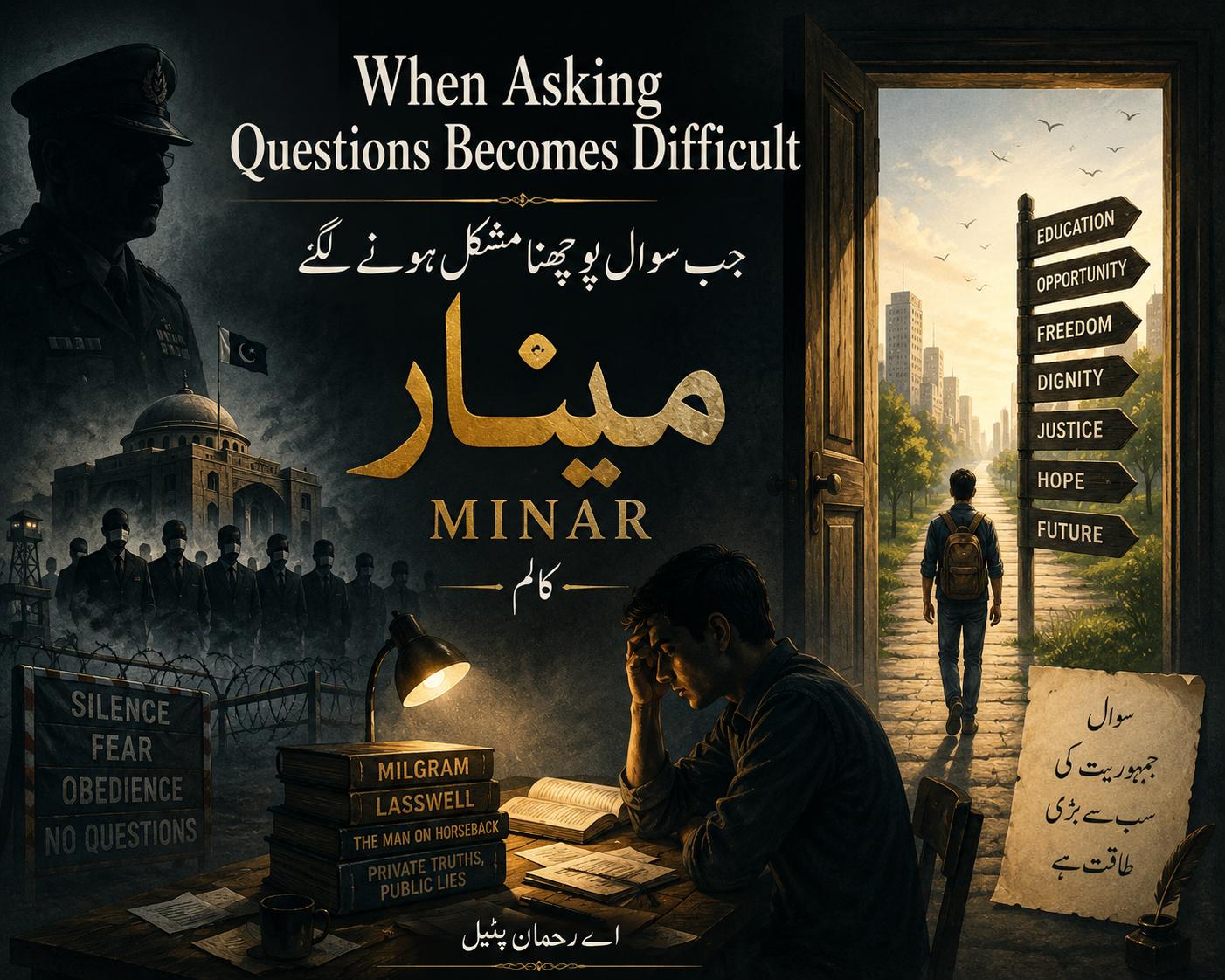
When Asking Questions Becomes Difficult
MINAR
A. Rehman Patel
In 1961, Yale psychologist Stanley Milgram began an unusual experiment.
He wanted to understand how far an ordinary person would go in obeying authority.
Participants were led to believe they were administering electric shocks to another person for incorrect answers. Many became distressed. Some protested. Yet a surprising number continued when instructed by the authority figure overseeing the experiment.
Milgram left us with a disturbing question that remains relevant today:
At what point does a person surrender moral judgment and begin submitting to authority?
Perhaps societies follow a similar path.
They do not wake up one morning and suddenly become silent.
Silence arrives gradually.
One person stops speaking. Another decides it is safer not to get involved. A third worries about his job or his children. Eventually, silence becomes so normal that the person asking questions begins to look unusual.
Perhaps the greatest success of power is not that people obey it.
It is when people begin to regard obedience as normal.
In 1941, American political thinker Harold Lasswell introduced the concept of the Garrison State, a state in which security and the perception of permanent threat gradually dominate other areas of national life, expanding the influence of institutions associated with security.
Lasswell was not describing one particular country. He was offering a warning: societies living under a constant sense of danger may surrender, in the name of security, institutional space they would not normally surrender.
British political scientist Samuel Finer later examined a related question in his influential book The Man on Horseback: why do military institutions enter politics, and what conditions make such intervention possible?
That second question is particularly important.
Because the story is not always only about the institution that occupies a space.
Sometimes it is also about the institutions that leave that space vacant.
Weak political parties, ineffective parliaments, fragile local governments, compromised bureaucracies and failing civilian institutions can create a vacuum.
Gradually, society begins to believe:
They can manage this institution too.
They can solve this crisis too.
Let us hand this responsibility to them as well.
At that point, the issue is no longer the competence of an individual.
It becomes a question of institutional boundaries.
Recently in Pakistan, reports emerged that retired military personnel would be recruited to monitor public schools in Punjab.
Many may be highly competent, disciplined and experienced. This column does not question their abilities.
The question is different:
If the system for monitoring schools is weak, should we strengthen the education administration or bring people from another professional sector to perform its responsibilities?
If civilian institutions are weak, should they be rebuilt or should their responsibilities gradually move elsewhere?
Because the power of one institution does not grow only because that institution is strong.
Sometimes the weakness of other institutions makes it stronger.
There is another question here, one that concerns Pakistan’s young generation.
Every year, thousands of graduates leave our universities carrying degrees, dreams and years of investment by their families into an already limited job market.
If limited government opportunities repeatedly go to people who have completed one professional career and, alongside pensions and other benefits, are able to begin another, a young graduate is entitled to ask:
When will my turn come?
This is not hostility toward retired professionals. It is a question about opportunities between generations.
How is a 25 year old supposed to gain experience if no one offers the first opportunity?
And when educated young people begin to believe that ability and hard work are no longer enough, one door starts appearing increasingly attractive:
The door out of the country.
The problem then is no longer simply Brain Drain.
The greater danger is Hope Drain.
When young people lose faith that their talent can find its best future in their homeland, the state does not merely lose doctors, engineers, scientists or technology professionals.
It loses part of its future.
The most dangerous migration begins when hope leaves the country first, and the person follows later.
Power, however, does not expand only through institutions. It can also establish itself inside the human mind.
In Private Truths, Public Lies, Timur Kuran describes Preference Falsification, when people privately believe one thing but publicly express another because remaining silent feels safer.
A government official thinks: why should I speak?
A journalist wonders: what difference will one article make?
A businessperson decides to mind his own business.
An ordinary citizen looks around and thinks: everyone else is silent, perhaps I am wrong.
Each person begins interpreting the silence of others as consent.
Yet behind closed doors, many may be asking exactly the same questions.
What appears to be a silent majority may sometimes simply be a crowd of silent individuals.
History also shows that powerful systems have not survived through force alone.
Sometimes fear does the work.
Sometimes privilege.
Sometimes social acceptance.
And sometimes one example is enough.
What happens to a few people can teach thousands of others to define the limits of their own voice.
Yet blaming one institution alone would make history too simple.
Power is not always merely taken.
Sometimes it is given.
Incompetence creates space for it. Corruption creates space for it. Political conflict and institutional weakness create space for it. Sometimes people themselves begin waiting for someone powerful to come and fix everything.
That is why democracy requires more than elections.
It needs a strong parliament, an independent judiciary, a professional civil service, effective local government, a free press and citizens who can love their country while still questioning the state.
Because patriotism and questioning are not opposites.
Sometimes the most patriotic question is precisely the one that is most uncomfortable to hear.
Milgram showed how easily the human mind can bend before authority.
Lasswell warned that a permanent climate of insecurity can alter the structure of a state.
Finer questioned the boundary between military and political power.
Kuran explained how private disagreement can gradually become public silence.
Together, they leave us with a question:
What kind of society are we leaving to our children?
One where education leads to opportunity?
Where institutions remain strong within their boundaries?
Where ability competes with ability?
Where disagreement is not treated as hostility?
And where those who ask questions are answered rather than silenced?
If power in a society begins to accumulate continuously in one direction, if the space for civilian institutions shrinks, if opportunities for young people become limited, if the cost of disagreement rises and silence begins to feel like the safest option, history teaches us that such signs should never be dismissed as normal.
Perhaps the final stage of submission is not when people lose the right to speak.
The real danger begins when people themselves stop feeling the need to speak.