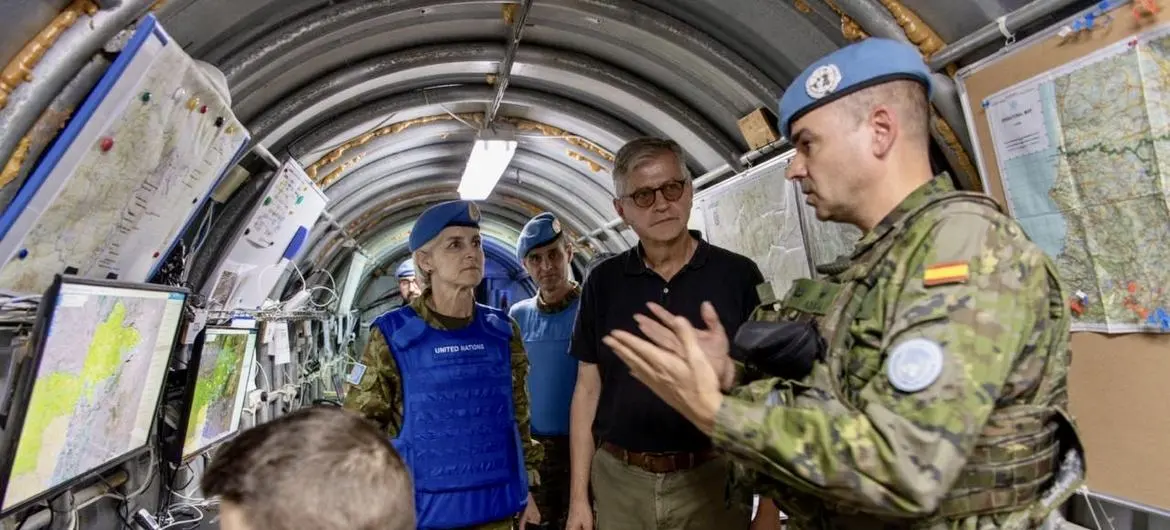
UN Resolution 1701 remains the central legal framework guiding the fragile peace between Lebanon and Israel. Adopted by the UN Security Council in August 2006, the resolution called for a full cessation of hostilities, the withdrawal of armed groups from southern Lebanon, and the deployment of UN peacekeepers along the Blue Line. Nearly two decades later, its implementation is still incomplete, and the question of whether it is truly holding is once again at the center of regional diplomacy.The resolution did not emerge in isolation. It was built on the foundation of earlier Security Council efforts, including UN Resolution 425, UNSC Resolution 426, and UNSC Resolution 1559, each of which addressed different phases of the long-running dispute over Lebanese sovereignty, foreign troop presence, and militia disarmament. Understanding UN Resolution 1701 today means understanding this entire chain of Security Council action, and how each measure has repeatedly fallen short of full compliance.
Background
The roots of UN Resolution 1701 trace back to a wider history of United Nations involvement in the Lebanon-Israel dispute, one that stretches back nearly five decades. UN Resolution 425 and UNSC Resolution 426, both passed in March 1978 following Israel’s invasion of southern Lebanon, first called on Israel to withdraw its forces immediately from Lebanese territory. Resolution 425 affirmed Lebanon’s sovereignty and territorial integrity within its internationally recognized borders, while UNSC Resolution 426 approved the operational guidelines that led directly to the creation of the UN Interim Force in Lebanon, widely known as UNIFIL. These two resolutions laid the earliest institutional groundwork for international peacekeeping along the volatile border and remain legally referenced in nearly every subsequent Security Council discussion on Lebanon. Decades later, UNSC Resolution 1559, adopted in September 2004, added another significant layer to the framework. It demanded the withdrawal of all remaining foreign forces from Lebanese soil, called for free and fair presidential elections without foreign interference, and, most consequentially, required the disbandment and disarmament of all Lebanese and non-Lebanese militias operating in the country. This provision was widely understood at the time, and remains understood today, to apply directly to Hezbollah, the Iran-aligned armed group that has functioned simultaneously as a political party and a heavily armed non-state military force within Lebanon. When full-scale war broke out between Israel and Hezbollah in July 2006, triggered by a cross-border raid in which Hezbollah fighters killed several Israeli soldiers and captured two others, the Security Council responded after 34 days of fighting with UN Resolution 1701. The resolution built directly on the unfulfilled principles of Resolution 425, Resolution 426, and Resolution 1559, essentially reissuing many of their core demands in a more detailed and enforceable form while adding new provisions specific to the 2006 conflict.
Details
UN Resolution 1701 text calls for several specific measures, each designed to prevent a return to open war along the Blue Line. It demands a full cessation of hostilities by both Hezbollah and Israel, the withdrawal of Israeli forces from southern Lebanon, and the disarmament of all armed groups other than the Lebanese state and UNIFIL south of the Litani River. Resolution 1701 Lebanon provisions also called for the enlargement of UNIFIL and the deployment of the Lebanese Armed Forces throughout the south to restore full state authority over territory that had, for years, functioned largely outside central government control. Beyond the immediate ceasefire mechanics, the UN Resolution 1701 text also addressed longer-term political goals. It called for the unconditional release of captured soldiers, support for the Lebanese government’s efforts to extend its authority over all Lebanese territory, and international assistance for the country’s reconstruction. It further reaffirmed respect for the Blue Line, the UN-demarcated withdrawal boundary between Lebanon and Israel, and asked the Secretary-General to develop proposals for delineating Lebanon’s international borders, including in the disputed Shebaa Farms area, a task that remains unresolved to this day. For years, Resolution 1701 Lebanon kept a relative, if uneasy, calm along the border, allowing both sides to avoid full-scale confrontation for nearly two decades despite periodic skirmishes. That calm collapsed after October 2023, when Hezbollah opened fire on Israel in solidarity with Hamas following the Gaza war, triggering more than a year of cross-border strikes, evacuations of border communities on both sides, and significant civilian and military casualties. A ceasefire brokered by the United States in late 2024 explicitly cited UNSC Resolution 1701 as its foundation, and both sides pledged, at least on paper, to return to its core terms, including Israeli withdrawal and Hezbollah’s retreat north of the Litani River. However, fighting flared again in early 2026, undermining months of relative stability. According to UN reporting, hostilities escalated sharply from March 2026 onward, shortly after US-Israeli strikes on Iran, with several UNIFIL peacekeepers killed in the renewed violence and Israeli forces reportedly operating up to ten kilometers inside Lebanese territory. A new ceasefire understanding was reached in April 2026 and extended multiple times through the following months, first by 45 days and then again in subsequent rounds of US-facilitated talks, though implementation of UN Resolution 1701 in full remains elusive and contested by both governments. Adding further uncertainty to the picture, the Security Council decided in 2025 to wind down UNIFIL entirely, with the mission’s mandate set to expire at the end of December 2026 after a final 16-month extension period. Lebanese officials have welcomed that extension period as necessary breathing room but have stressed repeatedly that UNIFIL’s presence remains essential until Resolution 1701 is fully implemented and Israeli withdrawal is complete. Discussions are now underway over what kind of reduced international presence, if any, might replace the peacekeeping force once it departs, with proposals ranging from a scaled-down UN Truce Supervision Organization mission to arrangements involving as few as 900 personnel, a fraction of UNIFIL’s peak strength of roughly 15,000 troops.
Quotes
Lebanese officials have repeatedly warned that the Security Council must act to prevent violations of Lebanese sovereignty and ensure that the current ceasefire understanding holds firm. Lebanon’s government has stressed on multiple occasions that UNIFIL’s presence remains essential to guaranteeing security and stability until Resolution 1701 is implemented in full, and it has called for continued international pressure on Israel to complete its withdrawal from occupied positions north of the Blue Line. Israeli representatives, for their part, have maintained that their forces will not fully withdraw from Lebanese territory until the ceasefire terms are completely met and Hezbollah’s rearmament is credibly addressed. Israel’s envoy to the UN has argued that Hezbollah, though militarily weakened during the 2023-2024 conflict, has continued efforts to rebuild its arsenal, and that Lebanon’s own institutions have struggled to respond effectively to that rearmament. UN officials overseeing the file have taken a more cautious, mediating tone. The Secretary-General has stressed that there is no purely military solution to the conflict and has warned that continued escalation would only deepen instability, sow resentment, and inflict further suffering on civilians on both sides of the Blue Line. Diplomats involved in the Mechanism overseeing the ceasefire, chaired by the United States and including France, have continued to describe the arrangement as fragile but functional, pending a more permanent political resolution.
Impact
The stakes tied to UN Resolution 1701 extend well beyond the immediate Lebanon-Israel border. A durable peace along the Blue Line is widely seen as a precondition for broader regional stability, particularly given Hezbollah’s ties to Iran and the wider web of conflicts across the Middle East, from Gaza to Syria to the Gulf. The question of whether Lebanon is with Iran or Israel is often raised in this context, though the reality is more layered than a simple binary: Lebanon’s government has formally sought neutrality and full sovereignty over its own territory, even as Hezbollah, a powerful non-state actor within Lebanon, maintains a longstanding strategic, financial, and ideological alliance with Iran that continues to shape the country’s security landscape. The planned withdrawal of UNIFIL by the end of 2026 raises fresh concerns about a potential security vacuum in southern Lebanon at a particularly volatile moment. Regional analysts note that any gap in international monitoring could increase the risk of miscalculation between Israeli forces and Hezbollah, especially with formal disarmament under UNSC Resolution 1559 still unresolved nearly twenty-two years after its adoption. Without a credible peacekeeping or monitoring presence, both sides may be more inclined to interpret ambiguous incidents as deliberate provocations, raising the likelihood of renewed escalation. The economic toll on Lebanon, already grappling with one of the world’s most severe financial crises since 2019, is also compounded by continued instability along its southern frontier. Displaced families in border villages have faced repeated cycles of evacuation and return, disrupting agriculture, local commerce, and basic services. For Israel, sustained military operations in Lebanon carry their own costs, both in terms of resources diverted from other fronts and in the diplomatic friction generated with allies who continue to view full implementation of Resolution 1701 as the only durable path forward.
Conclusion
Nearly twenty years after its adoption, UN Resolution 1701 continues to shape the diplomatic and military calculus between Lebanon and Israel, functioning as both a legal reference point and a practical roadmap that neither side has fully honored. Every subsequent round of ceasefire diplomacy, from the 2024 US-brokered agreement to the extensions negotiated throughout 2026, has returned to the same core provisions first laid out nearly two decades ago: Israeli withdrawal, Hezbollah’s disarmament north of the Litani River, and the full deployment of Lebanese state authority across the south. With UNIFIL’s mandate set to expire at the end of 2026 and ceasefire arrangements still fragile, the coming months are likely to prove decisive for the future of the entire framework built around Resolution 1701, Resolution 425, Resolution 426, and Resolution 1559. Whether a lasting political settlement can finally deliver on the resolution’s original promise of full Lebanese sovereignty, a demilitarized south, and a genuinely respected Blue Line remains one of the most closely watched questions in Middle East diplomacy. For now, the region continues to operate in the same holding pattern it has occupied for much of the past two decades: a ceasefire that holds just enough to avoid full-scale war, without ever fully resolving the underlying dispute that produced it in the first place.
FAQs
Is there an UN resolution against Israel?
Yes, the UN Security Council has passed several resolutions addressing Israeli actions and obligations over the decades, including resolutions related to its withdrawal from occupied Lebanese and Palestinian territories, such as Resolution 425, Resolution 1701, and others tied to the broader Arab-Israeli conflict. These resolutions vary widely in scope, ranging from ceasefire and withdrawal demands to calls regarding settlement activity and nuclear safeguards, and are generally framed as obligations tied to international law and regional stability rather than punitive measures in isolation. Israel has, at different points, accepted, disputed, or only partially implemented the terms of these resolutions, making their real-world enforcement a matter of continued diplomatic negotiation rather than automatic compliance.
Did Israel agree to UN Resolution 242?
Israel has stated publicly that it accepts UN Resolution 242, adopted in November 1967 following the Six-Day War, which calls for the withdrawal of Israeli armed forces from territories occupied in that conflict in exchange for peace, secure and recognized boundaries, and an end to the state of belligerency between the parties. However, the interpretation and implementation of the resolution’s exact territorial scope, including whether it requires withdrawal from all or merely some occupied territory, has remained a point of ongoing dispute between Israel, its neighbors, and international bodies for well over five decades, and continues to inform debates over borders and settlements today.
Is Israel in violation of UN Resolution 487?
UN Resolution 487, passed unanimously in June 1981, condemned Israel’s bombing of Iraq’s Osirak nuclear reactor and called on Israel to place its own nuclear facilities under International Atomic Energy Agency safeguards without delay. Israel has never placed its nuclear program under IAEA oversight and has maintained a longstanding policy of deliberate ambiguity regarding its nuclear capabilities. Critics and several UN member states argue that this position remains inconsistent with the resolution’s core demand, though Israel has not formally acknowledged a violation and continues to treat its nuclear posture as a matter of national security policy rather than one governed by that resolution.