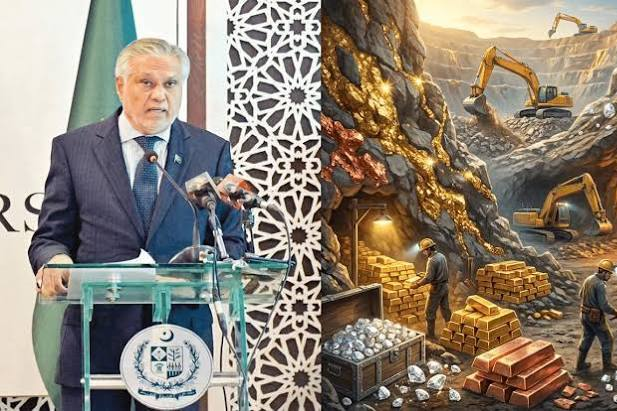
Deputy Prime Minister and Foreign Minister Ishaq Dar has said that Pakistan natural resources, including minerals, hydrocarbons and other assets, are worth between $8 trillion and $10 trillion. He called this the most conservative estimate while speaking at a ceremony in Karachi on Friday. The event welcomed the Turkish seismic research vessel Oruc Reis, which will support offshore oil and gas exploration.
Background
For years, Pakistan has been described as a country with large untapped mineral and energy wealth, yet much of it remains unexplored or undeveloped. The offshore zone alone covers around 300,000 square kilometres, but only 18 wells have been drilled there since independence in 1947. A basin study by the US firm DeGolyer and MacNaughton has pointed to significant untapped hydrocarbon potential in the country’s offshore basins.
The government has recently revived offshore exploration after a gap of nearly two decades. The Offshore Bid Round 2025 was launched in January 2025 and offered 40 offshore blocks in the Indus and Makran basins for petroleum exploration. Turkish Petroleum Offshore Company has since partnered with OGDCL, Mari Energies and Pakistan Petroleum Limited for work in three blocks. It also holds a 25 percent interest and operatorship in the Eastern Offshore Indus C block in the Arabian Sea.
Estimates of Pakistan natural resources have also been discussed at earlier official events. Dar and other senior officials have previously cited figures ranging from $6 trillion to $10 trillion, including at the Pakistan Minerals Investment Forum held in Islamabad in April 2025. The latest statement places the figure at the higher end of those earlier ranges.
Details of the Ceremony
The Oruc Reis arrived in Karachi on Thursday, and the formal welcome ceremony took place the next day at Karachi Port. Dar greeted the leadership and professionals of Turkish Petroleum, along with the captain, crew and seismic research team of the vessel. He described the occasion as a historic moment for the energy sector and for the partnership between the two countries.
According to Dar, the vessel brings Turkish scientific expertise together with the experience of national energy companies to advance exploration in Pakistan’s offshore domain. He said the data gathered by the ship could deepen understanding of the geological structures beneath the seabed. That information, he added, would give the country a stronger basis for its future exploration planning.
The minister was candid about the risks involved. He described offshore exploration as complex, capital intensive and uncertain, and he acknowledged that a seismic survey cannot guarantee a commercial discovery. He also said that Pakistan natural resources cannot be turned into national wealth without first investing in the basic work of surveying and drilling.
Dar revealed that the Turkish energy minister had told him the seismic mission would take around five to six months. He joked that the crew would not be allowed to leave until they delivered good news of a real discovery. The remark drew attention because it reflected the high expectations attached to the mission.
What Dar Said About Debt and Resources
One of the most discussed parts of the speech was Dar’s response to the debt trap narrative. He said he often meets people who describe Pakistan as a heavily indebted country, and that he always rejects that description. In his view, the combined value of mines and minerals, hydrocarbons, gemstones and rare earth materials far exceeds the national debt burden.
Dar also stressed that offshore work must follow the highest standards of maritime safety and environmental protection. He called the seas an economic asset but also a national trust, and said development and environmental stewardship must move forward together. That position signals that the government wants to balance growth with responsible resource management.
On the partnership with Turkiye, Dar said three memorandums of understanding had been signed between relevant agencies of both countries. He said Pakistan wants a long term energy partnership covering offshore exploration, minerals and renewable energy. He also called for closer cooperation between Pakistani geologists and engineers and their Turkish counterparts, along with new links between universities in marine science and offshore engineering.
Impact and What It Means
If exploration succeeds, the impact on Pakistan could be significant. New offshore gas or oil finds could reduce dependence on imported fuel, ease pressure on foreign exchange reserves and strengthen energy security. Readers following the wider economic debate can also see how resource planning connects with Pakistan’s economic challenges and the pressure on public finances.
The regional impact is also worth noting. A deeper energy partnership between Pakistan and Turkiye could attract further investment and technical cooperation from other friendly countries. For more developments of this kind, readers can follow the international news section and the latest national news from across the country.
However, it is important to separate an estimated value from proven, recoverable reserves. Some analysts have previously warned that outdated technology, weak regulation, security concerns and long project timelines can delay the conversion of resource estimates into real income. The Pakistan natural resources figure is therefore best viewed as a statement of potential rather than a guarantee of immediate economic gain.
Conclusion
The statement by Ishaq Dar has put the spotlight back on the scale of Pakistan natural resources and the long road needed to turn them into economic strength. The next five to six months of seismic work by the Oruc Reis will be closely watched by investors, energy companies and policymakers. Results from the survey could shape future licensing decisions and the pace of offshore development.
Much will depend on transparent data, stable policies and steady investment. If the survey identifies promising structures, Pakistan could move closer to its goal of using its own energy and mineral wealth to support growth. Until then, the estimate remains a headline figure that needs careful follow up and verified results.
FAQs
How much are Pakistan natural resources worth according to Ishaq Dar?
Ishaq Dar said that the estimated worth of Pakistan natural resources, including minerals, hydrocarbons, gemstones and rare earth materials, is between $8 trillion and $10 trillion. He described this as the most conservative estimate during a ceremony in Karachi. The figure is an official estimate of potential value and does not mean the full amount has been proven or can be extracted quickly.
What is the Oruc Reis and why is it in Pakistan?
The Oruc Reis is a Turkish seismic research vessel that arrived in Karachi on Thursday. It will carry out seismic surveys to map geological structures under the seabed in Pakistan’s offshore waters. The data collected will help companies and the government decide where to drill for oil and gas, which makes the vessel a key part of the revived offshore exploration programme.
How long will the seismic mission take?
Dar said the Turkish energy minister told him the mission would take around five to six months. During that period, the vessel and its research team will gather and analyse seismic data in the designated offshore areas. Dar joked that the team would not be allowed to leave without good news, which shows the expectations attached to the project, although a seismic survey alone cannot guarantee a commercial discovery.
What did Dar say about Pakistan being in a debt trap?
Dar rejected the idea that Pakistan is stuck in a debt trap. He argued that the value of the country’s minerals, hydrocarbons, gemstones and rare earth materials is far greater than its debt burden. His comments were meant to highlight the long term potential of the economy, though economists often point out that resource estimates must be developed and monetised before they can help reduce debt.
Does the resource estimate mean Pakistan will become rich soon?
Not necessarily. An estimated value of Pakistan natural resources is different from proven reserves that can be extracted at a profit. Exploration is expensive and uncertain, and developing mines or offshore fields takes years. Success depends on reliable data, investment, security, strong regulation and modern technology, so any economic benefit is likely to arrive gradually rather than overnight.