Toronto woke up Wednesday to one of the most alarming mornings in recent memory. A thick, orange blanket of wildfire smoke settled over the city, turning the sky an eerie amber colour and pushing Toronto’s air quality to the worst in the entire world. Environment Canada quickly issued an orange-level air quality warning, urging residents to stay indoors and limit all outdoor activity until conditions improve.
What Is Happening in Toronto Right Now
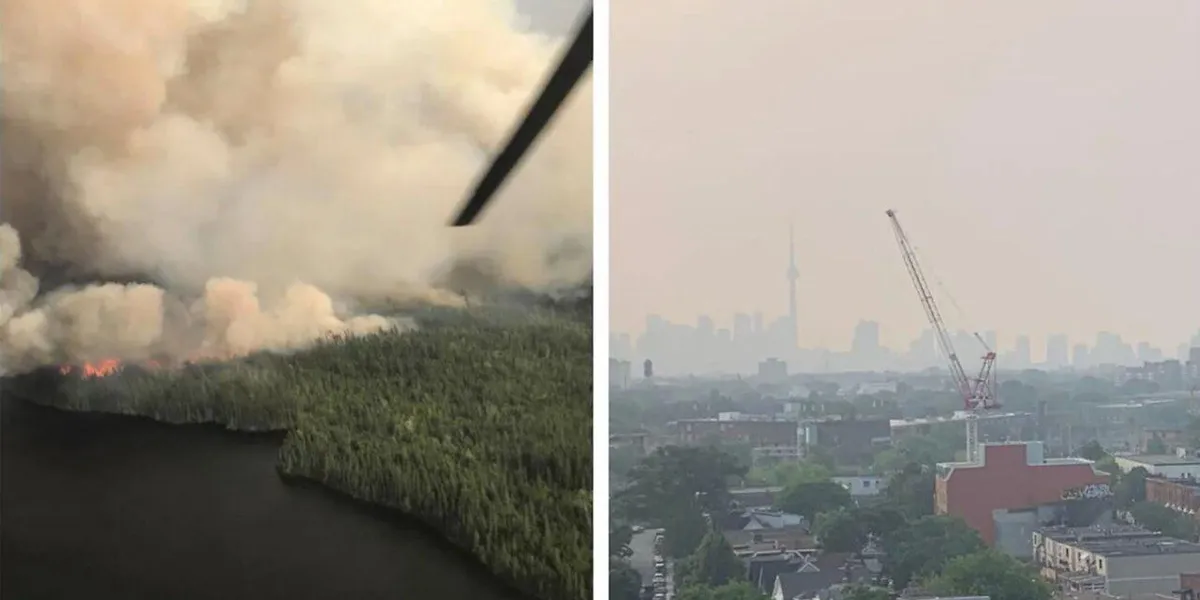
The smoke blanketing Toronto is not coming from a local source. It has drifted hundreds of kilometres south from massive, out-of-control wildfires burning in northwestern Ontario. A strong jet stream is transporting the smoke southeast, with southern Ontario experiencing degraded air quality starting Wednesday and lingering into Thursday.
As of publication, air monitoring service IQAir ranked Toronto as having the worst air quality in the world, as thick smoke from forest fires burning in northwestern Ontario continues to pour into the region. Environment Canada issued an orange air quality warning Wednesday morning, saying smoke from the ongoing wildfires is causing poor air quality and reduced visibility across the Greater Toronto Area.
Residents waking up Wednesday morning could barely make out the CN Tower through the haze. The air smelled like burning wood across all neighbourhoods, from Scarborough to Etobicoke. Many people stepping outside reported immediate irritation in their eyes and throats, some within just minutes of exposure.
The Ontario Wildfires Behind the Smoke
The fires causing all of this are not small. As of Tuesday evening, fire officials say there are 148 active wildland fires in the northwest region, prompting evacuation orders for several First Nation communities.
Out-of-control fires are still burning and spreading fast in northwestern Ontario. Smoke from northern Ontario wildfires has spread more than 1,000 km, with the jet stream carrying it southeast.
Evacuation orders remain in place for Armstrong and Whitesand due to advancing wildfires. Communities in these areas have been forced to leave their homes with little notice as fire lines advance quickly in dry, hot conditions. The scale of the fire activity across the northwest is described by authorities as extreme, with crews struggling to contain blazes that keep growing.
Toronto Air Quality: How Bad Is It
According to the Air Quality Health Index (AQHI), Toronto’s air quality sits at 8, placing it in the high-risk category. Conditions are expected to worsen overnight, with the index potentially reaching 10+, the highest “very high risk” category.
To put that number in plain terms, an AQHI of 10+ means the air poses a health risk to every single person breathing it not just those with existing conditions. “During heavy smoke conditions, everyone’s health is at risk regardless of their age or health status,” Environment Canada said in the warning.
Experts say the high humidity is trapping the thick smoky air over the region. This is making the situation worse than it would be on a drier day, because the smoke particles are staying low to the ground instead of dispersing upward. Combine that with an ongoing heat wave and the result is what experts are calling a dangerous double crisis.
Weather and Smoke Forecast for Toronto
On Thursday, a slight improvement in air quality in the GTA is expected compared to Wednesday’s levels. However, it remains a high-risk air quality day, well into the poor range. The thickest part of the smoke plume is expected to shift more south, affecting London, Sarnia and Windsor more than on Wednesday.
Environment Canada said conditions may improve on Friday. That means residents are looking at at least two more days of heavy smoke before any meaningful relief arrives. The weekend outlook is more hopeful, with forecasters suggesting winds may shift and push the smoke plume away from southern Ontario.
The wildfire smoke kept the temperatures much cooler as Toronto was bracing for another day in the low- to mid-30s. The temperature stayed steady around 25 degrees Celsius all day as the sun was completely covered by the smoke plume.
What Experts Are Saying
Scientists and doctors are not mincing their words about how serious this situation is.
Dr. Jeffrey Siegel, a professor with the University of Toronto’s department of Civil and Mineral Engineering, said the health impact to residents in the city, including otherwise healthy individuals, is “very significant.” “It is intensifying and we are going to have certainly for the rest of today and probably into tomorrow some very unhealthy conditions,” he told CP24. “Unfortunately, it comes along with the heat wave and so we’ve kind of got a double whammy.”
Dr. Siegel added that what Toronto is experiencing is no longer unusual. “We’ve seen this increasing in frequency,” he said. “I think this represents something like the new normal.”
Dr. Ashley Sebastian, a family physician from Brampton, said it poses a serious challenge. “It’s a bit of a challenge with the air quality and the heat. It poses a serious challenge for some of our patients. Most of our vulnerable population, those who are unhoused, the elderly, the children can see some adverse effects, including exacerbations in asthma, for example.” She also noted she was seeing a noticeable spike in patients arriving with breathing difficulties on Wednesday.
Eric Kennedy, an associate professor and expert on wildfire management at York University, urged people to take precautions and to consider wearing a mask if going outdoors. Even low levels of smoke can cause health impacts for some people, he noted.
Health Risks: Who Is Most at Risk
Environment Canada warns that exposure to heavy wildfire smoke can affect everyone’s health, though some people are at greater risk. Common symptoms include eye, nose and throat irritation, headaches and a mild cough. More serious, though less common, symptoms can include wheezing, chest pain and a severe cough.
Those most vulnerable to wildfire smoke include adults aged 65 and older, pregnant people, infants and young children, and anyone with an existing illness or chronic health condition. People who work outdoors are encouraged to reduce or avoid strenuous outdoor activity where possible and seek medical attention if they experience concerning symptoms.
If you are experiencing chest pain, difficulty breathing, or severe coughing that does not stop, do not wait. Go to your nearest emergency room or call 911 immediately.
How the City Is Responding
City officials moved quickly once the warning was issued. Mayor Olivia Chow said the city and Toronto Public Health are taking action to keep residents safe from the smoke and the heat by opening up six cleaner air spaces, including City Hall and Metro Hall.
The City of Toronto says that the air quality warning has prompted officials to cancel today’s FIFA Fan Festival. “The decision was made to prioritize the health and safety of attendees, as well as police, fire, paramedics, event staff, volunteers and other personnel supporting the event as they would be exposed to air quality conditions for an extended period of time,” the city said in a written statement.
All of the city’s outdoor pools and wading pools will be closed on July 16. CampTO programs will be running with outdoor activities moved indoors. Field trips are cancelled. Other outdoor registered programming will either be cancelled, postponed, or moved indoors where possible.
The City of Vaughan also cancelled its Canada Celebrates the FIFA World Cup 2026 semi-final celebration event at Assembly Park due to the air quality advisory.
Impact Beyond Toronto
The smoke crisis is not staying within Toronto’s borders. Smoke from the wildfire is also affecting residents south of the border. According to the National Weather Service New York, smoke will thicken over the state into tonight, possibly lingering into the end of the week. An air quality alert is in effect across New York state. Niagara Falls will pause its fireworks program on Wednesday due to air quality advisories in the region.
This cross-border effect underlines how large-scale Ontario wildfires have become. What starts as a forest fire in a remote northern community can, within days, affect tens of millions of people across two countries. The 2026 fire season is shaping up to be one of the most damaging on record, and experts say decisions made now about forest management and climate policy will determine how bad future seasons become.
What You Should Do Right Now
Staying safe during this smoke event comes down to a few clear steps. Keep windows and doors closed as much as possible to stop smoke from entering your home. If you must go outside, wear a well-fitted N95 or KN95 mask, not a cloth mask, as cloth offers minimal protection against fine smoke particles. Avoid exercise or any strenuous activity outdoors, since heavier breathing draws more particles deep into your lungs.
Run air purifiers inside your home if you have one, and set your car’s air system to recirculate rather than pulling in outside air. Check the AQHI reading regularly at weather.gc.ca or through the IQAir app before deciding whether to go out. If you belong to a vulnerable group elderly, pregnant, young children, or people with heart or lung conditions treat every outdoor trip as a last resort until the warning is lifted.
FAQs
What is causing the smoke in Ontario?
The smoke currently affecting Ontario is coming from a large cluster of out-of-control wildfires burning in the northwestern part of the province. As of mid-July 2026, there are 148 active wildland fires in the region, many of which are still spreading. The fires are burning through dry forests during an extreme heat wave, producing massive smoke plumes. A strong jet stream is then picking up that smoke and carrying it hundreds of kilometres southeast, directly into southern Ontario including the Greater Toronto Area. Evacuation orders have already been issued for communities including Armstrong and Whitesand, and fire crews are struggling to contain the blazes as conditions remain dry and hot.
Why is the sky yellow or orange in Toronto?
When wildfire smoke enters the atmosphere, it contains billions of tiny particles called fine particulate matter, specifically PM2.5. These particles scatter sunlight in a way that filters out the blue and green wavelengths and allows the longer red, orange, and yellow wavelengths to pass through. The result is that the sky takes on an eerie yellow, orange, or even reddish colour depending on how thick the smoke is and the angle of the sun. The denser and lower the smoke sits in the atmosphere, the more dramatic the colour change appears. In Toronto on July 15, 2026, the smoke was heavy enough to completely block blue sky and give the entire city a distinctive amber glow that many residents found deeply unsettling. The same phenomenon was observed during major wildfire events in 2023 and earlier years, and scientists warn it is becoming more common as wildfire seasons grow longer and more intense across Canada.
What fires are currently burning in Ontario?
The most dangerous fires are concentrated in northwestern Ontario, a remote and heavily forested region of the province. As of Tuesday evening, July 15, fire officials confirmed 148 active wildland fires burning in the northwest, with many classified as out-of-control. The fires near Armstrong and Whitesand have forced mandatory evacuations, displacing First Nations and other communities. These fires have grown rapidly due to a combination of an extreme heat wave, low humidity, and dry vegetation following weeks of below-average rainfall. Fire crews from across the province, and in some cases from other parts of Canada and internationally, are deployed to fight the blazes, but containment remains difficult given the vast and remote terrain involved.