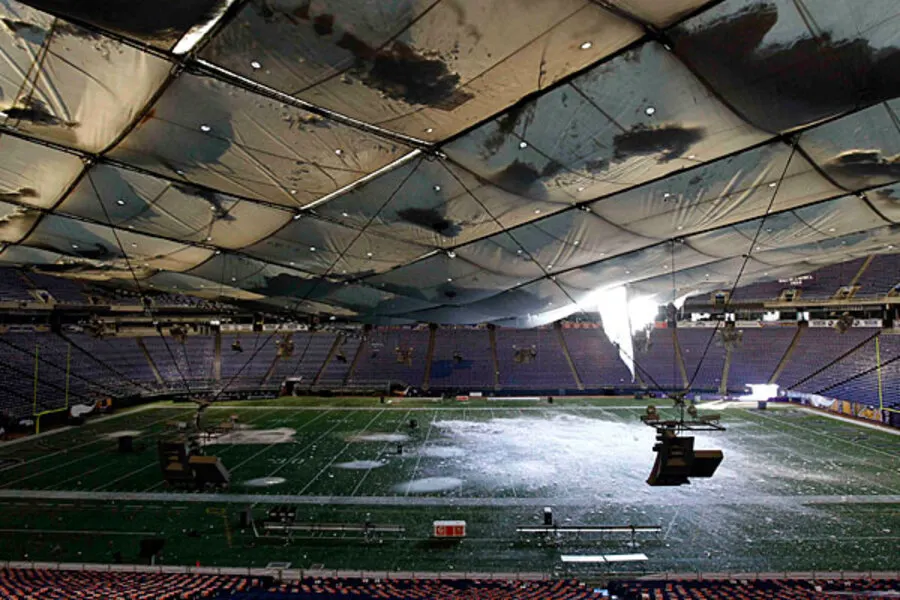
The Metrodome collapse remains one of the most dramatic stadium failures in American sports history. On December 12, 2010, the inflatable roof of the Hubert H. Humphrey Metrodome in Minneapolis gave way under the weight of a massive winter storm, forcing the Minnesota Vikings to relocate their game and reigniting global interest in the stadium’s troubled structural past. The incident was actually the fifth roof failure in the building’s history, following earlier collapses in 1981, 1982, and 1983.
Background
The Hubert H. Humphrey Metrodome, commonly known simply as the Metrodome, opened its doors in Minneapolis in 1982 as the new home for the Minnesota Vikings, the Minnesota Twins, and later the Minnesota Timberwolves. Its most distinctive feature was an air-supported fiberglass and Teflon roof, a design choice that made the Metrodome unique among American sports venues at the time.
That same roof design, however, proved to be a persistent vulnerability. The Metrodome roof collapse in 1982 occurred just months after the stadium’s official opening, when heavy December snow tore through the fabric panels and deflated the structure days before a Vikings game against the Dallas Cowboys. This was not an isolated event either, as similar failures had already struck the roof in November 1981, before the venue was even fully operational. The pattern continued into the following year, with another major tear recorded in April 1983 that postponed a Minnesota Twins game against the California Angels. A partial failure in 1986, caused by high winds rather than snow, added to the Metrodome’s reputation as a structure with a fragile roof, even though it hosted a Super Bowl, a World Series, and an MLB All-Star Game during its operational lifetime.
Details
The most significant and widely remembered Metrodome collapse took place in the early hours of December 12, 2010. A powerful winter storm swept through the Twin Cities over the weekend of December 10 and 11, dumping well over a foot of heavy, wet snow across the Minneapolis region along with strong winds. Snow removal crews were pulled from the roof due to the dangerous conditions, leaving the accumulating weight unchecked overnight.
At around 5:00 a.m. local time, the strain became too much for the aging fabric to bear. Multiple roof panels tore apart, and the dome deflated dramatically, leaving a gaping hole in the Minneapolis skyline. Remarkably, Fox Sports cameras that had been set up inside the stadium ahead of the scheduled Vikings game captured the entire Metrodome collapse video, which quickly spread across news outlets and became one of the most viewed clips of stadium failures in recent memory. No injuries were reported as a direct result of the roof failure itself, largely because the collapse happened before dawn while the stadium was empty. However, the damage was extensive, with snow and ice pouring into the seating bowl and playing field, and heavy equipment left dangling precariously from the collapsed structure. With the Metrodome rendered unusable, officials were forced to answer an urgent question: where did the Vikings play when the Metrodome collapsed? The NFL initially moved the postponed Vikings-Giants game to the University of Minnesota’s outdoor TCF Bank Stadium, though ultimately the contest was relocated further to Ford Field in Detroit, home of the Detroit Lions, to avoid additional weather complications.
Quotes
Stadium officials at the time acknowledged that the scale of the December storm had overwhelmed the roof’s structural limits, noting that snow removal teams had been withdrawn purely for safety reasons as conditions deteriorated overnight. Engineers who later reviewed the failure explained that the air-supported design, while innovative for its era, always carried an inherent vulnerability to heavy, wet snow accumulating faster than it could be cleared. Sports commentators covering the incident described the scene inside the Metrodome as almost unbelievable, pointing to the surreal contrast between bright morning sunlight streaming through the torn roof and the snow-covered turf below. League officials also confirmed that player and public safety were the top priority in deciding to relocate the game rather than attempt any emergency repair before kickoff.
Impact
The Metrodome roof collapse of 2010 had consequences that extended well beyond a single postponed football game. Financially, the Vikings organization faced significant losses, with tens of thousands of ticket holders affected and concession revenue disrupted for a home game that had to be moved out of state entirely. The incident also renewed public and political debate in Minnesota about the long-term future of the aging stadium. Lawmakers and team officials had already been discussing a replacement venue, and the dramatic images from the Metrodome collapse video added urgency to those conversations, strengthening the case for a permanent, weather-resistant facility. Beyond Minnesota, the collapse became a widely cited case study in structural engineering circles, illustrating the risks associated with air-supported roof systems in regions prone to heavy snowfall. It also briefly returned public attention to the stadium’s history, as many casual sports fans learned for the first time that this was not the first Metrodome roof collapse but rather the fifth in the building’s history.
Conclusion
The 2010 collapse ultimately marked the beginning of the end for the Hubert H. Humphrey Metrodome. The Minnesota Twins had already departed for Target Field in 2010, and following the roof failure, plans accelerated for a new home for the Vikings. The Metrodome hosted its final events before being officially closed in December 2013 and demolished in 2014. In its place, U.S. Bank Stadium rose on the same site in downtown Minneapolis, opening in 2016 with a fixed, transparent roof designed specifically to withstand the region’s harsh winters without the structural risks that had plagued its predecessor. Today, the story of the Metrodome collapse continues to serve as a reference point whenever discussions arise about stadium safety, air-supported roof engineering, and the challenges of building major sports venues in cold-weather climates. The Metrodome Minneapolis chapter remains a defining piece of the city’s sports infrastructure history, remembered as much for its roof failures as for the championship moments it hosted.
FAQs
Why did the Vikings stadium collapse?
The Metrodome, home of the Minnesota Vikings, collapsed because its air-supported fabric roof could not withstand the weight of an extreme winter storm that struck the Twin Cities in December 2010. More than a foot of heavy, wet snow accumulated on the roof panels overnight, and once snow removal crews were pulled for safety reasons, the buildup became too great for the structure to bear. Several fabric panels tore apart, causing the dome to deflate rapidly in the early morning hours before the stadium was set to host a scheduled NFL game. This particular failure was actually the fifth such incident in the Metrodome’s history, following earlier roof issues in the 1980s that were also linked to heavy snowfall and strong winds.
Did the Minneapolis Metrodome collapse?
Yes, the Minneapolis Metrodome experienced multiple roof collapses throughout its operational history, with the most well-known incident occurring on December 12, 2010. Earlier collapses also struck the stadium in November 1981, December 1982, and April 1983, all caused by heavy snow accumulation on its air-supported fiberglass and Teflon roof. A partial failure caused by high winds also occurred in 1986. The recurring structural issues eventually contributed to the decision to close the Metrodome permanently in December 2013 and demolish the building in 2014, paving the way for the construction of U.S. Bank Stadium on the same site in downtown Minneapolis.
What stadium roof collapsed?
The stadium whose roof famously and repeatedly collapsed was the Hubert H. Humphrey Metrodome in Minneapolis, Minnesota. Its distinctive air-supported dome roof, made of Teflon-coated fiberglass fabric, was designed to stay inflated using internal air pressure, but this design proved vulnerable to heavy snow loads throughout the stadium’s history. The most significant and widely publicized collapse took place in December 2010, when a major winter storm caused several roof panels to tear and deflate entirely, forcing the relocation of a scheduled Minnesota Vikings game. The Metrodome roof collapse remains one of the most referenced stadium engineering failures in American sports history.