

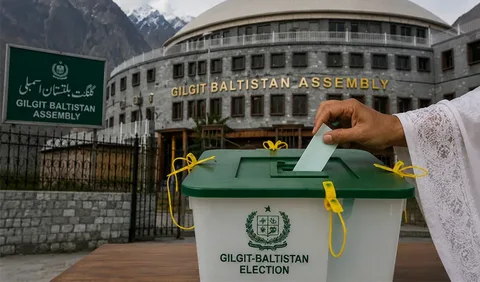

The federal government has reaffirmed its commitment to working closely with the Government of Gilgit-Baltistan, with Prime Minister Shehbaz Sharif telling newly elected Chief Minister Amjad Hussain that Islamabad will support development priorities across the region’s key departments, from health to finance to agriculture.
Background
Gilgit-Baltistan elected a new assembly in June 2026, and PPP’s Advocate Amjad Hussain was elected chief minister on June 22, backed by an unusual coalition spanning the PPP, PML-N, IPP, MWM, and a PTI-backed independent lawmaker. He was sworn in on July 6 in a ceremony in Gilgit attended by PPP Chairman Bilawal Bhutto-Zardari and GB Governor Syed Mehdi Shah.
Soon after Hussain assumed office, Prime Minister Shehbaz Sharif telephoned him directly to congratulate him and pledge federal cooperation. According to Radio Pakistan, the Prime Minister said the federal government would work with the Government of Gilgit-Baltistan for the development and prosperity of the area and the welfare of its people.
This exchange sets the tone for how the new administration plans to run key departments, including the GB health department, Finance Department GB, and the Gilgit Development Authority, all of which will depend heavily on continued coordination with Islamabad for funding and project approval.
Details
In his maiden speech as chief minister, Hussain laid out an ambitious agenda touching almost every arm of the Government of Gilgit-Baltistan. He pointed to chronic power shortages, some parts of the region facing up to 22 hours of daily loadshedding, and pledged that ongoing hydropower projects would be monitored daily until completion.
Hussain also announced sweeping reforms to how departments recruit staff. He said his government would enforce strict merit-based hiring across all departments and pledged to create 8,000 new jobs in different sectors. This has fueled fresh interest in health department Gilgit Baltistan jobs, as residents look for opportunities under the new administration’s promised hiring drive.
On land and development matters, GB has long grappled with disputes over how the Gilgit Development Authority and related bodies manage public land. As leader of the opposition in the previous assembly, Hussain had championed the “Haq-e-Malkiat” (Right to Ownership) campaign, calling for stronger land rights protections for GB residents, a theme he carried into his cabinet’s early priorities.
The Finance Department GB is expected to play a central role in the coming months as the new government works to secure a larger share of federal development funds. GB Assembly members have already raised the issue directly, with lawmakers pushing for a special climate fund from the Centre following recent flooding and glacial lake outburst risks in the region.
Beyond finance and development, the Agriculture department Gilgit Baltistan is also under scrutiny as the new cabinet reviews how to support the region’s fruit, wheat, and livestock sectors, which remain central to the local economy despite the area’s difficult terrain and short growing season.
Administratively, appointments to the List of Secretaries of Gilgit-Baltistan are expected to see changes in the coming weeks as the new GB Cabinet finalizes ministerial portfolios and reshuffles senior bureaucrats to align with its development priorities.
Quotes
Prime Minister Shehbaz Sharif, in his call to the new chief minister, said the federal government would collaborate with the Gilgit-Baltistan government to support development and improve welfare across the region, according to Radio Pakistan’s official statement on the call.
Chief Minister Hussain, addressing the assembly after his election, said solving the problems faced by the people of Gilgit-Baltistan would remain his government’s foremost priority, noting that the region was among the richest in the world in terms of natural resources and vowing that these resources would be used for human development.
He also struck a note of caution on the region’s finances, stating plainly that improvements to infrastructure and services would not happen without consistent revenue collection, adding there would be no compromise on ensuring bills were paid to keep public services sustainable.
Impact
The renewed federal-provincial cooperation carries real weight for a region that depends heavily on Islamabad for both funding and policy direction. Departments like the Finance Department GB and the GB health department rely on annual federal transfers, meaning the tone set in these early conversations between the PM and CM will likely shape budget allocations for the next fiscal year.
For ordinary residents, the more immediate impact may come through jobs. The chief minister’s pledge to create 8,000 positions, combined with a promised overhaul of recruitment across departments, has already generated significant public interest, particularly around health department Gilgit Baltistan jobs and postings tied to the Agriculture department Gilgit Baltistan.
The broader political impact is also notable. A party different from the one ruling at the Centre formed a government in GB through electoral consensus rather than confrontation this time, and both sides have publicly framed this as an opportunity for smoother cooperation compared to past periods of federal-provincial tension.
Conclusion
With the new Government of Gilgit-Baltistan cabinet still finalizing portfolios and the List of Secretaries of Gilgit-Baltistan expected to be updated in the coming weeks, attention will turn to how quickly promised reforms in health, finance, and agriculture actually reach people on the ground. The coming months will show whether the warm early exchanges between Islamabad and Gilgit hold up once budget negotiations and development priorities get worked out in detail.
Frequently Asked Questions
Who is the current IG of Gilgit-Baltistan 2026?
The current Inspector General of Police for Gilgit-Baltistan is Dr. Akbar Nasir Khan, who assumed office on February 4, 2026. He is a senior officer of the Police Service of Pakistan and was transferred to the post from the Federal Investigation Agency, where he had been serving under the Interior and Narcotics Control Division. He previously served as Inspector General of Islamabad Police, where he focused on police reforms and technology-driven policing initiatives, and he replaced Afzal Mehmood Butt as head of the roughly 50,000-strong Gilgit-Baltistan Police force.
Can Pakistanis buy land in Gilgit-Baltistan?
This is a genuinely contested issue. Officially, Gilgit-Baltistan’s land laws have historically restricted land purchases to residents with domicile in the region, similar to protections that once applied in other parts of disputed Kashmir, since GB has not been constitutionally integrated as a full province of Pakistan. In practice, however, residents and civil society groups have long alleged that land has been allotted to outside parties and large projects, including infrastructure tied to the China-Pakistan Economic Corridor, without adequate local consultation. This tension led to the passage of a Land Reforms Act in 2025 aimed at overhauling older colonial-era land classification rules, though the issue remains a source of ongoing protest and political debate in the region.
Does Gilgit-Baltistan want to join Pakistan?
Public opinion and political positions on this question vary within Gilgit-Baltistan itself. Some political voices and parties have pushed for the region to be granted full provisional provincial status, with representation in Pakistan’s parliament, arguing this would give residents stronger constitutional rights and access to federal resources. Others, including some civil society and rights groups, argue that GB’s status should remain tied to the broader unresolved Kashmir dispute and any final decision on integration should wait for a UN-supervised plebiscite covering the wider Jammu and Kashmir region, as originally envisioned in United Nations resolutions from the late 1940s.