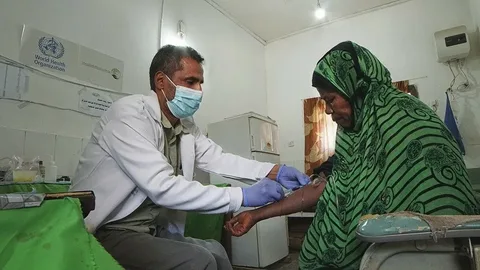
The Yemen healthcare crisis has reached a breaking point, with more than 20 million people now cut off from basic medical care. Years of conflict, chronic underfunding, and the near-total collapse of Yemen’s healthcare system have left ordinary citizens with almost nowhere to turn. As hospitals shut their doors and doctors run out of supplies, growing numbers of patients are abandoning modern treatment altogether and putting their trust in herbal shops and honey remedies instead.
Background
For decades, Yemen’s health infrastructure has been battered by war, poverty, and repeated funding cuts from international donors. The result is a system that today can barely function in even the most basic sense. According to World Health Organization estimates, roughly half of the country’s health facilities are no longer operating at all, a gap that severely limits the country’s capacity to respond to recurring disease outbreaks such as cholera and diphtheria.
This isn’t a new problem, but the Yemen healthcare crisis has worsened steadily each year as the conflict drags on. Families that once could rely on public hospitals for even minor treatment now find themselves navigating a system stripped of staff, medicine, and equipment. For many, the only remaining option is to look elsewhere, and that elsewhere increasingly means the herbal medicine stalls and honey shops that have multiplied across cities like Taiz.
Details
In Taiz, one of the hardest-hit cities in the country, residents describe a healthcare system so weakened that even basic diagnoses have become unreliable. Reporting from the region has documented cases where patients suffering from serious illnesses were initially misdiagnosed, only for their conditions to worsen dramatically before the real problem was identified. In several documented cases, patients turned to herbal practitioners out of desperation after being told they could not afford treatment abroad, a route many Yemenis are pushed toward for complex conditions that local hospitals simply cannot manage.
Herbal medicine shops have existed in Yemen for generations, rooted in traditions that predate modern hospitals entirely. But what was once a supplementary or cultural practice has, amid the collapse of formal healthcare, become for many the primary and sometimes only option available. These shops are now common across nearly every neighbourhood, and for their owners, herbal remedies have become a thriving business rather than a fallback practice.
Practitioners in these shops often claim they can treat a sweeping range of conditions, from everyday headaches to cancer and other chronic diseases. Some have expanded their reach through social media, occasionally partnering with online influencers to market their remedies to a wider audience. Many root their credibility in religious tradition, pointing to references to honey as a healing substance in Islamic scripture and in the sayings of the Prophet Muhammad regarding certain medicinal plants.
Medical professionals, however, remain deeply skeptical. Physicians interviewed on the ground say that while some patients report short-term relief, this does not equate to a genuine cure, and delays caused by relying on unproven remedies frequently allow underlying illnesses to progress untreated. Several patients described being hospitalised in a far worse condition after months of herbal treatment, only to discover that their original disease had advanced significantly during that time.
Quotes
Medical experts stress that herbal practitioners typically lack any formal medical training and rely instead on inherited knowledge and informal trial-and-error methods. One internal medicine specialist, who works closely with patients returning from failed herbal treatments, noted that certain infections show symptoms that naturally fluctuate over time, meaning temporary improvement can be mistaken for a cure when in fact only qualified doctors can properly confirm that a condition has been fully treated.
Herbal practitioners, for their part, defend their work as a legitimate craft passed down through generations of study under experienced elders rather than something casually inherited. Several argue that the growing popularity of their remedies reflects genuine results, even as they acknowledge operating without any official licensing or oversight from health authorities, since they classify themselves as sellers of natural products rather than formal medical providers.
Local health officials have confirmed that complaints against herbal shops are typically redirected to legal authorities rather than health departments, since these businesses fall outside standard medical regulation. Some shops have reportedly been shut down after offering unrelated and unregulated services alongside their herbal products, prompting renewed calls from patients and families for stronger government oversight of an industry operating with almost no accountability.
Impact
The broader impact of the Yemen healthcare crisis extends far beyond individual patients making risky choices out of desperation. With half the country’s medical facilities non-functional, the nation’s ability to contain infectious disease outbreaks is severely compromised, raising the risk of wider public health emergencies that could spill across borders in the region. Humanitarian organisations have repeatedly warned that Yemen remains one of the world’s most severe ongoing humanitarian crises, with healthcare collapse sitting alongside food insecurity and displacement as core drivers of suffering.
The rise of unregulated alternative medicine also places additional strain on an already fragile system, since patients who delay proper treatment often return to hospitals in more critical condition, requiring more intensive and costly care than if they had received timely diagnosis and treatment in the first place. This creates a cycle where the healthcare system’s weakness feeds unregulated alternatives, which in turn deepens the burden on the few functioning hospitals that remain.
Conclusion
Patients and families affected by the Yemen healthcare crisis are increasingly vocal in demanding regulation of herbal medicine shops, arguing that businesses dealing directly with sick people should not operate free of oversight. Without renewed international funding and a genuine effort to rebuild basic medical infrastructure, experts warn that more Yemenis will continue turning to unregulated remedies simply because they have no other choice. Until then, the Yemen healthcare crisis is likely to remain one of the defining humanitarian emergencies in the region, with ordinary citizens left to navigate an impossible choice between unaffordable formal care and unregulated alternatives.
Frequently Asked Questions
What is causing the Yemen crisis?
The Yemen crisis has been driven by years of prolonged conflict, which has devastated the country’s infrastructure, economy, and public institutions. On top of the war itself, chronic underfunding from international donors has left essential services, especially healthcare, unable to function properly. Combined with widespread poverty and repeated disruptions to food and medical supply chains, these factors have compounded into one of the most severe humanitarian emergencies currently unfolding anywhere in the world, with millions of ordinary citizens bearing the brunt of a crisis largely outside their control.
What is the problem in Yemen now?
At present, the core problem in Yemen is the near-total collapse of its healthcare system, with roughly half of all health facilities across the country no longer functional. This means more than 20 million people lack reliable access to even basic medical care, forcing many to rely on unregulated herbal remedies and informal treatment options instead of proper hospitals. Beyond healthcare, Yemen also continues to face severe food insecurity, economic instability, and repeated outbreaks of preventable diseases such as cholera, all of which are worsened by the lack of functioning medical infrastructure to respond effectively.
Is Yemen the worst humanitarian crisis?
Yemen is widely regarded by international humanitarian organisations as one of the worst humanitarian crises currently occurring globally, frequently cited alongside a small number of other nations facing similarly catastrophic conditions. The scale of the crisis is reflected in the sheer number of people affected, with tens of millions requiring some form of humanitarian assistance and a healthcare system so weakened that basic medical treatment is now out of reach for a large share of the population. While comparisons between global crises are difficult to rank precisely, Yemen consistently appears among the most severe emergencies tracked by aid agencies today.