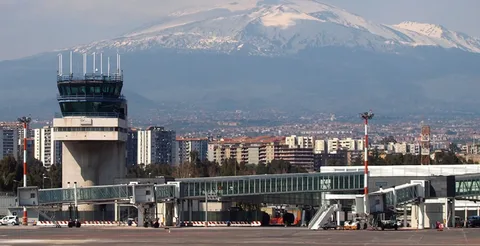
Mount Etna, Europe’s tallest and most active volcano, erupted again on Saturday, sending a thick plume of volcanic ash into the sky above eastern Sicily and forcing Catania Airport to suspend all incoming flights. The disruption has left hundreds of travellers checking the Catania Airport flight status repeatedly as they try to work out whether their journey will go ahead as planned.
Catania Airport, officially known as Vincenzo Bellini Catania-Fontanarossa Airport, confirmed the closure in a statement issued on Saturday morning. Anyone tracking the Catania airport flights today page on the airport’s website would have seen a wave of “delayed” and “suspended” notices appear within a short span of time as the ash cloud spread over the airspace.
Background
Mount Etna sits close to Catania, and the airport has long operated under the shadow of the volcano’s unpredictable activity. Standing at roughly 3,324 metres, Etna is the tallest active volcano on the European continent and has a documented history of eruptions stretching back half a million years.
Since last July, tough restrictions and ash advisories have already been in place around the mountain because of increasingly intense eruptive activity. Local mountain guides had even staged demonstrations earlier this year after authorities in Catania suspended or restricted excursions to the lava flow zones, arguing the restrictions were excessive given that the lava was moving slowly enough to be viewed safely.
Italy’s National Institute of Geophysics and Volcanology, the agency responsible for monitoring Etna around the clock, had noted in January that while eruptions were continuing, the lava fronts were cooling and not advancing further at that time. Saturday’s eruption shows that the volcano’s activity remains far from settled, and it is once again dictating the Catania Airport Departures terminal and arrivals schedule.
Details
According to the airport’s official statement, the closure was triggered directly by the ash plume drifting into the flight corridors used by aircraft approaching Catania. “Due to Etna’s eruptive activity and the associated release of volcanic ash into the atmosphere, the airspace corresponding to the cloud has been closed,” the airport said, confirming that safety, not capacity, was the reason for the halt.
Crucially, the suspension only affects Catania Airport arrivals. Departures of aircraft already sitting on the tarmac in Catania continued to operate normally, meaning travellers heading out of Sicily were not automatically affected in the same way as those trying to fly in. Passengers checking Catania airport flights arrivals boards were advised that inbound aircraft were being held, diverted, or delayed until conditions improved.
Airport authorities said arrivals were suspended until 12:00 local time, or 10:00 GMT, giving airlines a clear window to plan around. However, as with any volcanic ash event, that timeline can shift quickly if the eruption intensifies or the wind direction changes, which is why officials urged travellers to keep refreshing the Catania Airport flight status page rather than relying on earlier information.
A live webcam maintained by Italy’s National Institute for Geophysics and Volcanology showed a steady plume of grey smoke rising from Etna’s summit throughout the morning, visible for kilometres around Catania and the surrounding towns on the eastern coast of Sicily.
Quotes
In its official statement, Catania Airport was direct about the scale of the disruption, saying that the airspace linked to the ash cloud had been closed as a precaution while the eruption continued. The airport did not specify exactly how many flights had been affected by the time the notice was issued, though the volume of queries around Catania flights cancelled today suggests the number was significant during the morning hours.
Italy’s volcanology institute, which tracks Etna’s seismic and eruptive behaviour continuously, has previously stressed that lava activity and ash emission can vary hour to hour, which is precisely why aviation authorities err on the side of caution whenever a plume like Saturday’s is detected near an active flight path.
Impact
Catania Airport is the main gateway to the eastern half of Sicily, an island that ranks among Italy’s most visited tourist destinations, particularly in the peak summer travel season. Any suspension to Catania Airport Departures and arrivals during August has an outsized effect, given the sheer number of holidaymakers moving through the terminal at this time of year.
For passengers, the immediate impact has meant longer waits at the airport, missed onward connections, and a scramble to rebook hotel transfers and car rentals timed around original arrival slots. Travel agents and airlines flying into Catania, including major carriers such as Ryanair, ITA Airways, easyJet, Wizz Air, Lufthansa, British Airways, and Delta on its long-haul route from New York, were all forced to adjust schedules or hold aircraft at their origin airports until the ash advisory was lifted.
Beyond the immediate inconvenience, volcanic ash disruptions like this one carry broader significance for Sicily’s tourism economy. Repeated closures, even short ones, can chip away at traveller confidence during the busiest weeks of the year, and they renew scrutiny over how well local infrastructure and warning systems keep pace with Etna’s increasingly active phase.
The disruption also lands against a backdrop of extreme weather stress across the wider Mediterranean and South Asian region this summer, with authorities in Pakistan separately warning of dangerous heat stroke conditions in 2026 as temperatures climb well beyond seasonal norms, underlining how unpredictable natural events, whether volcanic or climatic, continue to test travel and public safety systems in different parts of the world simultaneously.
Conclusion
Catania Airport has said arrivals should resume once the ash cloud clears the designated airspace corridor, but volcanic disruptions of this kind rarely follow a fixed timetable. Passengers are strongly advised to check the Catania Airport flight status directly with their airline before heading to the terminal, since ash advisories can be extended or lifted early depending on how the eruption develops through the day.
Given Etna’s recent pattern of frequent activity, aviation authorities and the airport operator are likely to keep contingency plans in place for the coming days, particularly as the volcano remains under close monitoring by Italy’s geophysics institute. For now, the safest approach for anyone flying to or from Sicily is to treat the Catania airport flights schedule as provisional until the airport confirms normal operations have fully resumed.
Frequently Asked Questions
How long is Catania Airport closed?
Catania Airport confirmed that arrivals were suspended until 12:00 local time, or 10:00 GMT, on Saturday, though this window can be extended if the ash plume from Mount Etna continues to drift into the airport’s flight corridor. Departures were not affected by the same restriction and continued operating normally throughout the closure period. Because volcanic ash advisories depend on real-time conditions rather than a fixed schedule, travellers are advised to keep checking directly with the airport or their airline for the latest confirmed reopening time rather than assuming arrivals will resume exactly at the stated hour.
What airlines fly to Catania Airport?
Catania Airport is served by a large number of carriers, including Ryanair and Wizz Air, both of which operate it as a base airport, alongside ITA Airways, easyJet, Lufthansa, British Airways, Aer Lingus, KLM, Air France, Turkish Airlines, Vueling, Volotea, and Delta, which runs a long-haul route connecting Catania with New York. In total, roughly 45 to 48 airlines operate scheduled routes into and out of Catania, linking the airport to more than 100 destinations across Europe, North Africa, the Middle East, and North America, making it one of the busiest airports in southern Italy.
Which airports fly direct to Catania?
Catania has direct connections with major hubs including Rome, Milan, Bologna, Venice, and Pisa within Italy, along with international routes to London, Paris, Frankfurt, Munich, Amsterdam, and Istanbul, among many others. Seasonal and long-haul routes also connect Catania directly with Montreal via Air Canada and New York via Delta, while numerous UK cities, including London, Manchester, Birmingham, and Edinburgh, are served by carriers such as Jet2, easyJet, and Ryanair. Travellers from destinations without a direct route can typically reach Catania with a single connection through hubs like Rome or Milan.