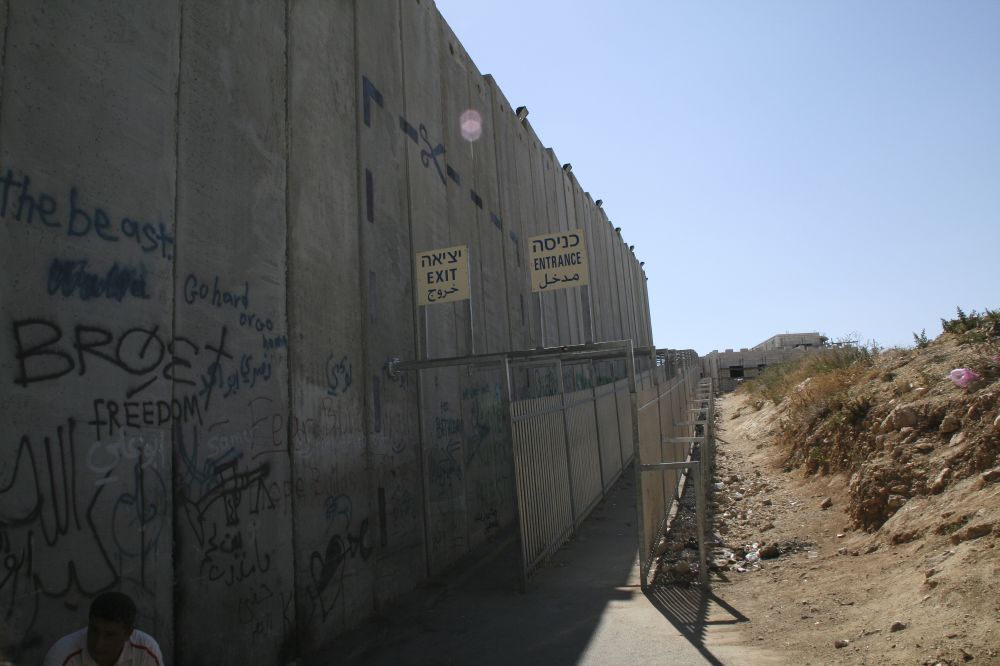
Israel is constructing a new 22-kilometer barrier known as the “Crimson Thread” through the northern Jordan Valley, extending decades of West Bank barrier construction that has reshaped Palestinian life since 2002. The project has cut off farmland, displaced herding communities, and renewed international attention on the original separation wall’s legal status.
Background
The West Bank barrier history begins in 2002, during the Second Intifada, when Israel’s government approved construction of a barrier following a wave of suicide bombings inside Israel. Officials described it as a security measure meant to stop attackers from entering Israeli territory.
The barrier’s route rarely follows the Green Line, the 1949 armistice boundary between Israel and the West Bank. Instead, roughly 85 percent of its path cuts into occupied territory, placing dozens of Israeli settlements on the Israeli side while separating Palestinian farmland, water sources, and communities from the rest of the West Bank.
In 2004, the International Court of Justice issued an advisory opinion finding that the sections of the barrier built inside the West Bank, including East Jerusalem, violated international law. The court called on Israel to halt construction, dismantle existing sections, and compensate affected Palestinians. Israel’s Supreme Court later ruled that the ICJ opinion was not binding domestically, and construction continued.
Details
Today, the West Bank barrier stretches roughly 700 kilometers when finished sections and planned sections are combined, more than double the length of the Green Line itself. West Bank barrier height varies significantly by location: in urban stretches such as parts of Jerusalem and Bethlehem, it takes the form of a concrete wall roughly eight meters tall, about twice the height of the former Berlin Wall. In more rural areas, the barrier is a lower, wider system of electric fencing, trenches, razor wire, motion sensors, and patrol roads spanning up to 100 meters across.
The West Bank barrier Jerusalem sections are among the most visible and heavily photographed, cutting directly through and around parts of the city and separating Palestinian neighborhoods from one another. Checkpoints along these sections regulate Palestinian movement into and around the city, a system that rights groups say has significantly restricted access to jobs, schools, and hospitals over the past two decades.
The newest addition to this system, the Crimson Thread, is different in scale and purpose from the original barrier. Israeli officials describe it as a security project meant to prevent weapons smuggling across the Jordan Valley’s eastern border. The plan calls for a barrier stretching roughly 500 kilometers along the entire eastern edge of the West Bank once complete, cutting through the Tubas governorate and isolating farming communities like Khirbet Atouf from Nablus and Tubas city.
Construction on the Crimson Thread began in March 2026 after Israel’s Supreme Court lifted an order that had temporarily blocked the project. Palestinian farmers in the area report that Israeli forces have cut water lines, uprooted hundreds of olive and grape trees, and issued demolition orders for homes and agricultural structures along the barrier’s path.
Quotes
An Israeli army spokesperson defended the Crimson Thread project when questioned by the Israeli outlet +972 Magazine, describing it as “a project based on a clear security need, for shaping the terrain and controlling and monitoring vehicular movement between the eastern border and the valley.” The spokesperson added that the land involved was largely state land and that seizure orders had been issued through what officials called a lawful legal process.
Palestinian residents affected by the barrier describe a different reality. Tubas official Mutaz Bisharat told reporters that Israeli bulldozers had uprooted more than 300 olive and grape trees and cut water lines serving tens of thousands of dunams of farmland as part of the project.
A former resident of the Yarza herding community, identified by the surname Daraghmeh, described how the area around the barrier had effectively become unlivable, saying settlers had repeatedly harassed residents and stolen livestock until families were forced to leave.
Impact
The humanitarian and economic consequences of the West Bank barrier system extend across the territory. The United Nations has previously estimated that movement restrictions linked to the barrier and related checkpoints cost the Palestinian economy billions of dollars annually, largely through lost access to agricultural land, markets, and jobs across the Green Line.
The Crimson Thread project adds a new layer to this pattern in the Jordan Valley specifically, an area Palestinians have long referred to as the West Bank’s breadbasket due to its agricultural output. Communities near Tubas and Nablus that once relied on the valley’s farmland now face reduced access to grazing land and water, pushing some families to abandon herding livelihoods entirely.
Beyond its economic toll, the barrier system has become a canvas for political expression. West Bank barrier graffiti, particularly on the concrete sections near Bethlehem, has drawn global attention for decades. West Bank Wall Banksy artwork, painted on sections of the barrier starting in the mid-2000s, made the wall an unlikely tourist stop and spread its imagery worldwide, even as the structure itself remained a source of daily hardship for Palestinians living beside it.
Conclusion
With the Crimson Thread now under active construction and Israel’s Supreme Court having cleared the way for further work, Palestinian communities in the northern Jordan Valley are bracing for continued land seizures and demolitions in the months ahead. International bodies, including the United Nations, have renewed calls for compliance with the 2004 ICJ opinion, though enforcement mechanisms remain limited.
Whether the new barrier expands to its full projected 500-kilometer length will likely depend on continued legal challenges inside Israel and the broader political climate around settlement expansion in the West Bank, an issue drawing international scrutiny alongside the ongoing war in Gaza.
Frequently Asked Questions
Does Israel have troops in the West Bank?
Yes, Israel maintains a significant military presence throughout the West Bank, including permanent bases, checkpoints, and patrol units that operate across all areas of the territory, even in sections technically designated for Palestinian civil administration under the Oslo Accords. In 2026, the Israeli army confirmed it was constructing its first permanent military post inside Area A, the zone meant to be under full Palestinian administrative control, marking a notable expansion beyond the boundaries set by past agreements. Troop presence tends to be heaviest near settlements, checkpoints, and barrier construction zones like the Jordan Valley.
How long is the West Bank barrier?
The original West Bank barrier, once fully completed, is projected to run approximately 700 kilometers, more than double the length of the 195-kilometer Green Line it roughly parallels. As of recent estimates, roughly 60 percent of the barrier has been built, with additional sections under construction or still in the planning stage. The newer Crimson Thread barrier in the Jordan Valley is a separate project, currently planned to stretch around 500 kilometers along the West Bank’s eastern edge once finished, though only a smaller initial stretch of about 22 kilometers has begun construction so far.
Who governs the West Bank now?
Governance in the West Bank remains divided under a system established by the 1990s Oslo Accords, which split the territory into Areas A, B, and C. The Palestinian Authority holds nominal civil and security control over Area A, shares civil control with Israel over Area B, and has no authority over Area C, which covers roughly 60 percent of the West Bank and remains under full Israeli military and civil control, including authority over settlement construction. In practice, Israeli military and settler activity has increasingly extended into areas nominally under Palestinian control, including the recent construction of a permanent Israeli army post inside Area A, further complicating the on-the-ground reality of who exercises actual authority.