

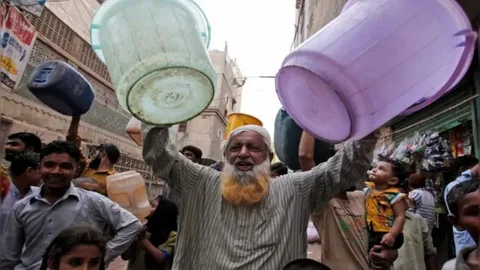

Pakistan is facing one of the most serious water crises in its history, and agriculture the backbone of its economy is feeling the worst of it. Millions of farmers across the country are struggling to irrigate their crops as rivers dry up, groundwater tables fall rapidly, and rainfall becomes dangerously unpredictable. If the water crisis in agriculture in Pakistan is not addressed urgently, experts warn it could trigger food shortages, mass rural unemployment, and an economic collapse the country is simply not prepared for.
Background
Pakistan was once considered a water-rich nation. The Indus River system one of the largest irrigation networks in the world fed vast agricultural lands and supported millions of rural families for generations. But that picture has changed drastically over the decades. According to the Pakistan Council of Research in Water Resources (PCRWR), per capita water availability has fallen from around 5,000 cubic metres in 1947 to below 1,000 cubic metres today, pushing the country well past the water scarcity threshold.
Agriculture consumes nearly 90 percent of Pakistan’s total freshwater supply. With a rapidly growing population, fast-paced urbanization, and the mounting pressure of climate change, the gap between water demand and supply is widening every year. What was once a seasonal shortage has now become a year-round crisis across many water shortage areas in Pakistan, affecting crop cycles, livelihoods, and food security all at once.
The Scale of the Problem
The water crisis in agriculture in Pakistan is not just a rural issue it is a national emergency that demands immediate attention. Pakistan’s water storage capacity has gradually declined from 16.26 million acre-feet (MAF) to just 13.68 MAF. As a result, the country now has only a 30-day water carryover capacity, compared to India’s 170 days and Egypt’s 700 days. This means Pakistan has almost no buffer when rainfall is delayed or river flows drop suddenly.
What makes this even more alarming is how heavily the country draws from underground reserves. Pakistan accounts for roughly 9 percent of the world’s total groundwater withdrawals — making it the third-largest groundwater user on the planet, despite having just 3 percent of the global population. This level of extraction is not just unsustainable it is pushing the country toward a point of no return.
Groundwater Is Running Out
Beneath the surface, the situation is just as critical. Groundwater is depleting at an alarming rate as river flows continue to dwindle and farmers become more dependent on tube wells to survive. Indiscriminate pumping continues unchecked across the country, and even in irrigated areas, water tables are declining by more than five feet every single year.
In Balochistan one of the most severely affected water shortage areas in Pakistan groundwater levels are falling by two to five metres annually. Over 30,000 illegal tube wells are operating in the province alone. A study by the International Union for Conservation of Nature (IUCN) found that Quetta’s water table dropped from about 50 metres in 2000 to over 150 metres by 2023. At this rate, farming communities in Balochistan face the very real prospect of having no accessible groundwater within the next decade.
How Climate Change Is Making It Worse
Climate change is not a future risk for Pakistan it is already reshaping the country’s water reality in ways that directly threaten agriculture. Global warming has accelerated the melting of glaciers in the Hindu Kush–Himalayan region, which supplies over 75 percent of the Indus River’s total flow. Extreme heatwaves have caused reservoirs and dams to lose up to 20 percent of their capacity through evaporation alone.
The result is a painful paradox. Pakistan faces devastating floods in some regions and severe drought-like conditions in agricultural zones often in the same year. Neither extreme can be managed effectively with the country’s outdated and underfunded water infrastructure. This dual threat is one of the defining causes of water crisis in Pakistan today, and it is only expected to intensify in the coming decades.
Causes of Water Crisis in Agriculture in Pakistan
Understanding the causes of water crisis in agriculture requires looking beyond the surface. The problem is the result of multiple failures environmental, structural, and political all colliding at the same time.
- Outdated Flood Irrigation
Pakistan still relies heavily on flood irrigation, one of the most wasteful methods of watering crops in use anywhere in the world. Enormous quantities of water are lost to canal seepage, field runoff, and evaporation before crops ever absorb a drop. Transitioning to drip or sprinkler irrigation would save a significant portion of this wasted water, but the shift has been painfully slow due to cost and lack of policy support. - Excessive Groundwater Extraction
The unregulated explosion of tube wells both electric and now solar-powered has become one of the leading causes of water crisis in agriculture across Pakistan. With 73 percent of the country’s area directly or indirectly dependent on groundwater, extraction has far outpaced natural recharge rates. The underground reserves that took thousands of years to accumulate are being drained within a single generation. - Water-Intensive Crops
Pakistan’s farming economy is built around crops that consume staggering amounts of water. Sugarcane, wheat, rice, and cotton the country’s main agricultural products — use disproportionately more water than their economic value justifies. Sugarcane alone requires five to six times more water than most alternative crops, yet political interests have kept it firmly at the centre of agricultural policy for decades. - Critically Low Water Storage Capacity
With only a 30-day water storage buffer, Pakistan cannot hold enough water during high-flow periods to carry farmers through dry seasons. This structural weakness means that even when rainfall and glacial melt are above average, most of that water flows unused into the sea. Building new storage infrastructure is one of the most urgent needs in addressing the causes of water crisis in Pakistan. - Weak Governance and Policy Failures
Millions of Pakistanis remain water insecure despite the country sitting on the Indus one of the world’s great river systems. Elite interests tied to water-intensive agriculture have blocked meaningful reform for years. Poor enforcement of water regulations, political interference in canal distribution, and the absence of a properly implemented National Water Policy have all combined to make a difficult situation far worse than it needed to be.
Water Shortage Areas in Pakistan
The water crisis does not affect all regions equally. Some parts of the country are bearing a far heavier burden, and the situation in these areas is already critical.
Balochistan is the most severely affected of all water shortage areas in Pakistan. Despite covering nearly 44 percent of the country’s landmass, it receives less than 200mm of annual rainfall. Agriculture here depends on groundwater for over 90 percent of its needs, while only 5 percent of farmland has access to canal irrigation. The collapse of groundwater reserves in this region is not a warning it is already underway.
Sindh, particularly its southern districts, suffers from severe inequality in canal water distribution. Farmers at the tail ends of irrigation channels often receive little or no water during critical growing seasons, while upstream users take more than their share. This structural injustice has pushed many Sindhi farmers into crisis even in years when overall water supply is adequate.
South Punjab including districts like Bahawalpur, Rahim Yar Khan, and Muzaffargarh experiences acute shortages during summer crop cycles. Low rainfall, silted canals, and excessive groundwater extraction have made this one of the most persistently stressed agricultural zones in the country.
Khyber Pakhtunkhwa faces a different dimension of the water crisis. Seasonal flows are increasingly erratic, making consistent irrigation impossible for small and subsistence farmers who cannot afford storage infrastructure of their own.
What Experts Are Saying
Dr. Munir Ahmed Babar, Professor at the US-Pakistan Centre for Advanced Studies in Water (USPCAS-W) at Mehran University of Engineering and Technology, has spoken plainly about how dire the situation is. “Quetta depends almost completely on groundwater, and that groundwater is going down by around one to 1.5 meters every year,” he said. “This means that more water is being pumped out than nature can refill. Continuing to install tube wells even solar-powered ones is not sustainable.”
The situation has become serious enough that the Lahore High Court stepped in and urged the Punjab government to formally declare a water emergency. The fact that judicial intervention was needed to push the executive branch into action says a great deal about how far institutional responses have fallen behind the reality on the ground.
The Impact on Pakistan’s Economy and Society
The consequences of the water crisis in agriculture in Pakistan extend far beyond individual farms. With agriculture employing a large share of Pakistan’s workforce and feeding its population of over 240 million, water-driven shocks create ripple effects across the entire economy. Poor harvests lead to rising food prices. Rising prices push more families into poverty. Rural unemployment accelerates migration to cities that are already overwhelmed.
Food security — one of the most basic measures of national stability is increasingly at risk. Pakistan imports significant quantities of food items it could grow domestically if adequate water were available. As agricultural output falls, the country’s dependence on food imports grows, draining foreign exchange reserves and increasing economic vulnerability.
Water quality is also becoming a serious concern. Excessive groundwater pumping is lowering water tables and increasing salt concentration in the remaining reserves. Agricultural runoff — carrying fertilizers, pesticides, and other chemicals is contaminating water sources used by farming communities for both irrigation and drinking. This dimension of the crisis is largely absent from policy discussions but has serious long-term implications for public health and food safety.
Conclusion
Pakistan’s water crisis in agriculture is not a problem that can be managed with small fixes or delayed responses. It is a deep, structural crisis that has been building for decades and is now accelerating under the pressure of climate change and population growth. Pakistan ranks among the ten countries most vulnerable to climate change, and the drought-like conditions seen in recent years are likely to intensify further in the decades ahead.
The country must quadruple its water productivity by 2050 simply to maintain current levels of food security as its population grows and water supplies shrink. That is an enormous challenge but not an impossible one, if action is taken now. The solutions are known: modern irrigation technology, regulated groundwater use, crop diversification, expanded water storage, and genuine governance reform. What has been missing is the political will to implement them at scale.
Pakistan still has time to change course. But the window for action is narrowing, and farmers across the country are running out of both water and patience.
FAQs
Q1: What are the five causes of water scarcity in Pakistan’s agriculture?
The five main causes of water scarcity affecting agriculture in Pakistan are all serious and deeply interconnected. The first is the continued use of flood irrigation, which wastes enormous amounts of water through seepage and evaporation before crops can absorb it. The second is the unregulated and excessive extraction of groundwater through tube wells, which has depleted underground reserves far faster than nature can replenish them. The third cause is the dominance of water-intensive crops like sugarcane, wheat, rice, and cotton, which consume disproportionately more water than their economic value justifies. The fourth is Pakistan’s critically low water storage capacity, which leaves the country with only a 30-day buffer and no ability to hold water for dry seasons.
Q2: How does water scarcity impact agriculture in Pakistan?
Water scarcity hits Pakistan’s agriculture at every level, from individual farms to the national economy. When canal water is insufficient, farmers are forced to either reduce the area they cultivate, switch to less productive crops, or rely on expensive tube well irrigation often at a cost that pushes them into debt. Crop yields drop sharply when water is unavailable during critical growth stages, particularly for staple crops like wheat and cotton. Lower yields mean less income for farming families and higher food prices for urban consumers. Across the water shortage areas in Pakistan, particularly in Balochistan and lower Sindh, entire communities are watching their livelihoods disappear as both surface water and groundwater become increasingly scarce. Over time, declining agricultural output accelerates rural-to-urban migration, putting further pressure on cities that are already struggling to absorb new arrivals.
Q3: What is the water crisis and why does it matter so much for Pakistan?
The water crisis refers to a situation where a country or region is no longer able to meet its freshwater needs in a sustainable, equitable, and reliable way. It can result from physical scarcity where there simply is not enough water or from the mismanagement of available resources, deteriorating water quality, or unequal access that leaves large parts of the population without adequate supply. For Pakistan, the water crisis is particularly consequential because the country’s economy, food supply, and rural employment all depend overwhelmingly on agriculture, which in turn depends almost entirely on freshwater. Pakistan has crossed the water scarcity line, with per capita availability now below the internationally recognized threshold of 1,000 cubic metres per person per year. Climate change is accelerating the problem by reducing glacier melt flows, intensifying droughts, and making rainfall less predictable.