

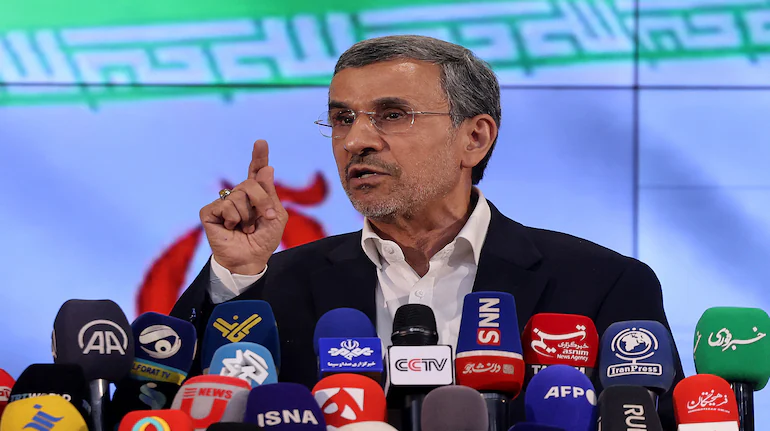

One of the most shocking intelligence revelations of 2026 has just come to light. The United States and Israel quietly selected one of Iran’s most controversial former leaders Mahmoud Ahmadinejad to head a new Iranian government after the war began. But the plan collapsed almost immediately, and Ahmadinejad’s current location remains unknown.
Background: A War Built on a Bigger Gamble
When U.S. and Israeli forces launched joint strikes on Iran on February 28, 2026, the public narrative was about halting Iran’s nuclear program. But behind closed doors, a far more ambitious objective was in motion regime change in Tehran.
The broader plan was reportedly conceived by Israeli intelligence chief David Barnea, who presented it to senior Trump administration officials in mid-January 2026. Israeli Prime Minister Benjamin Netanyahu followed this up with an hour-long Situation Room briefing on February 11, 2026, making the case to President Trump that the Islamic Republic was ready to fall.U.S. intelligence had doubts about whether the plan would work. But Trump administration officials expressed cautious optimism. The war began weeks later.
The Unlikely Choice: Why Ahmadinejad?
Here is where the story takes a truly stunning turn. The man chosen by the U.S. and Israel to lead a post-Khamenei Iran was Mahmoud Ahmadinejad a figure who spent his presidency calling for Israel to be “wiped off the map” and openly defying Washington at every turn.This was not a random name pulled from a list. According to U.S. officials briefed on the plan, Ahmadinejad had actually been consulted about the regime change proposal. An associate of the former Iranian president confirmed that the Americans saw him as someone capable of managing “Iran’s political, social and military situation.”
The logic, however strange it sounds, had a certain internal consistency. Ahmadinejad was not a product of the clerical establishment. He had clashed repeatedly with Supreme Leader Khamenei during his own time in power. He was placed under house arrest by the current Iranian government and barred from running in subsequent presidential elections. In the eyes of Washington and Tel Aviv, that made him an insider who was also an outsider someone who knew the system but was no longer part of it.
The approach echoed what had been done in Venezuela, where the U.S. had similarly backed a figure from within the existing political structure to replace Nicolás Maduro.
The Operation That Went Wrong
On the first day of the war, the Israeli Air Force launched a strike on Ahmadinejad’s residence in Tehran. The strike was not intended to kill him. U.S. officials explained that the operation was designed to eliminate the guards who had been monitoring him under house arrest essentially a jailbreak carried out from the air.
But something went wrong. Ahmadinejad was wounded in the strike.He survived. But the near-death experience changed everything. According to reporting by The New York Times which was first to break this story Ahmadinejad became disillusioned with the plan after the attack. Rather than stepping forward to lead a transitional government, he withdrew entirely. His current whereabouts are unknown, and he has not appeared publicly since.
An earlier report in The Atlantic had described the attack on his home as “in effect a jailbreak operation,” citing anonymous associates. After that report surfaced, The New York Times received further confirmation directly from an Ahmadinejad associate, who confirmed he had indeed understood the airstrike as an attempt to free him.
What Happened Inside Iran
The day the war began, Israeli strikes also killed Supreme Leader Ayatollah Ali Khamenei, along with dozens of other senior Iranian officials. Iran was thrown into an unprecedented leadership vacuum. An Interim Leadership Council was formed, but the question of who would lead Iran next remained wide open.
President Trump, speaking publicly in the early days of the war, had said it would be best if “someone from within” Iran took charge of the country. That statement now reads very differently in light of what has been revealed Trump was apparently already aware of the Ahmadinejad plan.
The broader Israeli operation involved several phases: coordinated airstrikes on high-value targets, activation of Kurdish armed groups along Iran’s western border to open a secondary front, and the eventual installation of a new government led by Ahmadinejad. When the central piece of that plan Ahmadinejad himself fell apart, the entire operation unravelled.
Mossad’s Confidence and Washington’s Doubts
Despite the failure, Mossad chief David Barnea reportedly maintained that the broader strategy would have succeeded if it had received full authorization to move forward. He told associates that decades of intelligence collection and covert operations inside Iran had laid the groundwork for exactly this kind of mission.
U.S. officials, however, had always carried doubts. Even before the war began, American intelligence was not fully convinced that regime change in Iran was achievable through the plan as designed. Those doubts proved well-founded.
The plan’s collapse has raised hard questions: Was the intelligence assessment of Ahmadinejad’s reliability accurate? Who authorized the airstrike on his residence? And was it ever realistic to expect a man placed under house arrest by his own government to then become that government’s replacement at Washington’s invitation?
Impact: What This Means for the Region
The revelation that the U.S. and Israel entered the Iran war with a specific, named individual in mind for regime change carries enormous geopolitical weight.
For Iran, it confirms that the war was never just about nuclear facilities. It was an attempt to reshape Iran’s entire political order. That framing will likely harden sentiment among Iranians who might otherwise have been open to change.
For regional allies, it raises questions about how much of this plan was shared with Gulf states, which had been quietly cooperating with both the U.S. and Israel in recent years.
For Russia and China, both of which have maintained ties with Tehran, the disclosure adds fuel to their narrative that the West uses military force as a vehicle for political manipulation.
For global diplomacy, any future U.S.-Iran talks already fragile will take place under the shadow of this revelation. Iranian negotiators will now know that sitting across from American officials means dealing with a government that, not long ago, was trying to pick their country’s next leader.
Conclusion: An Audacious Gamble That Collapsed
The U.S.-Israel plan to install Ahmadinejad as Iran’s leader was, by any measure, one of the most audacious covert political operations in recent memory. It involved striking a deal with a man who had spent years denouncing both countries, carrying out a wartime airstrike meant to free him, and then expecting him to walk into Tehran’s corridors of power as a cooperative partner.
It did not work. Ahmadinejad is injured, missing, and apparently no longer willing to play the role that was written for him.
Iran’s leadership crisis continues. The Islamic Republic’s future remains deeply uncertain. And the world is only beginning to understand just how far Washington and Tel Aviv were willing to go to reshape the Middle East.
FAQs
What is the Strait of Hormuz ceasefire proposal?
Following the February 2026 U.S.-Israeli strikes on Iran and the resulting conflict, various diplomatic efforts have been floated to stabilize the Persian Gulf. A Strait of Hormuz ceasefire proposal refers to efforts led by regional and international mediators to prevent the conflict from disrupting one of the world’s most critical oil shipping lanes. Iran previously threatened to close the strait in response to military pressure, and any formal ceasefire framework would need to address the strait’s freedom of navigation as a key condition.
Why is the U.S. against Iran?
The U.S.-Iran conflict has deep roots going back to the 1979 Islamic Revolution, when Iranian students seized the U.S. Embassy in Tehran and held 52 Americans hostage for 444 days. Since then, Washington has accused Iran of sponsoring terrorism, supporting militant groups like Hezbollah and Hamas, developing a nuclear weapons program, and threatening the security of U.S. allies, particularly Israel and Saudi Arabia. Iran’s alignment with Russia and China in recent years has intensified American hostility.
What is the outcome of U.S.-Iran talks?
Diplomatic negotiations between the U.S. and Iran in 2025 and early 2026 failed to produce a breakthrough on Iran’s nuclear program. The breakdown of those talks is widely cited as one of the factors that accelerated the decision to launch military strikes in February 2026. As of May 2026, Iran is in a leadership crisis following the killing of Supreme Leader Khamenei, and formal diplomatic channels between Washington and Tehran remain effectively non-functional.