

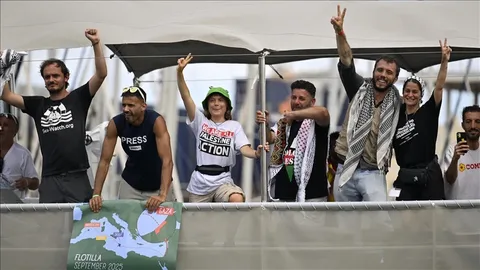

Israeli naval forces have intercepted all remaining vessels of the Global Sumud Flotilla in international waters, detaining hundreds of flotilla activists from dozens of countries. At least 87 activists from the Global Sumud Flotilla have begun a hunger strike in protest against what they described as their abduction by Israel, and in solidarity with over 9,500 Palestinian prisoners held in Israeli jails. The dramatic high-seas confrontation has triggered global Sumud Flotilla protests and renewed international debate over Israel’s ongoing naval blockade of Gaza.
Background: What Is the Global Sumud Flotilla?
The word flotilla means a fleet of small ships sailing together toward a common destination. The Global Sumud Flotilla takes its name from the Arabic word sumud, meaning steadfastness or resilience a deeply symbolic term in Palestinian political culture.
The Global Sumud Flotilla is an international movement of coordinated, nonviolent action, by land, sea, and across borders, working to end Israel’s illegal siege on Gaza, confront the complicity that enables occupation, and stand with the Palestinian people. The mission brings together civilians, doctors, lawyers, journalists, and activists from across the globe.
The Spring 2026 mission was described as a historic escalation in civilian-led action to break the siege of Gaza, with specialized teams of doctors, eco-builders, and war crimes investigators planning to work alongside Palestinians as they endure ongoing attacks and begin rebuilding homes, schools, and hospitals.
Details: How the Interception Unfolded
Israeli forces raided the Gaza-bound aid flotilla, with video showing numerous vessels being boarded and crews detained despite being in international waters approximately 250 nautical miles from the coast of Gaza. Unlike previous interceptions mostly carried out at night, Israeli military personnel boarded the boats in broad daylight.
Israeli forces on Tuesday intercepted all remaining vessels from the activist flotilla attempting to challenge Israel’s naval blockade of Gaza. A live feed on the Global Sumud Flotilla website showed armed Israeli soldiers boarding the vessels as activists in life vests raised their hands, after which soldiers destroyed cameras mounted on the vessels.
The flotilla consisted of 50 ships carrying 428 activists from 44 countries, including 78 Turkish participants. The crisis operations room confirmed that the Israeli army had illegally intervened against all flotilla ships in international waters, with the last vessel intercepted being the Lina al-Nabulsi.
This was not the first interception. Following an earlier Israeli Navy interception of the activist fleet and the detainment of key figures, the Global Sumud Flotilla had set sail anew from the Turkish port of Marmaris with 54 vessels and over 500 activists, in what organisers called a second attempt to challenge the blockade.
The Bombs Behind the Flotilla’s Urgency
The Global Sumud Flotilla’s renewed push comes against a backdrop of devastating bombardment. Israeli Prime Minister Benjamin Netanyahu disclosed to the Israeli parliament that Israeli forces carried out massive airstrikes on the Gaza Strip, dropping 153 tons of bombs equivalent to 337,307 pounds in what he framed as retaliation for an alleged ceasefire violation by Hamas.
The Gaza government media office reported 80 Israeli ceasefire violations since the US-sponsored agreement came into effect, resulting in 97 Palestinians killed and 230 others injured. The Israel dropped 153 tons of bombs on Gaza on Sunday disclosure outraged flotilla activists, who cited it as proof of why their mission was morally necessary.
The scale of destruction in Gaza with hospitals, schools, and civilian infrastructure destroyed is precisely the context that drives thousands of international volunteers onto the new flotilla missions season after season.
The Sumud Flotilla Tracker: Where Things Stand
According to the Sumud Flotilla tracker maintained by the Global Sumud Flotilla’s own crisis operations room, the current status is as follows. All ships from the most recent Mediterranean mission have been intercepted. Hundreds of activists remain in Israeli detention. Eighty-seven have declared a hunger strike.
Two key organisers GSF Steering Committee member Saif Abu Keshek and Thiago Avila were detained and held in Ashkelon’s Shikma detention facility before being deported. Abu Keshek was held for questioning over his affiliation with a Hamas-linked organisation, while Avila was suspected of “illegal activity.”
Haaretz flotilla coverage and other Israeli media have framed the interceptions as a security necessity, while international human rights organisations have called them unlawful. The Haaretz flotilla reporting also noted that Israel worked to control the media narrative around the mission, viewing it as a political threat amid ongoing peace negotiations.
Quotes: What Officials and Experts Are Saying
Turkey’s foreign ministry condemned the Israeli intervention as an “act of piracy,” adding that Ankara was taking necessary steps to ensure the safe return of Turkish citizens aboard the flotilla in coordination with other relevant countries.
Amnesty International’s Senior Director Erika Guevara Rosas stated that Israel’s interception of the Global Sumud Flotilla vessels and the arbitrary detention of activists “underscores the dangerous consequences of decades of impunity for Israel’s ongoing atrocity crimes against Palestinians,” calling it “appalling” that peaceful solidarity activists had been detained.
An activist aboard one of the intercepted ships, Martina Comparelli, said live: “We are being intercepted in broad daylight. The occupation forces have no shame whatsoever.”
On the other side, Arab-Israeli activist Yoseph Haddad, who launched a counter flotilla, said: “We send a clear message to all the ‘terror flotilla’ activists. You are not welcome here,” calling on those who wanted to support Palestinians to instead “free Gaza from the terrorist organization Hamas.”
Impact: Global Sumud Flotilla Protests Spread Worldwide
The interceptions have not silenced the movement they have amplified it. Global Sumud Flotilla protests have erupted across Europe, the Americas, and Asia. Demonstrators gathered outside the Greek Foreign Ministry in Athens, marched in London’s Parliament Square, and held rallies in Italian cities including Milan.
Israel faced international condemnation and protests after its forces intercepted around 40 boats carrying aid and more than 400 foreign activists. Cameras broadcasting live feeds from the boats, verified by Reuters, showed armed Israeli soldiers boarding ships while passengers huddled in life vests with hands raised.
Turkish President Recep Tayyip Erdogan condemned the action as “thuggery,” saying it demonstrated that Israel’s government has no intention of allowing hopes for peace to grow, and adding that Israel had attacked “voyagers of hope.”
The flotilla meaning steadfast civilian resistance to a naval blockade has resonated with tens of thousands of supporters worldwide who see the Global Sumud Flotilla as a symbol of non-violent solidarity with Gaza’s two million residents.
Conclusion: What Comes Next
Despite repeated interceptions, the Global Sumud Flotilla shows no sign of halting. The organisation has declared its mission ongoing and vowed to continue sending new flotilla missions until the blockade is broken. With global Sumud Flotilla protests growing louder and the humanitarian situation in Gaza remaining catastrophic, pressure on both Israel and Western governments is intensifying.
The hunger strikes by detained flotilla activists, the diplomatic fallout with Turkey, and the public condemnation from Amnesty International suggest the movement is gaining momentum rather than losing it. The international community now faces a clear test: whether civilian non-violent action at sea will eventually compel a shift in policy or whether interceptions at gunpoint in international waters will continue without legal consequence.
FAQs
Why is the US protecting Israel so much?
The United States has maintained strong military, economic, and diplomatic support for Israel for decades, rooted in several factors. These include a longstanding strategic alliance in the Middle East, strong domestic lobbying by pro-Israel organisations, shared intelligence and military cooperation, and historical ties dating back to Israel’s founding in 1948. The US views Israel as a key democratic partner in a volatile region. However, this relationship is increasingly contested domestically and internationally, with growing calls from within the US for conditionality on military aid given the scale of civilian casualties in Gaza.
Does Turkey support Hamas?
Turkey’s relationship with Hamas is complex and has evolved over time. Ankara has maintained political contacts with Hamas leadership and has allowed some Hamas figures to reside in Turkey, viewing Hamas as a legitimate political and resistance movement rather than a terrorist organisation a classification Turkey does not apply to the group. However, Turkey has also publicly stated it supports a two-state solution and is not a military backer of Hamas operations. Turkey’s condemnation of the Global Sumud Flotilla interceptions reflects its broader support for Palestinian rights and its criticism of Israel’s blockade, rather than direct support for Hamas military activity.
Why can’t Israelis enter Bethlehem?
Bethlehem is located in Area A of the West Bank, which is under full Palestinian Authority civil and security control under the Oslo Accords. Israeli civilians are legally prohibited from entering Area A under Israeli law, classified as a security risk. Israeli military forces do operate in the West Bank under separate rules of engagement. The restriction reflects the fragmented political geography created by the Oslo framework, where the West Bank is divided into Areas A, B, and C with differing levels of Palestinian and Israeli administrative control. Palestinians with the right permits can enter Israel, but movement in both directions is heavily restricted by checkpoints, permits, and the separation barrier.