

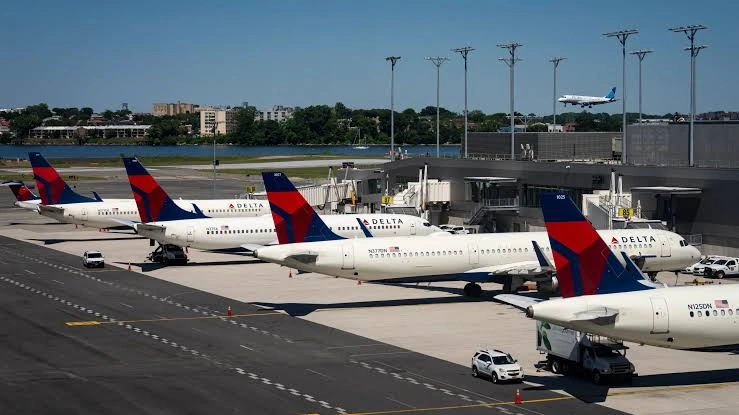

US Flights Delayed after a severed fiber-optic cable disrupted air traffic control operations across major airports in New York, New Jersey, Pennsylvania and Massachusetts.
NEW YORK: Hundreds of flights were delayed or canceled across major US airports after construction workers accidentally severed a fiber-optic cable used for air traffic control communications, causing major disruptions across the Northeast.
The disruption affected airports in New York, New Jersey, Pennsylvania and Massachusetts on Monday, September 21, as the Federal Aviation Administration (FAA) imposed ground stops and restricted incoming flights at several major airports.
The incident occurred just before the United Nations General Assembly (UNGA) began its high-level meetings in New York, with dozens of world leaders and government officials arriving in the city.
Major airports affected included John F. Kennedy International Airport, LaGuardia Airport, Newark Liberty International Airport, Philadelphia International Airport and Boston Logan International Airport, along with smaller airports in the New York area. More than 100 flights were also diverted to other airports during the disruption.
The flight disruptions were linked to a communications failure involving the Terminal Radar Approach Control (TRACON) facility in Philadelphia, which manages aircraft approaching and departing airports across the region.
FAA Administrator Bryan Bedford said a telecommunications circuit had failed, and when the system attempted to switch to a backup connection, officials discovered that a fiber-optic line in New Jersey had also been damaged.
A construction crew working in New Jersey accidentally cut the backup fiber line. New Jersey Transit said its workers were digging at a work site where utility markings had been incorrectly positioned, contributing to the accidental cable cut.
Transportation officials said the loss of communications affected the FAA’s ability to safely manage aircraft movements, prompting the agency to halt or restrict incoming flights at several airports.
The incident demonstrated how a failure involving a single telecommunications connection can have a major impact on air traffic across a large part of the US Northeast.
The disruption created widespread problems for travelers, with thousands of flights delayed or canceled across the country.
Flight-tracking service FlightAware reported that about 7,000 flights were delayed or canceled, including roughly 1,400 at the three major New York-area airports. At Newark, more than half of scheduled flights were canceled during the disruption, according to Reuters.
Newark is a major hub for United Airlines, while Philadelphia International Airport is an important hub for American Airlines.
Philadelphia also experienced additional restrictions after an initial ground stop was lifted, while Boston temporarily stopped accepting flights because of traffic spilling over from other affected airports. Reagan Washington National Airport also experienced a temporary halt because of increased traffic volume.
Passengers were advised to check directly with their airlines for updated departure and arrival information because delays continued even after the underlying communications problem was addressed.
US Transportation Secretary Sean Duffy later announced that the affected telecommunications lines had been repaired and that normal airport operations in the Northeast were beginning to resume.
However, officials warned that passengers could continue to experience delays as airlines and airports worked through the backlog created by the hours-long disruption.
The FAA emphasized that restoring safe air traffic operations was the priority before normal flight schedules could fully resume.
The timing of the outage added to concerns because New York was preparing to host the annual UN General Assembly, bringing a large number of international leaders and senior officials into the region.
The disruption affected the arrival of international travelers, although some high-profile visitors managed to reach New York before the restrictions took effect.
The incident has also renewed attention on the condition of the US air traffic control system, which has faced telecommunications failures and other technical problems in recent years.
Congress previously approved $12.5 billion for air traffic control modernization, including upgrades to aging infrastructure and efforts to increase the number of air traffic controllers. FAA officials have said additional funding will be required to complete the modernization program.
The latest disruption comes after previous communications problems at the Philadelphia facility that handles air traffic for airports including Newark. The FAA has been working on a broader modernization program intended to replace outdated telecommunications infrastructure and improve the reliability of the national air traffic control network.
For travelers, however, the immediate concern was the backlog of delayed and canceled flights. Although the damaged telecommunications infrastructure was repaired Monday evening, officials said it would take time for airline schedules to return to normal.
The incident highlights the critical role of telecommunications networks in modern aviation and how an accidental infrastructure failure can quickly affect thousands of passengers across multiple states.