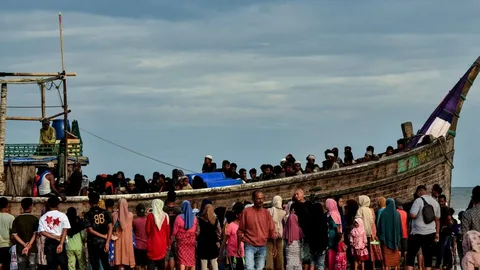
More than 500 people are feared dead after two boats carrying Rohingya refugees capsized in the Bay of Bengal this week. The vessels had left Myanmar’s Rakhine state in late June, carrying passengers who included families from refugee camps across the border in Bangladesh.
Background
The Rohingya are a mostly Muslim ethnic minority who have lived for generations in Myanmar’s western Rakhine state, though the government there has long denied them citizenship. Understanding who the Rohingya are helps explain why so many keep risking dangerous sea crossings.
Rohingya language sets the community apart from Myanmar’s Buddhist majority; it is closely related to the Chittagonian dialect spoken in nearby Bangladesh, which is part of why Myanmar’s government has historically treated the Rohingya as outsiders rather than citizens. Most Rohingya are Sunni, not Shia, following a branch of Islam common across South and Southeast Asia, though the community’s Muslim identity has repeatedly been used to justify discrimination against them.
Violence against the Rohingya escalated sharply in 2017, when Myanmar’s military launched a crackdown described by United Nations officials as a clear example of ethnic cleansing. Since then, roughly 1.2 million Rohingya have remained trapped in overcrowded camps in Bangladesh, unable to safely return home.
Details
According to the International Organization for Migration and the UN refugee agency, one of the two boats that sank this week was carrying around 250 people and lost contact with authorities shortly after leaving Myanmar. The second boat, of similar size, disappeared under comparable circumstances.
Officials said the timing made the journey especially dangerous. Rohingya refugees typically avoid boat crossings during the monsoon season, when torrential rain and rough seas make the route far riskier, yet desperation continues to push families onto overcrowded vessels bound for Malaysia and Indonesia. Aid workers note that children make up a large share of those on board these voyages; a Rohingya girl traveling alone or separated from parents during a crossing is, sadly, not an uncommon story in past disasters on this same route.
Indonesia has become one of the more common landing points for Rohingya boats in recent years, alongside Malaysia and Thailand. Rohingya in Indonesia often arrive after journeys lasting weeks, landing on the shores of Aceh province, though local communities there have grown increasingly reluctant to accept new arrivals as camps fill up.
Separately this week, the BBC published an exclusive interview with a group of Rohingya refugees who described being deported from India back toward Myanmar, a country many of them fled years ago. Their accounts add to a growing body of reporting on how South Asian governments are handling Rohingya populations within their borders.
Pakistan is also home to a significant population, with estimates suggesting several hundred thousand Rohingya in Pakistan, many settled in Karachi for decades after earlier waves of displacement. Unlike the recent Bangladesh camps, this population has lived in Pakistan long enough that many are only loosely connected to the current crisis in Myanmar, though they remain largely undocumented and lack formal citizenship status.
Less widely known is the presence of Hindu Rohingya refugees, a small minority within the wider Rohingya population. While the vast majority identify as Muslim, several hundred Hindu families identifying as ethnic Rohingya also fled Rakhine state in 2017 and now live in separate sections of refugee camps in Bangladesh, distinguishing themselves through a different Rohingya flag and cultural symbols than those used by the Muslim majority.
Quotes
The UNHCR and IOM said in a joint statement that recent flooding and heavy rain across the region “would have made such journeys especially risky,” underscoring how dangerous conditions were even before the boats capsized.
A UN official, commenting on the broader pattern of violence that triggered the original 2017 exodus, previously described Myanmar’s military crackdown as “a textbook example of ethnic cleansing,” a characterization that has shaped how international bodies discuss the crisis ever since.
Aid workers in Bangladesh’s camps have repeatedly said that shrinking humanitarian funding is forcing more families to consider dangerous boat journeys as an alternative to indefinite camp life, even when the risks are well understood.
Impact
The regional impact of this tragedy is significant. Bangladesh, which already hosts the world’s largest refugee settlement, faces renewed pressure as survivors and grieving families arrive seeking support, while donor governments have been slow to increase humanitarian funding despite years of appeals.
For countries like Indonesia and Malaysia, repeated boat arrivals raise difficult questions about resettlement capacity, border enforcement, and regional cooperation on a crisis that shows no sign of easing. Some local communities have grown less welcoming as arrivals continue year after year with no long-term solution in sight.
The tragedy also puts renewed scrutiny on Myanmar’s military government, which continues to deny the Rohingya citizenship and has made little visible progress toward conditions that would allow safe, voluntary returns. Until that changes, aid groups warn that similar sea crossings, and similar losses of life, are likely to continue.
Conclusion
With monsoon season still active in the Bay of Bengal, authorities in the region are bracing for further attempted crossings in the weeks ahead. Search efforts for survivors of this week’s capsized boats are ongoing, though hopes of finding many more people alive are fading.
Humanitarian organizations continue to call for expanded resettlement programs and increased funding for camps in Bangladesh, while diplomatic pressure on Myanmar to grant the Rohingya citizenship rights has produced little visible change. Until that shifts, more boats will likely attempt the same crossing, and more families will likely take the same risk.
Frequently Asked Questions
What is Rohingya meaning?
The term “Rohingya” is generally understood to derive from “Rohang” or “Roshang,” older names for the Arakan region of Myanmar now known as Rakhine State, combined with a suffix indicating “from” or “belonging to” that place. In practice, the word refers to a distinct ethnic and linguistic community that has lived in that region for generations, though the correct Rohingya pronunciation varies slightly depending on dialect, with most English speakers saying it as “roh-HING-yah.” Myanmar’s government has long disputed the term itself, preferring to describe the community as “Bengali” to suggest they are recent migrants from Bangladesh rather than a native ethnic group, a framing rejected by most Rohingya and international human rights organizations.
Who are the Rohingya refugees in Pakistan?
Pakistan hosts one of the oldest and largest Rohingya populations outside Myanmar and Bangladesh, with estimates ranging from a few hundred thousand to as many as a million people, according to various advocacy groups and local reporting. Many arrived in earlier waves of displacement going back to the 1990s and settled primarily in Karachi, where entire neighborhoods now have multi-generational Rohingya communities. Despite decades of residence, most remain without formal citizenship or legal documentation, leaving them vulnerable to discrimination, limited access to education and healthcare, and restricted employment opportunities within Pakistan’s informal economy.
What is the solution to the Rohingya crisis?
There is no single, agreed-upon solution to the Rohingya crisis, but humanitarian organizations and governments generally point to a combination of approaches: safe and voluntary repatriation to Myanmar once citizenship rights and security guarantees are restored, expanded third-country resettlement programs for the most vulnerable refugees, and sustained humanitarian funding to improve conditions in overcrowded camps in Bangladesh in the meantime. Long-term stability ultimately depends on Myanmar’s government reversing decades of policy that denies the Rohingya citizenship, a political shift that has not materialized despite years of international pressure, sanctions, and diplomatic engagement.