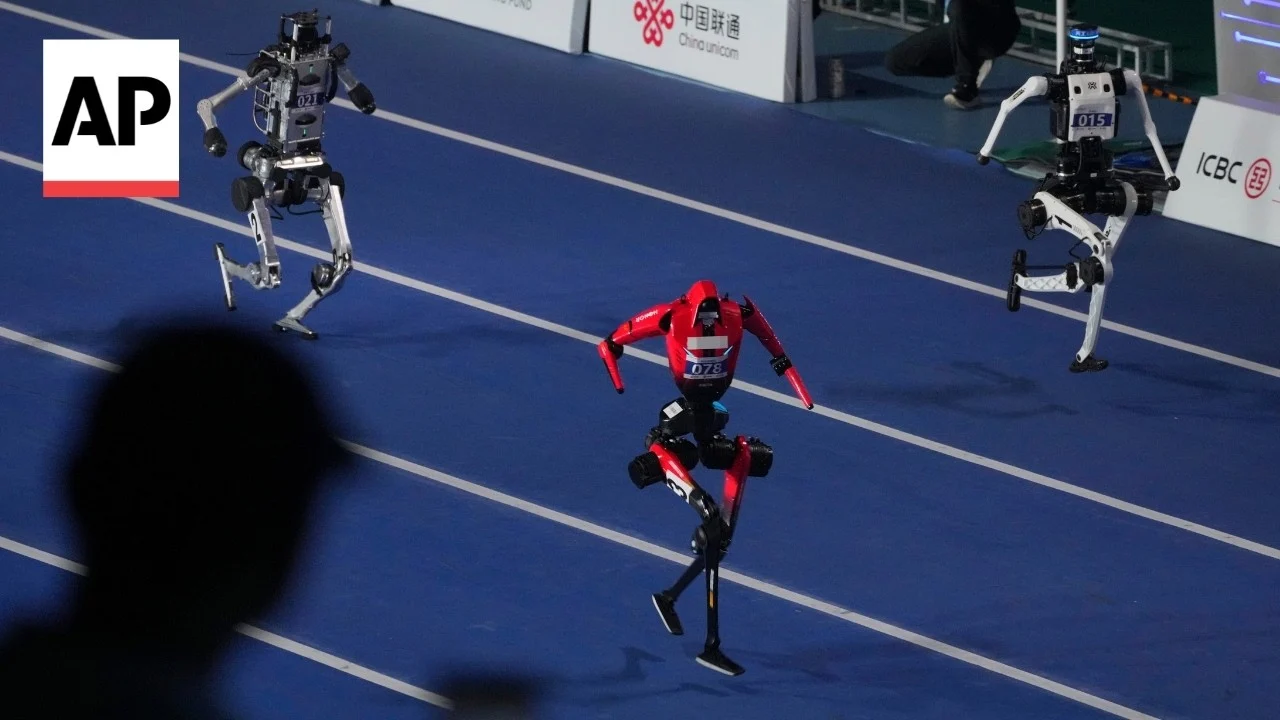
The World Humanoid Robot Games opened in Beijing on August 22, 2026, and a humanoid robot immediately stunned spectators by beating Usain Bolt’s legendary 100m world record. More than 2,000 robots from 666 teams and 16 countries are competing in what organizers are calling the biggest robotics showcase ever staged. The five-day event runs until August 26 at the National Speed Skating Oval.
Background
The World Humanoid Robot Games trace their roots back to smaller robotics contests such as RoboCup, which first tested two-legged machines on a soccer field in Japan back in 2002. That modest experiment has since grown into a full-blown international sporting spectacle built entirely around humanoid machines.
The first edition of the World Humanoid Robot Games took place in Beijing in August 2025. It brought together 280 teams and more than 500 robots from 16 countries, competing across 26 events that included boxing, football, medicine sorting, and cleaning tasks. That inaugural race saw the robot Tiangong Ultra win the 100m sprint in a modest 21.50 seconds, a result that felt more like a proof of concept than a genuine athletic achievement. A year later, the numbers have exploded. This year’s World Humanoid Robot Games feature 2,056 robots from 666 teams, a jump organizers have described as a 311 percent surge compared to the first edition. The event is being held at the National Speed Skating Oval, the same venue built for the 2022 Winter Olympics, and it opened during the same week as the 2026 World Robot Conference, where nearly 3,000 robotics products were put on display across Beijing.
Details
The opening day of the World Humanoid Robot Games delivered a result nobody in athletics history saw coming. A humanoid robot named Lightning, built by Chinese smartphone maker Honor, completed the 100m sprint in a preparatory test at 9.32 seconds, reaching a peak speed of 14.5 metres per second. That mark alone would have been enough to beat the 9.58-second world record set by Jamaican sprinter Usain Bolt at the 2009 World Athletics Championships in Berlin. During the actual heat at the opening ceremony, Lightning crossed the line in 9.47 seconds after falling behind early and surging past its rival near the finish. Its competitor, Tiangong Ultra from the Beijing Humanoid Robot Innovation Center, won the heat outright with a result of 9.39 seconds. Both times comfortably beat the human record, marking one of the most dramatic robotics milestones ever recorded on a track. The 100-metre race was not the only event to produce eye-popping numbers. In the standing high jump, a robot from Beijing-based X-Humanoid cleared 2.88 metres, a staggering leap compared to the mere 0.95 metres achieved by the best humanoid competitor at last year’s Games. That result also surpassed the human high jump world record of 2.45 metres, set by Cuba’s Javier Sotomayor back in 1993.
This year’s competition has been restructured into two broad categories. The first covers 26 competitive events spread across nine disciplines, including athletics, football, gymnastics, weightlifting, martial arts, street dance, sport dance, tug of war, and pitch-pot, a traditional Chinese precision game with roots in ancient archery rituals. The second category introduces six scenario-based contests set in real-world environments such as factories, hotels, homes, hospitals, retail spaces, and emergency response sites, designed to test practical robot capabilities rather than pure athletic performance. Organizers have also confirmed that, for the first time, the 100-metre race has been converted into a fully autonomous event, meaning robots had to run without any human teleoperation assistance. That detail matters enormously for the robotics industry, since it shows machines are no longer simply remote-controlled performers but increasingly capable of independent decision-making during physical competition. Robot football has also taken a noticeable step forward this year. Players are now able to dribble the ball while moving and execute diving saves, a level of coordination officials compared to a jump from “preschoolers” to “youths” in footballing terms. More than 1,000 individual competitions are being staged across the five days, spanning running, table tennis, soccer, and dozens of other disciplines.
Quotes
Jiang Guangzhi, director of the Beijing Municipal Bureau of Economy and Information Technology, said ahead of the Games that robot athletes were expected to show far greater autonomy, dexterity, and real-world practicality this year compared to the first edition. He explained that scenario-based events would no longer be confined to simulated venues, but would instead be staged in genuine factories, hotels, and model homes, pushing humanoid robots away from being simple demonstration tools and toward becoming practical, productive machines.
Wang Peng of the Beijing Academy of Social Sciences offered one of the more memorable assessments of how far the technology has come in just twelve months. He said last year the question was simply whether the robots could finish the race, while this year the real question is whether they can actually get the job done. Beijing resident Li Yanfeng, who attended the opening ceremony, admitted she had once felt uneasy about artificial intelligence because of fears it could replace human workers. She said watching the pace of development in person convinced her that the technology’s rise is now unstoppable, prompting her decision to come and see it firsthand. Fellow spectator Yang Shangzheng described the display as remarkable, noting that robots were now performing sports that are ordinarily reserved for human athletes. Another visitor, Liu Tao, who brought his son to watch the opening events, said he had come hoping to witness what he called the best robot performances on display.
Impact
The results emerging from the World Humanoid Robot Games carry weight far beyond the stadium. China already manufactures the majority of the world’s humanoid robots, and this event has become a very public demonstration of how quickly that industry is advancing on both the athletic and industrial fronts. Beijing has framed the Games as a platform for innovation, technological verification, and industrial growth, aiming to cultivate talent and boost the sector through direct competition between manufacturers. The timing is also significant on the geopolitical front. The Games opened just weeks after the United States Federal Communications Commission announced restrictions on imports of newly manufactured foreign humanoid robots, a move widely seen as targeting Chinese manufacturers over national security concerns. That regulatory pushback highlights how humanoid robotics has evolved from a niche engineering pursuit into a genuine flashpoint in the broader technology race between the United States and China. Regionally, the Games have turned Beijing into a global showcase city for embodied artificial intelligence, drawing companies, researchers, and government officials from 16 countries. Organizers have positioned the event as more than entertainment, describing it as a real-time market map that reveals which robotic capabilities are close to commercial deployment and which still require significant engineering breakthroughs, particularly in areas like obstacle navigation and heavy lifting that still rely on human teleoperation. The broader robotics and automation industry is also watching closely, since companies like Unitree, Fourier Intelligence, Booster Robotics, and X-Humanoid are using the platform to prove their hardware against rivals in full public view. Universities and research institutes account for a large share of participating teams, underlining how the event doubles as an academic proving ground as much as a corporate marketing opportunity.
Conclusion
The 2026 World Humanoid Robot Games has already delivered one of the most talked-about moments in recent robotics history, with a machine crossing the 100-metre line faster than the fastest human being ever recorded. Yet organizers and analysts alike stress that the sprinting record is only part of the story unfolding in Beijing this week. With scenario-based events now testing robots in genuine hotels, hospitals, and factory floors rather than staged environments, the Games are increasingly functioning as a live rehearsal for how humanoid machines might eventually integrate into everyday human workplaces. Organizers have already confirmed that Beijing will continue hosting the event annually, and the launch of the World Robot Cooperation Organization alongside other initiating bodies suggests ambitions to formalize international standards for humanoid robot competition going forward. As the five-day event continues through August 26, further results are expected across football, martial arts, weightlifting, and the newly expanded scenario-based categories. Whether international participation grows meaningfully beyond the current 16 countries will likely determine if the World Humanoid Robot Games evolves into a genuinely global institution, or remains primarily a China-led showcase with select international guest teams. Either way, the sprint that beat Usain Bolt has already ensured that this year’s edition will be remembered as a turning point for humanoid robotics on the world stage.
Frequently Asked Questions
- Which is the best humanoid robot in the world?
There is no single robot universally agreed upon as the best, since performance depends heavily on the specific task being measured, whether that is speed, strength, dexterity, or autonomous decision-making. At the 2026 World Humanoid Robot Games, Honor’s robot Lightning and X-Humanoid’s high jump robot stood out for breaking human world records in sprinting and jumping respectively, while Unitree and Fourier Intelligence robots have earned strong reputations for their all-round athletic and industrial capabilities in earlier competitions. Ultimately, the “best” humanoid robot title tends to shift year to year as manufacturers unveil upgraded models with faster processors, better balance systems, and more advanced autonomous control software.
- Which is the best robot game in the world?
The World Humanoid Robot Games, held annually in Beijing since 2025, is widely regarded as the largest and most comprehensive humanoid robot competition currently in existence, featuring more than 2,000 robots and dozens of events ranging from athletics to real-world scenario tasks. It has often been described in international media as an “Olympics for robots” because of its scale, structure, and the sheer diversity of disciplines involved, spanning everything from football and martial arts to hospital and hotel simulation tasks. Other notable robotics competitions include RoboCup, which focuses specifically on autonomous soccer-playing robots, and various university-led robotics challenges, but none currently match the scale of the Beijing-based Games.
- What is the name of the game about humanoid robots?
The official name of the competition is the World Humanoid Robot Games, first launched in Beijing in August 2025 and now in its second edition running from August 22 to 26, 2026. It should not be confused with RoboCup, an older and separate international competition that predominantly focuses on autonomous robotic soccer rather than the broader multi-sport, multi-scenario format used in the World Humanoid Robot Games. The event is organized with support from bodies including the World Robot Cooperation Organization and the Chinese Institute of Electronics, among other initiating organizations