


Pakistan’s Foreign Office on Monday strongly condemned drone attacks carried out against Saudi Arabia. The statement called the attacks a serious violation of the Kingdom’s sovereignty and territorial integrity. This is the latest and most significant chapter in Pakistan-Saudi Arabia relations, now backed by a formal military pact signed in September 2025.
Background: A Relationship Rooted in History
The Pakistan-Saudi Arabia relationship stretches back to the 1960s, when Pakistani troops were first stationed along Saudi borders during the North Yemen Civil War. Since then, both nations have maintained deep economic, religious, and security ties. Millions of Pakistani workers reside in Saudi Arabia, and bilateral remittances have historically been a lifeline for Pakistan’s economy.
For CSS exam preparation, the Pakistan-Saudi Arabia CSS topic falls under Pakistan’s foreign policy priorities. It covers religious solidarity, economic interdependence, and strategic security cooperation in the Muslim world.
The Strategic Mutual Defence Agreement (SMDA)
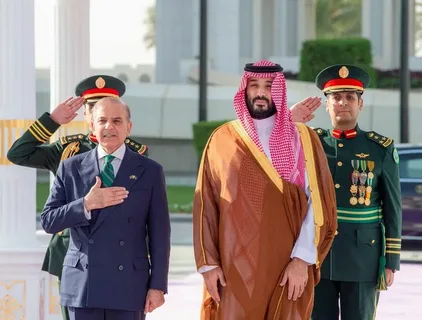
On 17 September 2025, Prime Minister Shehbaz Sharif and Saudi Crown Prince Mohammed bin Salman signed the Strategic Mutual Defence Agreement at Al-Yamamah Palace in Riyadh. This landmark Pakistan-Saudi Arabia agreement established that any act of aggression against one country would be treated as an act against both.
Pakistan’s newspaper Dawn described it as “the most significant upgrade to Pakistan-Saudi defence relations in decades.” The pact is the first formal military alliance between an Arab Gulf state and a nuclear-armed country. It drew global attention, especially regarding whether it extends Pakistan’s nuclear umbrella to Saudi Arabia.
Latest News: Pakistan-Saudi Arabia Military Cooperation in Action
The full scale of Pakistan’s military deployment to Saudi Arabia was confirmed on Monday, May 18, 2026, by Reuters. The deployment includes approximately 8,000 combat-capable troops, around 16 JF-17 Thunder fighter aircraft jointly built with China, two squadrons of drones, and a Chinese-made HQ-9 air defence system.
All military platforms are operated by Pakistani personnel, with costs covered by Saudi Arabia. Sources described the force as “substantial” and “combat-ready,” intended to support Saudi Arabia’s military if the Kingdom faces further attacks. This marks a major escalation of Pakistan-Saudi Arabia military cooperation beyond previous training missions and joint exercises.
Pakistan’s Diplomatic Response to the Drone Attacks
Saudi Arabia’s defence ministry reported that three drones were intercepted and destroyed after entering the Kingdom’s territory from Iraqi airspace. Pakistan’s Foreign Office responded swiftly, stating the attacks represent a serious attempt to undermine regional peace and stability.
Pakistan’s Information Minister Attaullah Tarar stressed that the defence of Saudi Arabia especially the protection of the Two Holy Mosques is of the highest priority for Islamabad. He called the drone strikes unprovoked and unjustified, and reaffirmed Pakistan’s commitment to Riyadh’s security.
Quotes
“The Government and the people of Pakistan stand in solidarity with the Government and people of the Kingdom of Saudi Arabia during this critical time, and reaffirm their full and unwavering support for the Kingdom’s security, peace and prosperity.” Pakistan Foreign Office Statement, May 18, 2026
“The defense of Saudi Arabia, particularly the protection of the Two Holy Mosques, is of paramount importance.” Attaullah Tarar, Pakistan’s Information Minister
“The agreement states that any aggression against either country shall be considered an aggression against both.” Saudi Arabia Press Department on the SMDA
Does Saudi Arabia Support Pakistan or India?
A common question in global discussions is: does Saudi Arabia support Pakistan or India? The answer is clear when it comes to defence. Saudi Arabia maintains trade ties with both nations, but its strategic alignment is far deeper with Islamabad. The SMDA is the first formal military pact between an Arab Gulf state and a nuclear-armed country and that country is Pakistan, not India.
India has reacted to the SMDA by stating it is carefully monitoring developments. Analysts note the pact sends a broader signal of strategic diversification that concerns New Delhi.
Regional and Global Impact
The deployment of Pakistani troops and jets to Saudi Arabia signals that the Pakistan-Saudi Arabia agreement is not merely symbolic. Pakistan is simultaneously serving as the primary diplomatic mediator between the United States and Iran, making its military presence in Saudi Arabia a delicate but deliberate balancing act.
Global energy markets are also watching closely, as attacks on Saudi Arabia’s energy infrastructure directly affect oil supply worldwide. Pakistan’s military presence adds a new dimension to how external powers calculate the risks of escalating Gulf conflict.
For Pakistan, deeper cooperation also protects its economic interests remittances, deferred oil payments, and Gulf employment for millions of workers.
Conclusion
The trajectory of Pakistan-Saudi Arabia relations in 2026 points toward an increasingly active and formalised partnership. As regional tensions continue to evolve, Islamabad holds a uniquely complex position a military partner to Riyadh and a peace mediator with Tehran at the same time.
Key developments to watch include whether the SMDA’s nuclear dimensions are formally clarified, and whether further Pakistani military assets are deployed as Gulf security deteriorates. The Pakistan-Saudi Arabia latest news makes one thing clear: their relationship has moved from diplomatic solidarity to a live, combat-ready military alliance.
FAQs
Who is Saudi Arabia’s best friend?
Saudi Arabia maintains strategic ties with the United States, Pakistan, and Gulf Cooperation Council members. However, Pakistan holds the most unique position it is the only country with which Saudi Arabia has signed a formal military defence pact, the SMDA of 2025, making it Riyadh’s closest security partner in the Muslim world.
Who is Pakistan’s best friend?
Pakistan’s closest strategic ally is China, which partners with Islamabad on CPEC and co-produces the JF-17 fighter jet. Saudi Arabia is Pakistan’s most important Islamic ally, and Turkey also maintains strong ties with Islamabad. Among Muslim nations, Saudi Arabia is consistently Pakistan’s most valued partner due to shared religious values, economic ties, and defence cooperation.
Which is more powerful, Saudi Arabia or Pakistan?
The two countries have different types of power. Pakistan is militarily stronger it has the world’s sixth-largest army and is a nuclear-armed state. Saudi Arabia does not possess nuclear weapons but vastly leads in economic strength due to oil revenues. The SMDA leverages these complementary strengths: Saudi wealth paired with Pakistani military depth.