Prime Minister Shehbaz Sharif has arrived in Beijing on a four-day official visit, marking a historic milestone in Pakistan-China relations. More than $7 billion in agreements and MoUs were signed during the trip, covering energy, agriculture, IT, and pharmaceuticals. The visit also marks the 75th anniversary of Pakistan-China diplomatic friendship, making it one of the most significant bilateral engagements in recent history.
Background: A Friendship Rooted in History
Pakistan-China relations have long been described as an “all-weather strategic cooperative partnership.” Since 1947, when Pakistan gained independence, the two nations have steadily strengthened their ties. Diplomatic relations were formally established in 1950, making Pakistan one of the first countries to recognize the People’s Republic of China.
Over the decades, Pakistan-China friendship grew through economic cooperation, military collaboration, and strategic alignment. For CSS aspirants, Pakistan-China relations remain a central topic in foreign policy, covering diplomacy, geopolitics, and regional economics. The history of Pakistan-China relations since 1947 shows a consistent pattern of mutual support at international forums.
The China-Pakistan Economic Corridor (CPEC), launched in 2015, marked a turning point in Pakistan-China relations history. With over $60 billion in Chinese investment, CPEC reshaped Pakistan’s infrastructure landscape. Now, with CPEC Phase-II underway, the two countries are entering a new era focused on industrialization, agriculture, and technology cooperation.
Details: What Happened in Hangzhou and Beijing
PM Shehbaz first landed in Hangzhou on May 23, 2026, where he inaugurated the third Pakistan-China Business-to-Business (B2B) Investment Conference. Over 500 companies from both sides participated, with discussions focused on clean energy, battery storage, solar technology, and pharmaceuticals.
Agreements and MoUs worth more than $7 billion were signed at the conference. The prime minister personally witnessed the signing of cooperation documents worth $1.22 billion between Pakistani and Chinese companies, according to the Prime Minister’s Office (PMO).
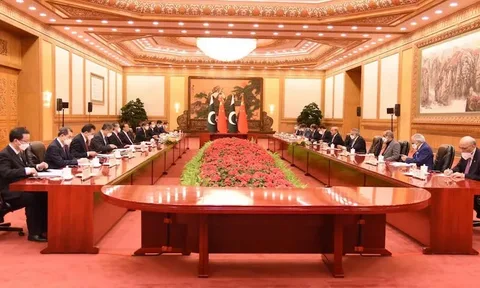
The PM then traveled to Beijing, where he held high-level meetings with Chinese President Xi Jinping and Premier Li Qiang. Topics included trade, investment, agriculture, science and technology, and people-to-people exchanges under the framework of Pakistan-China all-weather strategic cooperative partnership.
Deputy Prime Minister Ishaq Dar and Planning Minister Ahsan Iqbal separately chaired the 2nd China-Pakistan Political Parties Forum in Beijing, with representatives from 12 Pakistani political parties. The forum reviewed CPEC 2.0 progress and reaffirmed strategic trust between both nations.
Key Areas of Pakistan-China Cooperation
PM Shehbaz outlined four priority sectors for deepening Pakistan-China cooperation: agriculture, information technology, special economic zones (SEZs), and mines and minerals. He made clear that Pakistan wants expertise, technology, and investment from China not loans or handouts.
On agriculture, the PM highlighted that China imports around $100 billion worth of agricultural products annually, while Pakistan’s share is still very small. He set a target of growing bilateral agricultural trade to $10 billion within five to seven years, calling it “not a big task” with proper support.
On SEZs, he drew attention to Karachi’s 6,000-acre economic zone and promised red-carpet treatment for Chinese investors, including long-term land leases on attractive terms. He also invited Chinese companies to set up joint manufacturing ventures in Pakistan and export goods to third-country markets.
Quotes
“We have signed MoUs worth billions of dollars, which now need to be converted into agreements. I am very happy to hear that 30 per cent of these MoUs have already been converted into agreements.” PM Shehbaz Sharif, Hangzhou B2B Conference
“Pakistan is looking for expertise, experience, investments not loans, not aid, not handouts. Handouts and aid never made a nation vibrant, never made a nation stand on its own feet.” PM Shehbaz Sharif, Hangzhou
“This visit will further deepen political trust, strengthen strategic coordination, expand practical cooperation, and consolidate the longstanding friendship between Pakistan and China.” Pakistan Foreign Office Statement
Impact: China-Pakistan Relations and Their Effect on India
The growing depth of Pakistan-China relations has major implications for South Asia, particularly for India. China-Pakistan relations’ impact on India remains a top concern in New Delhi. India views CPEC with particular sensitivity, as part of the corridor passes through Gilgit-Baltistan a region India claims as its own territory.
Beijing’s consistent military and diplomatic support for Islamabad directly affects India’s regional security calculations. As CPEC Phase-II accelerates and both countries deepen industrial and technological cooperation, the strategic balance in South Asia continues to shift in ways that India closely monitors.
The visit also addressed the ongoing US-Iran conflict, with both countries reaffirming their shared five-point de-escalation principles — a reminder that Pakistan-China relations now carry significant weight in global geopolitics as well.
Key Figures at a Glance:
- MoUs & Agreements Signed: $7 billion+
- B2B Deals Witnessed by PM: $1.22 billion
- Diplomatic Anniversary: 75 years
- Agricultural Trade Target (5–7 years): $10 billion
Conclusion: Future of Pakistan-China Relations
This Beijing visit is widely regarded as one of the most productive engagements in Pakistan-China relations 2025. With the 75th anniversary of diplomatic ties as a backdrop, both governments are clearly shifting their partnership from infrastructure-heavy development toward a broader model of industrial, agricultural, and technology-driven integration.
CPEC Phase-II is expected to draw greater private sector investment, with SEZs at its center. Deals signed with global companies like CATL, Alibaba, and Xiuzheng Pharmaceuticals signal that Pakistan-China friendship is expanding into new economic frontiers.
The real test now lies in execution. PM Shehbaz’s repeated emphasis on converting MoUs into actual agreements shows awareness that Pakistan-China relations must now move from words to action. As both nations mark 75 years of unbroken friendship, the next chapter will be defined not by promises but by results.
Frequently Asked Questions
Is China giving J-35 fighter jets to Pakistan?
As of 2026, there is no officially confirmed agreement for China to supply the J-35 stealth fighter to Pakistan. Pakistan currently operates Chinese-made J-10C and JF-17 Thunder jets. While Islamabad has expressed interest in advanced platforms, any J-35 deal remains publicly unconfirmed. Defense cooperation is a sensitive pillar of Pakistan-China relations and such transfers are rarely announced in advance.
Can a Pakistani go to China?
Yes, Pakistani citizens can travel to China for tourism, business, education, or work with a valid Chinese visa. As part of growing Pakistan-China friendship, both governments actively encourage people-to-people exchanges. Pakistani students also benefit from Chinese government scholarships. A visa must be obtained from the Chinese Embassy or Consulate in Pakistan before departure.
Which country invests most in Pakistan?
China is Pakistan’s largest foreign investor, primarily through CPEC. The $7 billion in deals signed during PM Shehbaz’s May 2026 Beijing visit further strengthens China’s top position. Other investors include the UAE, Saudi Arabia, and the UK but none come close to the scale of Chinese commitments under CPEC and beyond.