


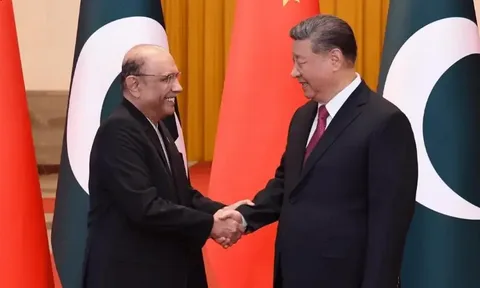
Pak-China relations received a fresh and high-profile reaffirmation as Chinese President Xi Jinping sent a congratulatory message to President Asif Ali Zardari on Pakistan Day, expressing his readiness to accelerate the building of an even closer China-Pakistan community with a shared future in the new era.
Xi praised Pakistan for steadfastly safeguarding its national sovereignty, independence, territorial integrity, and national dignity, adding that as a close friend, China is sincerely pleased with Pakistan’s development achievements.
China stands ready to work to accelerate the building of an even closer China-Pakistan community with a shared future in the new era and bring greater benefits to both peoples.
The message arrived at a significant moment in current pak-china relations — one marked simultaneously by a milestone anniversary, a new five-year action plan, and quietly growing questions about the direction of CPEC and pak-china relations in the years ahead.
Background
The Pakistan Day message fits into a pattern of sustained high-level engagement that has defined pak-china relations through the past year.
The year 2026 marks the 75th anniversary of the establishment of diplomatic relations between China and Pakistan. President Xi Jinping stated that the ironclad friendship between China and Pakistan has been forged through the trials of history, transcending geopolitical interests and serving as a significant positive factor for regional peace, stability, and development.
China is willing to further synergize its 15th Five-Year Plan with Pakistan’s National Economic Transformation Plan for the 2024 to 2029 period, work with Pakistan to advance the development of the upgraded Version 2.0 of the China-Pakistan Economic Corridor, and deliver more achievements in key areas such as industry, agriculture, mining, transportation, and people’s livelihoods.
Chinese Premier Li Qiang and Foreign Minister Wang Yi also shared similar messages with their Pakistani counterparts on the occasion, signalling the breadth and seriousness of Beijing’s engagement across all levels of government.
What Xi Said — The Full Message
The Pakistan Day message from Xi was notable both for its warmth and its strategic framing of current pak-china relations.
President Xi underscored the significance of this year, noting that it marks the beginning of China’s 15th Five-Year Plan as well as the 75th anniversary of diplomatic relations between China and Pakistan. The Chinese president expressed hope that both countries would carry forward their traditional friendship, enhance strategic communication, and align their development strategies.
Xi Jinping pointed out that China and Pakistan are good neighbours linked by the same mountains and rivers, good friends with mutual trust, good partners supporting each other through thick and thin, and good brothers sharing weal and woe. China stands ready to work with Pakistan to firmly support each other, strengthen the bond of cooperation, deepen strategic coordination, and accelerate the building of an even closer China-Pakistan community with a shared future in the new era.
Xi expressed hope that both sides will carry forward their traditional friendship, enhance strategic communication and alignment of development strategies, and move forward together on their respective paths to modernisation.
The message also arrived in the context of reported fissures in bilateral ties. The Chinese leader heaping praise on Pakistan comes in the backdrop of reports of fissures between the all-weather allies. Islamabad moved closer to Washington after President Donald Trump assumed a second term, with Pakistan’s Army Chief warming up to him, raising eyebrows in Beijing. The effusiveness of Xi’s message can therefore be read as both a reaffirmation and a recalibration — Beijing restating its commitment to pak-china relations at a moment when Islamabad’s diplomatic compass has shifted somewhat toward the west.
The Action Plan Behind the Words
The rhetoric of closer pak-china relations is backed by a formal document signed by both sides.
The two sides signed the Action Plan for Building a Closer China-Pakistan Community with a Shared Future in the New Era covering the period from 2025 to 2029. The plan reflects the adapting to the trend of the CPC Central Committee with Xi Jinping at its core, and positions the construction of the China-Pakistan Community with a Shared Future as the will of the people and the trend of the times.
The two sides will further deepen high-level political mutual trust, high-level practical cooperation, high-level security cooperation, and high-level international coordination, accelerating efforts to build an even closer China-Pakistan Community with a Shared Future in the New Era, and contributing greater strength to common prosperity of the two countries and to peace and development of the region.
The two sides will hold the second China-Pakistan Political Parties Forum and the China-Pakistan Economic Corridor Political Parties Discussion Mechanism Conference in China this year.
CPEC and Pak-China Relations — The Bigger Picture
No assessment of current pak-china relations is complete without confronting the state of CPEC and pak-china relations on the ground.
CPEC has been a cornerstone of China-Pakistan relations for more than a decade. For Beijing, it was a strategic gamble to avoid the infamous Malacca dilemma; for Pakistan, it was considered an economic game changer. Both Beijing and Islamabad viewed CPEC as a win-win initiative.
The reality has proved more complicated. China stepped back from Pakistan’s flagship CPEC project, the Main Line-1 railway upgrade, after Pakistan’s Prime Minister’s visit to Beijing failed to secure fresh funding or major Phase-2 CPEC projects. Instead, Pakistan returned with MoUs valued at $8.5 billion, focused largely on agriculture, electric vehicles, solar energy, health, and steel — falling short of the headline infrastructure investments many had anticipated.
The slow progression of CPEC projects has irked Beijing. The Chinese ambassador to Pakistan complained that Pakistan has destroyed CPEC. Many projects have stalled, including the Main Line 1 railway project, which is the costliest component of CPEC at USD $6.8 billion.
Pakistan’s political instability, debt distress, and persistent security challenges have long frustrated Chinese investors. With the current Action Plan, dialogue continues only to be materially activated when Pakistan addresses China’s concerns, presents viable projects, and ensures their implementation.
Despite these tensions, both governments continue to publicly frame CPEC and pak-china relations in optimistic terms. Both sides agreed to advance the construction of the upgraded Version 2.0 of the China-Pakistan Economic Corridor and to strengthen cooperation in industries, agriculture, and mining.The upgraded CPEC 2.0 framework is now the vehicle through which Beijing and Islamabad are trying to revive momentum on a project that has underdelivered relative to its original ambitions.
Quotes
“As a close friend, China is sincerely pleased with Pakistan’s development achievements.” — President Xi Jinping, Pakistan Day message to President Zardari
“China and Pakistan are good neighbours linked by the same mountains and rivers, good friends with mutual trust, good partners supporting each other through thick and thin, and good brothers sharing weal and woe.” — President Xi Jinping
“The ironclad friendship between Pakistan and China remains strong over time, and the bilateral relationship is of strategic significance.” — Sardar Ayaz Sadiq, Speaker of the National Assembly of Pakistan
“Pakistan reaffirms its commitment to the one-China principle and will continue to firmly support China on all issues concerning China’s core interests.” — Mohammad Ishaq Dar, Deputy PM and Foreign Minister of Pakistan
Impact
For pak-china relations, Xi’s Pakistan Day message reinforces the political foundations of the bilateral partnership at a moment when economic frictions and Pakistan’s warming ties with Washington have introduced a degree of strategic uncertainty. The 75th anniversary year provides both governments with a natural occasion to restate their commitment — and to manage any drift before it becomes consequential.
For CPEC and pak-china relations, the gap between official rhetoric and ground-level delivery remains the central challenge. The project that was meant to be the material expression of the friendship has underperformed across almost every metric — job creation, infrastructure completion, and economic transformation. CPEC 2.0 is now carrying the weight of a second attempt to get it right.
For the region, current pak-china relations matter well beyond the bilateral. Pakistan’s position as a transit hub linking China to the Arabian Sea, and China’s role as Pakistan’s largest creditor and strategic partner, mean that the health of this relationship has direct implications for regional connectivity, energy security, and the balance of influence in South Asia.
FAQs
Is China a good friend of Pakistan?
China is widely regarded as Pakistan’s most consistent and strategically significant ally. The two countries describe their relationship as an ironclad friendship and all-weather strategic cooperative partnership, with China providing Pakistan with diplomatic cover at the United Nations, military equipment, and the bulk of its major infrastructure financing through CPEC. However, current pak-china relations also carry tensions — over CPEC delays, debt repayment, security failures against Chinese workers, and Pakistan’s recent tilt toward Washington — which complicate the straightforward characterisation of China as an unconditional friend.
Who is the biggest friend of Pakistan?
China is consistently identified as Pakistan’s closest and most reliable strategic partner at the state level. The Chinese side reiterated that the China-Pakistan relationship is a priority in its foreign relations and of special significance in China’s foreign policy. The Pakistani side underscored that the Pakistan-China relationship is the cornerstone of its foreign policy.Saudi Arabia and Turkey also maintain close ties with Pakistan, and the United States has historically been a significant security partner, but neither matches the depth and consistency of pak-china relations as they currently stand.
Why is CPEC stopped?
CPEC has not fully stopped but has experienced severe delays and a significant slowdown. Pakistan’s political instability, financial crisis, and terrorism have all limited the implementation of CPEC projects.China stepped back from funding the flagship ML-1 railway after concerns over Pakistan’s security environment, bureaucratic delays, and debt sustainability. It was the delay in CPEC 2.0 due to domestic factors in Pakistan itself that prolonged the debt crisis and disrupted the potential success of the initiative.Both governments are now working to revive momentum under the CPEC 2.0 framework, though analysts remain cautious about whether the structural problems that caused the slowdown have been genuinely resolved.
Conclusion
Xi’s Pakistan Day message is more than diplomatic courtesy. It is a restatement of strategic intent at a moment when pak-china relations are navigating genuine uncertainty — a Pakistan that is hedging westward, a CPEC that has underdelivered, and a region convulsed by the ongoing Gulf conflict that is reshaping alignments everywhere.
The language of ironclad friendship, shared mountains, and even closer community is familiar. What gives it renewed weight in this anniversary year is the action plan behind it, the five-year roadmap committing both sides to specific deliverables, and Beijing’s clear signal that it considers current pak-china relations worth investing in politically even when the economic returns have disappointed.
Whether the words translate into a revived CPEC, deeper trade ties, and a genuinely closer community will be the test that defines pak-china relations through the second half of this decade.