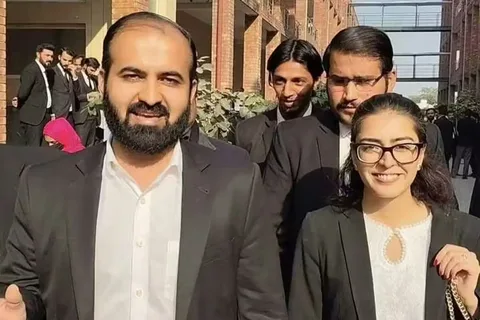
The Supreme Court of Pakistan on Thursday adjourned until September 17 the applications filed by human rights lawyers Imaan Zainab Mazari-Hazir and her husband, Hadi Ali Chattha, who are seeking an early hearing of their criminal appeal against the Islamabad High Court’s February 19 refusal to suspend their sentences. A two-member bench, headed by Justice Naeem Akhtar Afghan and comprising Justice Ishtiaq Ibrahim, remarked that either the court would decide the matter or the applicants would have to withdraw the case, as the long-running legal battle over the couple’s convictions in the controversial social media posts case continues to drag through the judicial process.
Background
Imaan Mazari and Hadi Ali Chattha are both practising lawyers in Islamabad known for representing clients in human rights, blasphemy and enforced-disappearance cases. Mazari, who studied law at the University of Edinburgh, is the daughter of Dr Shireen Mazari, a former federal minister for human rights and senior Pakistan Tehreek-e-Insaf leader who has since parted ways with the party. Chattha is a criminal lawyer who has represented victims of sexual violence and blasphemy accusations, and has worked with the Asma Jahangir Legal Cell. The couple were sentenced on January 24, 2026, by an Islamabad sessions court to a combined 17 years in prison on multiple charges under the Prevention of Electronic Crimes Act, over tweets the prosecution argued amounted to an anti-state narrative. One of the posts cited in the case referenced a call for supporters to gather in solidarity with Baloch rights activist Mahrang Baloch. The pair have maintained that the prosecution was politically motivated and tied to their long-standing human rights advocacy, including previous arrests in 2023 linked to unrest following former prime minister Imran Khan’s arrest.
Details
Since their conviction, Mazari and Chattha have pursued a parallel track of appeals aimed at securing their release while their main case works through the courts. They filed appeals against the sentence in the Islamabad High Court in early February, along with applications requesting suspension of the sentence pending appeal. The IHC, however, denied that suspension request on February 19, prompting the couple to escalate the matter to the Supreme Court.
What followed has been a lengthy back-and-forth between the two courts. In May, the Supreme Court directed the IHC to decide the sentence-suspension applications within two weeks, a deadline the high court did not meet, drawing a further challenge from the National Cyber Crime Investigation Agency against the Supreme Court’s own order. By late July, the IHC had at least ruled the applications maintainable, rejecting a prosecution objection that they had been filed prematurely, though it then adjourned the matter indefinitely, before more recently fixing the sentence-suspension pleas for hearing on September 8. Running alongside that IHC track, the couple separately approached the Supreme Court seeking an early hearing of their broader appeal, a request that has now been pushed to September 17 after Thursday’s proceedings. Throughout the case, the couple’s legal team, led by senior counsel Faisal Siddiqi, has repeatedly argued that delays in scheduling have effectively extended their clients’ imprisonment without a final ruling on the merits of the appeal itself. Prosecutors and the NCCIA have, in turn, pressed procedural objections at multiple stages, including disputes over whether applications were filed too early and whether parallel proceedings before both courts should continue simultaneously.
Quotes
The bench’s remarks on Thursday captured the court’s growing impatience with the pace of the case. The Supreme Court observed that the matter would either be decided by the court itself or that the applicants would need to withdraw it altogether, signalling limited appetite for further delay. Earlier in the proceedings, Justice Muhammad Ali Mazhar had noted that the apex court could not directly interfere with an interim high court order, though he suggested the underlying matter be fixed for hearing rather than left pending indefinitely. Rights organisations have continued to characterise the underlying prosecution as disproportionate. Index on Censorship, a UK-based free expression group, has previously called for the couple’s release, describing Mazari as one of Pakistan’s more prominent human rights lawyers and noting her past recognition for her advocacy work. Her mother, Shireen Mazari, has been an outspoken public critic of the case throughout, repeatedly describing the family’s treatment by authorities as unjust in public statements and court filings, including a separate petition she filed seeking guaranteed access to visit her daughter and son-in-law in custody.
Impact
The case has drawn sustained attention from international press freedom and human rights bodies, given Mazari and Chattha’s public profile as lawyers who have represented journalists, activists and victims of enforced disappearance. Their prosecution under Pakistan’s cybercrime law has been cited by rights groups as part of a broader pattern of legal action against government critics following the unrest of May 2023. Domestically, the case has also become a point of friction between Pakistan’s superior courts, with the Supreme Court and Islamabad High Court repeatedly disagreeing over timelines and jurisdiction, and the NCCIA separately challenging the Supreme Court’s own directives. For the legal community in Islamabad, the case has come to represent a broader test of how quickly appellate courts can move when sentence-suspension applications sit unresolved for months at a time.
Conclusion
With the Supreme Court’s own hearing on the broader appeal now set for September 17, and the Islamabad High Court separately due to take up the sentence-suspension pleas on September 8, the coming weeks are likely to bring the most consequential developments in the case since the original conviction in January. Whether either court moves to suspend the sentences before then, or whether the matter continues to be pushed further down the calendar, will determine how much longer Mazari and Chattha remain in custody while their appeal is still pending a final decision on the merits.
Frequently Asked Questions
Who is Imaan Mazari’s husband?
Imaan Mazari’s husband is Hadi Ali Chattha , fellow Islamabad-based lawyer who practises criminal law and has represented clients in blasphemy and sexual violence cases, including work with the Asma Jahangir Legal Cell. The couple married in December 2023 and have since worked together on human rights cases, and they were jointly arrested, charged, tried and sentenced in the same social media posts case that remains before Pakistan’s courts. Chattha has continued to appear alongside his wife at every stage of the ongoing legal proceedings, including the most recent Supreme Court hearing.
How old is Imaan Mazari?
Imaan Mazari, whose full name is Imaan Zainab Mazari-Hazir, was reported to be 32 years old as of January 2026, according to international press freedom organisation Index on Censorship. She graduated from the University of Edinburgh with a law degree in 2015 and began building her legal career shortly afterward, going on to represent journalists, activists and victims of human rights violations in Pakistan’s courts over the following decade.
Who is Imaan Mazari’s mother?
Imaan Mazari’s mother is Dr Shireen Mazari, a prominent Pakistani politician who served as federal minister for human rights during the Pakistan Tehreek-e-Insaf government and previously held the role of the party’s senior vice president before resigning from PTI in 2023. Shireen Mazari has remained a vocal public advocate for her daughter and son-in-law throughout their legal proceedings, including filing a separate court petition seeking guaranteed access to visit them while they remain in custody. Imaan Mazari’s father, Dr Tabish Aitbar Hazir, was a prominent Pakistani paediatrician who died in December 2022.