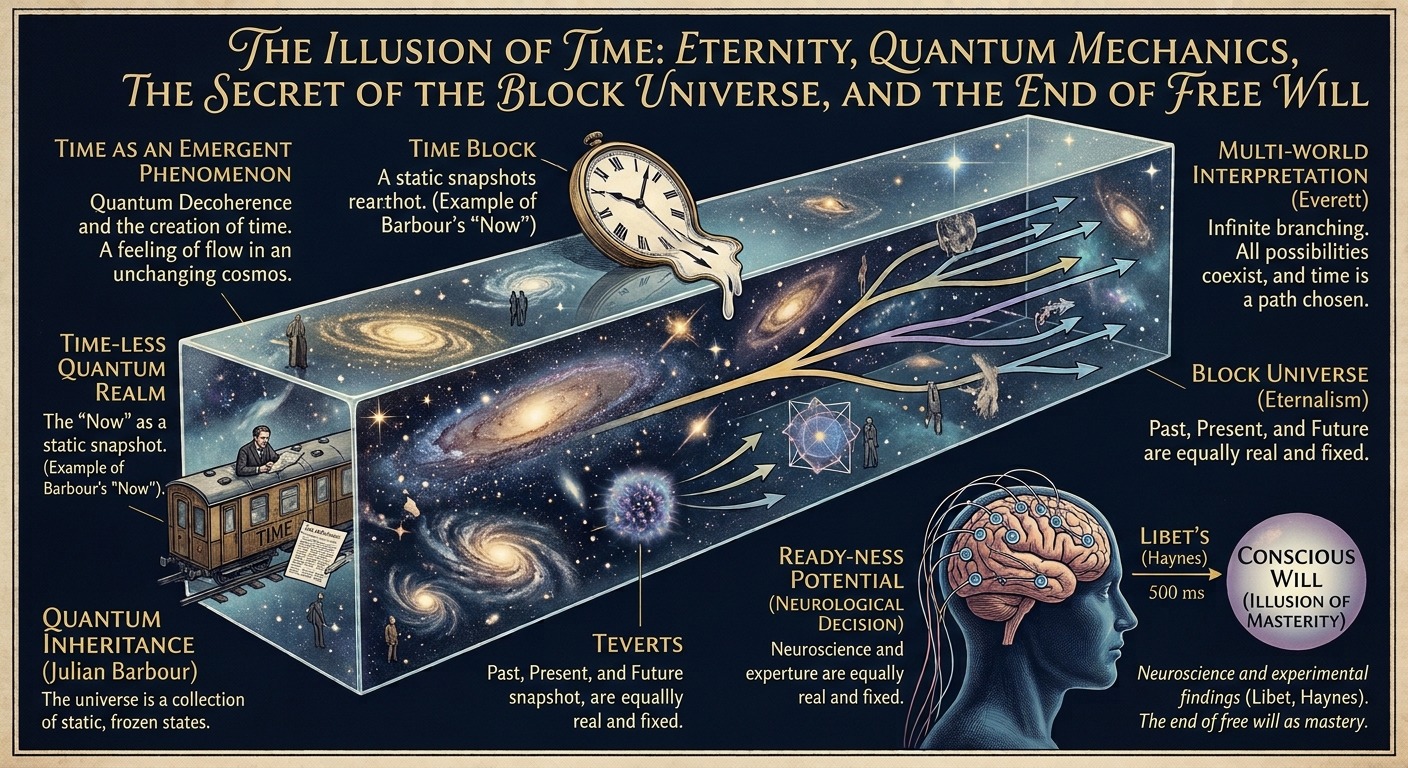
The Illusion of Time: Eternity, Quantum Mechanics, the Secrets of the Block Universe, and the End of Free Will
Mian Iftikhar Ahmad
Questions emerging in the worlds of modern theoretical physics, quantum mechanics, and neuroscience regarding the existence of time and human volition have brought human intellect to a juncture where the most fundamental truths of the universe and humanity seem to directly contradict our everyday experiences and observations.
From the movement of clock hands to the advancements in quantum entanglement—is time truly a scientific illusion?
Quantum decoherence and the emergence of time—is this merely the perception of flow within an unchanging universe?
Platonia’s world—do our past, present, and future already exist? Is the concept of fate on the verge of being scientifically validated?
Within the canvas of eternity, is an unchanging journey through the past, present, and future continuously underway?
The boundaries of space and time—have quantum mechanics and mathematics eliminated time from the fundamental equations of the universe?
These are the new fundamental questions brought to light by scientific progress. For centuries, humanity believed that time flows continuously in one direction like a river, where the past is left behind, the present is where we breathe, and the future remains hidden in unknown depths. However, modern scientific research has shattered this assumption. Time, which we measure using the hands of our clocks, does not exist at all within the fundamental laws of the universe. In this unchanging block universe, human self-perception as absolute masters of decision-making—that is, free will—is merely a persistent illusion constructed by brain chemistry and quantum processing.
This astonishing scientific journey began in 1965 when Julian Barbour, a twenty-eight-year-old British student, read a 1958 scientific paper by Paul Dirac that attempted to mathematically translate general relativity into the fundamental principles of quantum mechanics. Studying the paper closely, Barbour realized that if the fundamental laws of the universe are evaluated at the quantum level, there is no need for time at all. This realization transformed Barbour’s life; he abandoned traditional research and academic professorships at scientific institutions to settle in an old farmhouse in a quiet English village. Earning a living by translating Russian scientific papers into English, he devoted his remaining time to uncovering the true nature of time. In his 1999 book The End of Time, Barbour presented a compelling stance: time as an independent flow does not exist. Instead, the entire universe is an infinite collection of static, frozen states, which he termed “Platonia,” drawing a parallel to the Platonic realm. To him, every moment or “Now” is a complete, static snapshot—a frozen snapshot where past, present, and future coexist eternally, while human consciousness merely travels along a path connecting these static images.
The solid mathematical foundation for Barbour’s thought was established in 1967 when John Wheeler and Bryce DeWitt attempted to apply Schrödinger’s fundamental quantum wave equation to all matter and energy in the universe. Waiting for a flight at Chicago’s O’Hare Airport, Bryce DeWitt combined Einstein’s general relativity—which governs large-scale structures like stars and galaxies—with quantum mechanics—which accounts for subatomic particles—to write the wave function of the entire universe. The result proved to be one of the greatest shocks in the history of physics: when the Hamiltonian operator, which measures total energy, acted on the wave function of the universe, the answer was zero. According to mathematical principles, when total energy equals zero on one side of an equation, the time-evolution variable mathematically vanishes—yielding what is known today as the Wheeler–DeWitt equation. The profound implication of this equation is that when we view the universe as a single entity, no trace of time’s movement remains, a dilemma known to physicists as the “Problem of Time.”

The vanishing of time from these equations was no coincidence; its deep scientific cause lies in the energetic structure of the universe itself. According to physicists, all matter and radiation in the universe carry positive energy, whereas gravity, which binds matter together, carries negative energy. When these two forms of energy are summed, they cancel each other out completely, yielding a total energy of zero for the universe. The fundamental law of quantum mechanics dictates that time evolution within any system depends on its total energy. Because there is no external frame of reference or clock outside the universe, there is mathematically no room for time within the universe as a whole. This surprising discovery supports Einstein’s concept of the space-time continuum. In March 1955, following the death of his closest friend Michele Besso, Albert Einstein wrote a famous condolence letter to Besso’s family, stating that while Michele had departed from this strange world a little ahead of him, it meant nothing, because for physicists, the distinction between past, present, and future is only a stubbornly persistent illusion. Einstein passed away just a month later, but the concept derived from his general relativity—known in modern physics as the four-dimensional Block Universe or Eternalism—endures. According to the block universe theory, the three spatial dimensions and the fourth dimension of time form a rigid 4D block in which every event in history, from the Big Bang to the final moment of the cosmos, exists simultaneously at fixed coordinates.
In his renowned work, physicist Brian Greene illustrated this block universe concept using the relativity of simultaneity. In Greene’s thought experiment, if an alien standing ten billion light-years away on a distant galaxy is stationary relative to Earth, its “now” aligns directly with our present moment on Earth. However, if that alien begins cycling away from Earth at a modest speed, the slice of space-time it considers “now” tilts, intersecting Earth’s history hundreds of years in the past. Conversely, if the alien turns around and cycles toward Earth, its “now” sweeps forward to intersect Earth’s future hundreds of years ahead. This implies that if our future is already part of someone else’s present in a distant corner of the cosmos, our future must already exist there in full detail.
Nevertheless, scientists faced a major question: if time does not exist at a fundamental level, why do we experience its flow in daily life, and what do our clocks measure? To resolve this mystery, Don Page and William Wootters proposed a mechanism in 1983 known as the Page and Wootters mechanism or “Time from Entanglement.” They theorized that while the universe as a whole is static and timeless, time emerges internally when sub-systems become quantum-entangled with one another. If one subsystem acts as a clock and becomes entangled with the rest of the system, an outside observer viewing the universe as a whole sees no change, whereas an internal observer entangled with the clock perceives the rest of the universe changing relative to the clock—giving rise to the perception of time. This model was experimentally verified in 2013 at an Italian research institute by Ekaterina Moreva and her team using entangled photons: from an external perspective, the photon system remained unchanged, whereas internal measurements recorded temporal evolution.
To fully understand the emergence of time from this fundamental level, it is essential to examine quantum coherence and decoherence, pioneered by physicist H. Dieter Zeh in the 1970s and later expanded by Wojciech Zurek. At the quantum scale, matter and energy exist in coherent superpositions—fluid, wave-like states without a defined arrow of time. In this coherent state, quantum equations behave identically backward and forward in time; they are time-symmetric. However, as soon as a microscopic quantum system interacts with its environment, quantum coherence is lost—a process called quantum decoherence. Decoherence disperses the system’s quantum information into the environment, causing the superposition to collapse into a single, classically defined outcome. According to Zeh and Zurek, quantum decoherence serves as the crucial bridge connecting the timeless quantum realm to our macroscopic classical world. Because this information leakage is effectively irreversible, it increases thermodynamic entropy, creating the one-way directional arrow that our consciousness perceives as the flow of time. Without quantum decoherence, quantum coherence could never transition into classical reality, and the perception of time could never emerge.
The discussion surrounding time in quantum mechanics extends even further. Hugh Everett III’s 1957 Many-Worlds Interpretation redefined the nature of time by proposing that the quantum wave function never collapses; instead, every quantum measurement or interaction causes the universe to branch into multiple parallel realities. In this framework, time is not a linear path but a branching tree, where every past quantum event creates a vast web of parallel universes, and the flow of time is merely experienced along the specific branch our consciousness traverses. Similarly, Richard Feynman’s diagrams in quantum electrodynamics reveal that mathematically, a particle moving forward in time is identical to an antiparticle (such as a positron) moving backward in time. This demonstrates that at the foundational level of quantum mechanics, forward motion in time is not an absolute requirement; the equations function symmetrically in both directions. Furthermore, advanced wave theories, including the Wheeler–Feynman absorber theory, suggest that quantum events are shaped not only by past causes but also by future boundary conditions, rendering the concept of a strictly one-way temporal flow highly questionable.
In parallel, Carlo Rovelli proposed the Thermal Time Hypothesis within Loop Quantum Gravity, arguing that time is an emergent statistical property rather than a fundamental entity. According to Rovelli and his colleagues, space-time is not smooth and continuous but consists of discrete quantum grains—spin networks—at the Planck scale ($10^{-35}$ meters), where time is entirely absent. Rovelli contends that the flow of time stems from our incomplete knowledge and inability to track every individual microscopic state. When we observe macroscopic systems involving trillions of particles, the blurring caused by increasing thermodynamic entropy generates the illusion of time passing. Conversely, String Theory posits that the universe is composed of fundamental vibrating strings operating within a pre-existing space-time background, aligning more closely with Einstein’s continuous block universe. While physicists like Lee Smolin and Sean Carroll advocate for time as a fundamental reality—arguing that cosmic evolution and change cannot be explained without it—they have yet to produce a unified equation that restores fundamental time at the quantum level.
This shift in our understanding of time and the block universe extends beyond physics, finding striking support in modern neuroscience regarding human free will. In the 1980s, Benjamin Libet conducted a landmark experiment at the University of California, San Francisco, that challenged the notion of conscious volition. Libet fitted participants with electroencephalography (EEG) sensors to monitor brain activity while asking them to press a button at a moment of their own choosing, noting the exact time they felt the conscious urge to act. The data revealed a startling result: the brain’s motor cortex generated an electrical signal—termed the readiness potential—roughly 500 milliseconds before the participant became consciously aware of their decision. This demonstrated that before a person consciously feels they have made a choice, the brain’s neural processes have already initiated the action, leaving conscious awareness to retroactively attribute the decision to “free will.”
In 2008, neuroscientist John-Dylan Haynes advanced this research using functional Magnetic Resonance Imaging (fMRI). Haynes demonstrated that neural activity in the prefrontal and parietal cortices could predict a participant’s decision to press a left or right button up to 7 to 10 seconds before the participant made the conscious choice. These experiments offer compelling empirical evidence that, much like the four-dimensional block universe, the human brain operates as a physical system governed by deterministic chemical and electrical interactions—suggesting that human decision-making is an embedded physical process rather than an uncaused act of free volition.
The scientific challenge to free will raises profound philosophical and legal questions regarding crime, punishment, and moral responsibility. If an individual does not originate their actions independently, and if an act is the inevitable outcome of neural processes within a deterministic block universe, the traditional justification for retributive justice loses its foundation. Thinkers like Daniel Dennett and Sean Carroll propose compatibilist frameworks, noting that while fundamental physics and neuroscience operate deterministically, concepts of moral accountability and legal structures remain necessary functional tools for societal organization, safety, and deterrence. Under this view, penalizing harmful behavior serves not as retribution for an uncaused choice, but as a crucial environmental input that deters future harm and reconditions behavior. If committing a crime is part of the physical causal chain, then law enforcement, judicial proceedings, and legal frameworks are equally embedded components of that same deterministic system.
Ultimately, the intellectual journey that began with Julian Barbour’s train ride, Benjamin Libet’s neurological experiments, quantum decoherence, the Many-Worlds interpretation, and Feynman’s quantum formulations brings us to a unified realization: time is not a fundamental constituent of the universe, nor is human volition exempt from physical laws. Rather, both are emergent phenomena arising from quantum entanglement, decoherence, thermodynamic entropy, and the neural architecture of the brain. What we experience as the passage of time and the shaping of destiny through choice are reflections within an eternal, unchanging cosmic canvas—a vast picture in which no moment is ever truly lost, but remains eternally preserved.