
Rising US debt, tighter dollar liquidity and shifting investor sentiment are reshaping global markets and challenging America’s financial dominance
(By: Mian Iftikhar Ahmad)
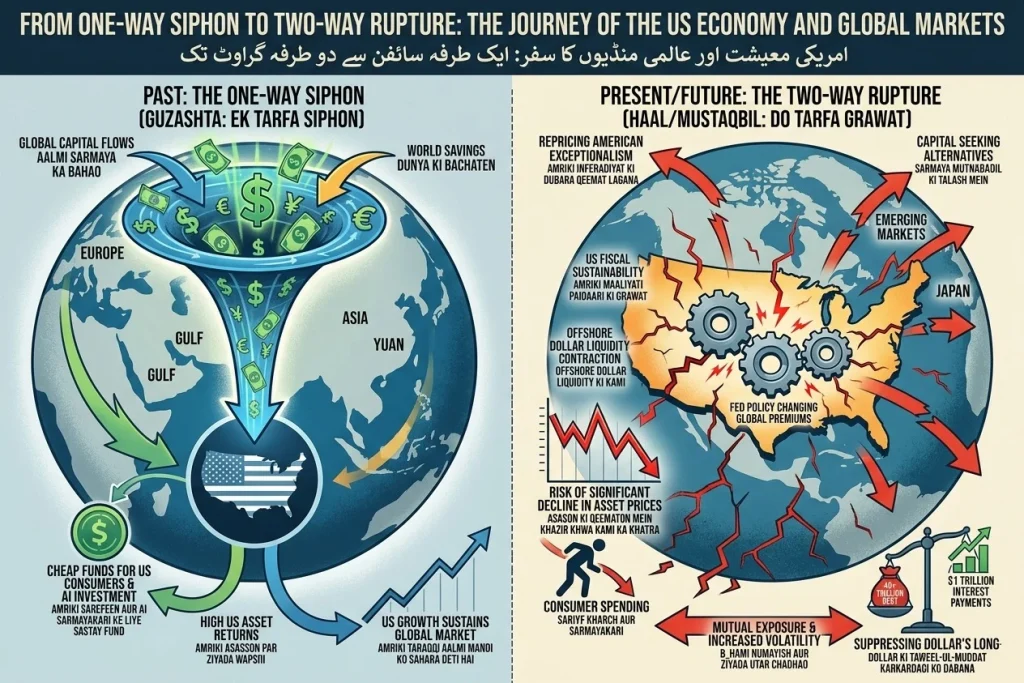
For decades, global investors have channelled vast amounts of money into US stocks and government bonds. These investments helped finance American consumer spending and business expansion. They also strengthened the dollar’s position in international markets.
Today, several economic pressures threaten this long-standing pattern. Rising government debt, tighter dollar liquidity and changing investor sentiment are reshaping the relationship between the United States and the global economy.
Investors now question whether American assets will continue to attract capital at the same pace. They also face a broader challenge: how will global markets respond if investors begin to favour other economies?
Two major forces support the US economy: consumer spending and investment in artificial intelligence (AI). Both depend heavily on financial market performance.
Rising stock prices increase household wealth, particularly through retirement accounts. This wealth effect encourages some consumers to spend more. Meanwhile, technology companies continue to invest heavily in data centres, computing infrastructure and AI development.
The International Monetary Fund raised its US economic growth forecast to 2.4 percent in early 2026, according to the supplied analysis. Strong AI investment helped support this outlook. The World Bank also highlighted the American economy’s contribution to improved global growth forecasts.
However, this dependence creates risks. A sharp stock market decline could weaken consumer confidence and reduce household spending. Companies might also delay major projects if falling share prices make expansion less attractive.
Consequently, financial market performance now plays a central role in shaping US economic growth.
The US Treasury market presents another major challenge. Investors once viewed rising Treasury yields as a sign of stronger economic growth. Today, higher long-term yields can also reflect concerns about government borrowing and widening fiscal deficits.
These pressures affect the wider economy. Higher yields increase borrowing costs for businesses and households. They can also reduce the prices investors are willing to pay for stocks.
Large technology companies face additional challenges. Many are expanding into capital-intensive businesses that require substantial investment. Higher financing costs could weaken their profitability and affect their market valuations.
This creates a difficult cycle. Rising government debt can push Treasury yields higher. Higher yields then increase borrowing costs and discourage investment.
Policymakers must support economic growth while addressing the fiscal risks that threaten long-term financial stability.
The supply of US dollars outside America also influences global financial stability. International banks, businesses and investors rely on dollar funding to support trade, lending and investment.
The supplied analysis identifies developments in the Gulf region and China as potential sources of pressure on offshore dollar liquidity.
Disruptions to Gulf energy production and exports could reduce the dollars available for international investment. Reconstruction and defence spending may also encourage regional governments to retain more funds at home.
China’s growing use of the renminbi in overseas lending and investment could change another traditional source of dollar flows. Instead of directing more trade earnings into dollar-denominated assets, Chinese institutions may increasingly use their own currency for international transactions.
These changes could raise currency-hedging costs and make dollar borrowing more expensive. Emerging markets may face additional pressure, particularly when their governments and businesses rely on international financing.
As a result, global financial conditions can tighten even when US domestic money markets appear relatively stable.
The dollar’s future depends on interest rates, demand for safe-haven assets and confidence in American government finances.
A resilient US economy can support the currency. However, persistent deficits and rising interest payments may weaken investor confidence over time.
The supplied analysis reports that US federal debt exceeded $40 trillion by August 2026. It also cites a debt-to-GDP ratio of 124 percent at the end of fiscal year 2025. Net interest payments reportedly exceeded $1 trillion during the first 11 months of fiscal year 2026.
These figures highlight the growing cost of servicing government debt. Continued borrowing could force policymakers to reconsider government spending, taxation and monetary policy.
Central banks are also diversifying their reserves. Their growing interest in gold and other assets reflects efforts to reduce dependence on a single reserve asset.
This trend does not necessarily signal an imminent collapse of the dollar. However, it shows why investors increasingly examine America’s fiscal outlook when making financial decisions.
Despite these risks, the United States retains significant economic advantages. Its financial markets offer depth and liquidity. Its universities, energy resources, technology sector and legal institutions also attract international investors.
Nevertheless, other markets are gaining attention. Improving corporate profits in Europe, governance reforms in Japan and better fiscal conditions in some emerging economies could make non-US investments more attractive.
Investors do not need to abandon American assets to diversify their portfolios. They can instead spread their investments across a wider range of markets.
This gradual shift could influence exchange rates, bond yields and stock valuations. It could also change the cost of financing governments and businesses around the world.
The key question is whether other economies can offer sufficiently attractive returns to challenge America’s dominant position in global investment portfolios.
The World Bank’s January 2026 Global Economic Prospects report raised its global growth forecast to 2.6 percent, according to the supplied analysis. Strong US economic performance contributed to the improved outlook.
However, World Bank Chief Economist Indermit Gill warned that the 2020s could become the weakest decade for global economic growth since the 1960s if current forecasts hold. The analysis also notes that per capita incomes in about a quarter of developing economies could remain below their 2019 levels.
These concerns reveal a difficult global economic environment. The world economy continues to show resilience despite policy uncertainty. Yet weak growth and financial vulnerabilities could create longer-term problems for governments and credit markets.
The United States presents a similar contradiction. Its economic strength supports global growth forecasts, but its financial dominance also concentrates risk within international markets.
A significant change in American asset valuations could therefore affect economies far beyond US borders.
The relationship between the United States and global markets is shifting from a largely one-way flow of capital to a more interconnected system. In this new environment, financial risks can move in both directions.
For decades, international investment helped lower American financing costs and support consumer spending. US economic growth then benefited other countries through trade and financial connections.
Today, rising Treasury yields can increase American borrowing costs while also affecting financial conditions abroad. Meanwhile, tighter dollar liquidity can pressure overseas banks and businesses that depend on US currency funding.
Policymakers must also balance competing priorities. Lower interest rates can support growth, but they may add to inflationary pressures. Higher rates can help control inflation, yet they also increase borrowing costs and government debt-servicing expenses.
These conflicting demands make economic policy more complicated and increase uncertainty for investors.
The changing investment landscape does not mean that the United States will lose its central role in global finance. Its capital markets, technology industry and economic institutions remain major sources of strength.
However, investors may become more selective as fiscal pressures increase and alternative markets improve. This could gradually reshape international capital flows and influence asset prices across regions.
The long-term outcome will depend on America’s ability to manage its debt, maintain investor confidence and sustain economic growth. Developments in global dollar liquidity and competing investment opportunities will also matter.
The next phase may bring a more diversified financial system, but it could also produce greater market volatility. For investors, understanding the links between US fiscal policy, dollar liquidity and global asset prices will become increasingly important.