HCoM Briefing — May 21, 2026
Mental Health Concerns of Houston’s Teens & Young Adults
Credit By Tariq Khan
Southern News Group | 11122 Bellaire Blvd., Houston, TX 77072
Thursday, May 21, 2026 | 11:00 a.m. – 1:00 p.m.
Moderated by Sandy Close, Ethnic Media Services / Houston Community Media (HCoM)
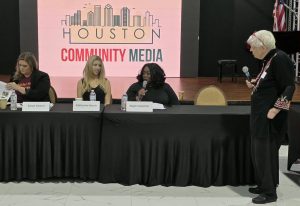
L to R: Sarah Howell, Dr. Katharine Neill Harris, Najah Callander — HCoM Briefing, May 21, 2026, Southern News Group, Houston TX
Overview
Houston Community Media (HCoM), a multilingual, multiracial network of ethnic media outlets serving Greater Houston, convened a two-hour community briefing on Thursday, May 21, 2026, at the Southern News Group headquarters at 11122 Bellaire Blvd. The event, titled “Mental Health Concerns of Houston’s Teens & Young Adults,” brought together a policy researcher, a school district administrator, and a frontline clinical social worker to address what all three described as a deepening and underreported public health emergency.
HCoM, launched in July 2022 with support from the Houston Endowment and operating under American Community Media Services (ACoM), regularly convenes these expert briefings to ensure Houston’s diverse ethnic media communities have access to accurate, research-backed information on the issues most affecting their readers, listeners, and viewers.
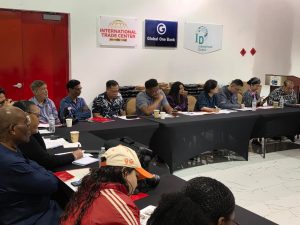
The event drew journalists, advocates, health workers, educators, and community leaders representing South Asian, African American, Latino, East Asian, Middle Eastern, and Filipino communities, among others — a reflection of the extraordinary diversity of Greater Houston and its ethnic media landscape. Visible in attendance were representatives linked to the International Trade Center Houston, Global One Bank, the International District, FCA (Trusted Financial Advisors Since 1975), the U.S. Commercial Service, and the Ethio-American Trade & Investment Council.
The briefing was moderated by Sandy Close, founder of Ethnic Media Services and an HCoM/ACoM coordinator. Three expert panelists delivered formal presentations followed by Q&A, concluding with a networking lunch catered by Phoenicia’s Specialty Foods.
 |
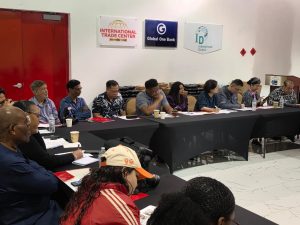 |
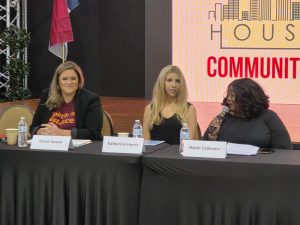
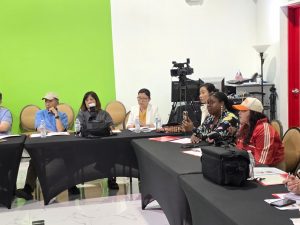
Left: Panelists Sarah Howell, Dr. Katharine Harris & Najah Callander | Right: Audience of ethnic and community media journalists
Background: A Crisis by the Numbers
The HCoM briefing came at a critical moment for Houston’s young people. Research from Rice University’s Baker Institute for Public Policy — presented at the event by Dr. Katharine Neill Harris — draws on the 2023 High School Youth Risk Behavior Survey (YRBS) for HISD and paints a sobering picture:
- Nearly 14% of HISD students in 2023 reported having attempted suicide in the previous year — higher than the national rate of 10%.
- More than 18% of HISD students had a plan for how they would attempt suicide — higher than the national rate of 16.4%.
- Students reporting mental health issues in HISD jumped from 26% in 2021 to 29% in 2023.
- Bullying in HISD schools rose sharply: nearly 16% of students reported on-campus bullying in 2023, up from 9% in 2021.
- Nearly one-fifth of HISD students missed school in 2023 due to feeling unsafe on campus.
- Nationally, the prevalence of diagnosed mental or behavioral health conditions among adolescents increased 35% between 2016 and 2023.
These numbers reflect a system under strain. The 2023 state takeover of HISD by the Texas Education Agency — which replaced the elected school board with a state-appointed board of managers and named a new superintendent — introduced significant administrative disruption. According to research from the University of Houston, HISD has since lost more than 13,000 students, with enrollment declines accelerating particularly in early elementary and early high school grades. The share of uncertified teachers has risen to nearly one in five. Meanwhile, key mental health service providers have reduced their footprint in HISD schools.
Moderator: Sandy Close
Founder, Ethnic Media Services | Coordinator, Houston Community Media (HCoM) / ACoM
Sandy Close, Founder of Ethnic Media Services, moderating the HCoM Briefing — addressing assembled ethnic and community media journalists
Sandy Close, a veteran American journalist with more than six decades in the field, moderated the briefing. Close is the founder of Ethnic Media Services and co-founder of Houston Community Media (HCoM), where she serves as an ACoM/ACMS coordinator alongside Nguyen Lee and Nakia Cooper. She began her journalism career in the mid-1960s in Hong Kong as China editor of the Far Eastern Economic Review and went on to serve as Executive Director of Pacific News Service from 1974 to 2017.
In 1996, Close founded New America Media (originally New California Media), building it into the first and largest collaboration of ethnic news organizations in the United States. In 2018, she founded Ethnic Media Services, a nonprofit focused on cross-cultural journalism to promote inclusive public discourse. She is a MacArthur Foundation “Genius Award” recipient (1995), a 2011 George Polk Award winner for Career Achievement, and co-producer of “Breathing Lessons,” the 1996 Academy Award-winning short documentary.
Under her guidance, the HCoM briefing moved efficiently through presentations and Q&A, ensuring Houston’s ethnic media community could report accurately and fully on this critical public health issue.
Sandy Close addressing the full room during Q&A — moderating questions from ethnic and community media journalists across Greater Houston
Speaker 1: Dr. Katharine Neill Harris
Alfred C. Glassell III Fellow in Drug Policy — Rice University Baker Institute for Public Policy
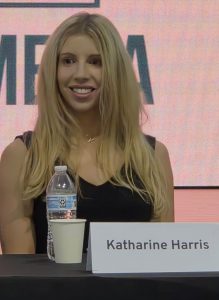
Dr. Katharine Neill Harris presenting her Baker Institute policy brief on student mental health at the HCoM Briefing, May 21, 2026
Dr. Katharine Neill Harris opened the briefing with a presentation of the Baker Institute policy brief she co-authored, “The State of Student Mental Health in Houston Schools,” published May 13, 2025. The brief — the first in a three-part series based on 2023 HISD Youth Risk Behavior Survey (YRBS) data — examines trends in mental health, bullying, and student safety from 2011 to 2023, comparing HISD trends against national data.
Dr. Harris, whose research analyzes the impacts of local, state, and national drug and public health laws, drew particular attention to the policy environment surrounding HISD’s mental health infrastructure. She highlighted that while the 2023 Texas legislature passed a bill allowing unlicensed chaplains to serve as school counselors — a response to the documented counselor shortage — schools widely rejected the measure due to inadequate training. Only one school district statewide opted to participate.
She also described the shrinking footprint of key mental health providers in HISD. Communities in Schools (CIS), a major provider of on-campus licensed mental health professionals, had providers in 42 HISD schools and six Sunrise Centers in the 2023–24 school year. By 2024–25, that number dropped to 25 schools and three Sunrise Centers — a significant reduction in direct student access to mental health care.
Dr. Harris closed with clear policy recommendations: permanent, on-campus mental health infrastructure; meaningful state funding (noting Texas had a $24 billion surplus at the start of the 2025 legislative session); expanded use of naloxone on campuses; evidence-based substance use prevention programs; and strengthened community partnerships to extend the district’s reach. She quoted directly from her research: “While these outside factors are beyond the school district’s control, schools are often the most stable part of a young person’s life. That’s why it’s so important for the district to partner with the community to support students’ mental health and address substance use.”
Speaker 2: Najah K. Callander
Deputy Chief of Family & Community Partnerships — Houston Independent School District
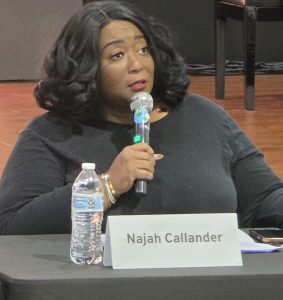
Najah Callander, Deputy Chief of Family and Community Partnerships, Houston ISD, speaking at the HCoM Briefing
Najah K. Callander brought the perspective of a senior HISD administrator who has been at the center of the district’s effort to rebuild its student support infrastructure since the state takeover. As Deputy Chief of Family and Community Partnerships for Houston ISD — the nation’s eighth-largest school district — she oversees six teams serving more than 170,000 students and their families.
Callander opened with a personal account of the experiences that drew her into community-centered education work, before walking the audience through HISD’s flagship response to the student support crisis: the Sunrise Centers.
Established in the fall of 2023, the seven Sunrise Centers were created partly in response to the HISD Student Needs Survey, which found that 27% of students lacked access to mental health services. The Centers function as comprehensive, walk-in community hubs co-located with institutions such as the YMCA, Boys and Girls Club, and the Youth Development Center. Each center provides case management, a food pantry, clothing and uniforms, medical care, mental health care, and student and parent enrichment programs — all free of charge and accessible without an appointment.
In their first year of operation (2023–24), Sunrise Centers served over 30,900 families. Rice University’s Houston Education Research Consortium (HERC) found that families who visited a Center showed a 33% improvement in student attendance or behavior. Callander described this outcome as evidence that meeting basic needs directly unlocks educational success.
She also emphasized HISD’s Annual Needs Assessment Survey as an essential tool for data-driven resource allocation, and called on community organizations, nonprofits, healthcare providers, and media to partner with the district to extend its reach — particularly into immigrant and refugee communities where stigma and language barriers often prevent families from accessing services.
Callander noted that in every community where Sunrise Centers operate, mental health services remain the most heavily requested resource. “Especially post-COVID,” she said. “We’re seeing it with our students and our families as people try to process the last three years. Some of those barriers and stigmas surrounding mental health are coming down, so we have a real opportunity to serve people in that area.”
Speaker 3: Sarah K. Howell, DSW, LCSW-S, CCST
Clinical Social Worker & Therapist | Executive Director, STAR Support | Founder, STAR Counseling & Consultation
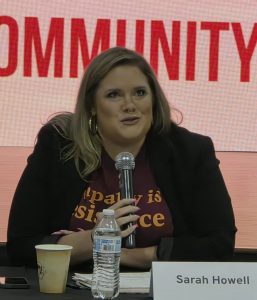
Sarah Howell, Clinical Social Worker and Therapist, speaking at the HCoM Briefing — her shirt reads ‘Empathy is Resistance’
Sarah K. Howell closed the formal presentations with the clinical and community-level perspective that grounded the panel’s policy discussions in the day-to-day realities of Houston’s most vulnerable young people. As Executive Director of Survivors of Torture, Asylee, Refugee Support (STAR Support) and Founder of STAR Counseling & Consultation, Howell described openly the many professional roles she occupies simultaneously — clinician, administrator, policy advocate, trainer, and community consultant — noting that addressing youth mental health in a city as complex as Houston requires wearing multiple hats.
Howell spent a decade as school social work supervisor at Las Americas Newcomer School and Jane Long Academy within HISD, where she worked directly with immigrant, refugee, and undocumented students and their families. That experience, she said, showed her the profound gap between the mental health needs of Houston’s most underserved youth and the clinical services available to them — a gap defined not only by funding shortfalls but by the near-absence of culturally responsive, trauma-informed practitioners who speak the languages and understand the experiences of their clients.
She specializes in complex trauma treatment using EMDR (Eye Movement Desensitization and Reprocessing) and Sand Tray Therapy — approaches she described as essential for working with children and young people who cannot always articulate their trauma in words. Her work includes forced migration trauma, gang-involved immigrant youth, and the intersection of legal vulnerability, poverty, and adolescent mental health.
Howell currently co-facilitates the Central American Minors working group in Houston and consults with the SAMHSA-funded Hispanic/Latino Behavioral Health Center of Excellence. She holds a Doctorate in Clinical Social Work from the University of Pennsylvania, an MSW in Political Social Work from the University of Houston, and a B.A. in International Politics and Diplomacy from Texas A&M University.
Her message to the assembled ethnic media journalists was direct: the youth mental health crisis in Houston is not abstract. It is visible in schools, in families, in clinics. And the communities that ethnic media serve — immigrant, refugee, working-class, multilingual — are often the communities bearing the greatest burden.
Community Engagement & Q&A
The briefing’s Q&A sessions produced a wide-ranging and at times passionate exchange between panelists and an engaged audience of ethnic and community media journalists from across Greater Houston. Questions covered the role of social media in accelerating youth mental health challenges, the shortage of Spanish-language and multilingual mental health providers, language access barriers in HISD’s support programs, the particular vulnerabilities of undocumented and mixed-status immigrant youth, and how community media can amplify mental health resources to the families who need them most.
 |
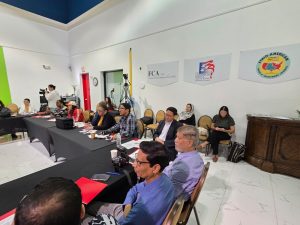 |
Ethnic and community media journalists from across Greater Houston — engaged audience members at the HCoM Briefing, May 21, 2026
All three panelists were consistent in their conclusion: no single institution — not the school district, not the clinical community, not policymakers — can solve this crisis alone. What is required is sustained, funded, cross-sector collaboration. Schools must have on-campus mental health infrastructure. The state must commit resources. Clinicians and nonprofits must extend their reach into underserved communities. And community media — the trusted voices reaching Houston’s most diverse neighborhoods — must continue to carry this story.
Closing Remarks
The formal program concluded with open Q&A for all speakers from 12:00–12:15 p.m., followed by individual press interviews and a networking lunch catered by Phoenicia’s Specialty Foods from 12:15–1:00 p.m.
Houston Community Media (HCoM) is a multilingual, multiracial network of ethnic and community media outlets serving Greater Houston. Launched in July 2022 with support from the Houston Endowment, HCoM operates under the umbrella of American Community Media Services (ACoM). Its briefings are designed to ensure that Houston’s ethnic media communities — and the diverse populations they serve — have access to accurate, expert-sourced information on the issues that matter most.
SPEAKER PROFILES
HCoM Briefing | Mental Health Concerns of Houston’s Teens & Young Adults | May 21, 2026
|
Dr. Katharine Neill Harris Alfred C. Glassell III Fellow in Drug Policy Rice University Baker Institute for Public Policy |
Najah K. Callander Deputy Chief, Family & Community Partnerships Houston ISD |
Sarah K. Howell, DSW, LCSW-S, CCST Clinical Social Worker & Therapist STAR Support / STAR Counseling & Consultation |
Dr. Katharine Neill Harris, Ph.D.
Dr. Harris is the Alfred C. Glassell III Fellow in Drug Policy at Rice University’s Baker Institute for Public Policy, where she analyzes the impacts of local, state, and national drug laws on communities and public health. Her current research focuses on cannabis regulation and overdose mitigation strategies. She co-authored the 2025 Baker Institute policy brief “The State of Student Mental Health in Houston Schools,” drawing on 2023 HISD Youth Risk Behavior Survey data. She holds a B.S. in criminal justice (George Mason University), an M.P.A. in public administration (Old Dominion University), and a Ph.D. in public administration and urban policy.
Najah K. Callander
Najah K. Callander is Deputy Chief of Family and Community Partnerships for Houston ISD, the nation’s eighth-largest school district. She oversees six teams serving over 170,000 students and their families, and leads the district’s strategy to strengthen school-family-community partnerships. With nearly 20 years of experience spanning the nonprofit and education sectors, she spearheaded the expansion of HISD’s Sunrise Centers — now serving over 30,000 families per year — and pioneered a first-of-its-kind data integration system connecting student interventions to outcomes across multiple district divisions. She is a sought-after voice on education equity, community partnerships, and systemic change.
Sarah K. Howell, DSW, LCSW-S, CCST
Sarah K. Howell is Executive Director of Survivors of Torture, Asylee, Refugee Support (STAR Support) and Founder of STAR Counseling & Consultation, where she specializes in complex trauma using EMDR and Sand Tray Therapy. She holds a Doctorate in Clinical Social Work from the University of Pennsylvania, an MSW in Political Social Work from the University of Houston, and a B.A. in International Politics and Diplomacy from Texas A&M University. She spent a decade as school social work supervisor at Las Americas Newcomer School and Jane Long Academy in HISD. She co-facilitates the Central American Minors working group in Houston and consults with the SAMHSA-funded Hispanic/Latino Behavioral Health Center of Excellence. Her focus areas include Hispanic and Latine mental health, forced migrant trauma, gang-involved immigrant youth, and culturally responsive, trauma-informed practice across clinical, community, and policy settings.
Houston Community Media (HCoM)
A multilingual, multiracial network of ethnic media outlets serving Greater Houston
Launched July 2022 | Supported by the Houston Endowment | Operating under American Community Media Services (ACoM)
Moderated by Sandy Close, Ethnic Media Services / ACoM | Lunch: Phoenicia’s Specialty Foods