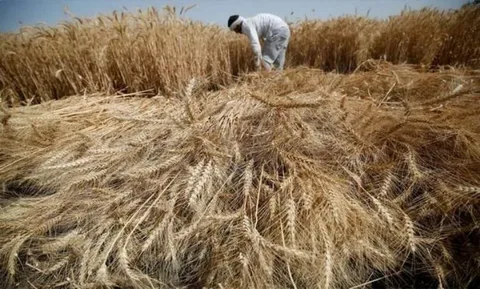
Authorities have set a Faisalabad wheat target of 1.834 million acres for the coming season. The decision was taken at a meeting of the Divisional Wheat Committee chaired by Commissioner Dr Imran Hamid Sheikh. Officials were told to complete sowing by November 20, and to ensure that seed, fertiliser and canal water reach farmers on time. The plan aims to make Faisalabad the leading division for wheat farming in Punjab.
Background: Why Faisalabad Wheat Cultivation Matters
Wheat is Pakistan’s main staple crop, and Punjab grows most of it. Faisalabad division, which includes four districts, is one of the province’s important wheat-producing areas. Each year, officials set an acreage goal before sowing so that departments can plan supplies and monitor progress.
The 1.834 million acre figure is not new for the division. The same target was set last season, and the agriculture department later reported that wheat was sown on about 1.868 million acres, above the goal. The year before that, the area under wheat was about 1.809 million acres. This record gives officials some confidence ahead of Rabi 2026-27.
Concerns about food security, input costs and unpredictable weather have kept wheat farming in Pakistan in the spotlight. Farmers often complain about the price of fertiliser and seed, and about water shortages at the tail end of canals. That is why administrators now stress smooth supplies as much as the acreage number itself.
Details: What the Divisional Wheat Committee Decided
According to the meeting report, the committee directed departments to ensure adequate fertiliser and certified seed at fixed rates. It also asked them to guarantee timely canal water up to the fields. These three inputs are the basics of a good crop, and delays in any of them can reduce yields.
Commissioner Dr Sheikh called for wider use of mechanical sowing, especially Super Seeders. He said farmers who already use the machines should be linked with other growers at the union council level, so more people can benefit. Super Seeders can sow wheat directly into rice stubble, which saves time and can reduce the need to burn crop residue.
Deputy commissioners were told to handle farmers’ complaints through district committees within 15 days. They must also report on the full supply of canal water to designated outlets. Another meeting will be held after 15 days to review progress against the wheat cultivation target assigned to each district. Director Agriculture Chaudhry Khalid Mahmood briefed the meeting, and Kisan Board representatives gave their suggestions.
Punjab Agriculture Department’s Sowing Advice
A separate review meeting was held by the Director General Agriculture (Extension) Punjab, Chaudhry Shahbaz Akhtar, at the Faisalabad office. He was told that the division’s target for Rabi 2026-27 is 1.83 million acres. He advised farmers to sow between November 1 and 20, use certified seed and adopt modern mechanised farming, particularly Super Seeders.
The same meeting focused on stopping crop-residue burning and keeping monitoring teams active round the clock. He later visited Tandlianwala and Samundri to meet farmers and discuss timely sowing and better techniques. These field visits show that the campaign is aimed at growers directly, not only at office meetings.
Quotes: What Officials Said
The commissioner said the provincial government would announce the wheat support price soon. He also said farmers’ rights would be protected, and that the aim was to make Faisalabad division the leading wheat-cultivating division in Punjab. Officials gave no figure for the new support price, so growers are waiting for that announcement.
Last season, the Punjab government fixed the wheat support price at Rs3,500 per 40 kilograms. Farmers will watch closely whether the new rate covers their costs. For many growers, the announced price often decides how much land they are willing to put under wheat.
Impact: What the Faisalabad Wheat Target Means
For farmers, clear deadlines and guaranteed inputs could reduce last-minute problems during sowing. Timely planting matters because late-sown wheat usually gives lower yields. The push for Super Seeders may also help growers who cultivate after rice, and it supports efforts to reduce smog caused by stubble burning.
At the provincial and national level, Faisalabad’s performance affects Punjab’s overall output. Punjab is the country’s largest wheat-growing province, so a good crop in its divisions helps stabilise supply and flour prices. A weak harvest, on the other hand, can push up prices and raise import needs.
There is also a wider economic effect. A strong crop supports rural incomes and the flour milling industry, and it can reduce pressure on foreign exchange if imports are avoided. Still, the outcome depends on weather, water availability and input prices, which no committee can fully control.
Conclusion: What Happens Next
The next steps are a review meeting in about two weeks and the announcement of the wheat support price by the provincial government. Sowing should be under way through November, with November 20 as the target date for completing the Faisalabad wheat cultivation plan. Officials will likely report progress on the acreage regularly.
If past seasons are a guide, the division has a good chance of meeting its goal. The real test will be whether farmers get seed, fertiliser and water on time, and whether the support price is attractive enough. Until then, the Faisalabad wheat target remains a plan that depends on delivery in the field.
Frequently Asked Questions (FAQs)
Which province is the largest producer of wheat in Pakistan?
Punjab is the largest wheat-producing province in Pakistan by a wide margin. Reports based on official estimates in earlier years put roughly three-quarters of the country’s wheat area in Punjab, and the province’s target for a season is usually around 16 to 17 million acres. Its fertile plains and canal irrigation network suit wheat, and divisions such as Faisalabad, Multan and Sahiwal contribute heavily. Sindh, Khyber Pakhtunkhwa and Balochistan also grow wheat, but on a much smaller scale. Because of this, national food security depends largely on how well Punjab’s crop performs each year.
What is the price of 1 kg of wheat in Pakistan?
There is no single fixed price, because rates change by city, quality and season. The Punjab government’s support price of Rs3,500 per 40 kg works out to about Rs87.5 per kg, though that is the price meant to protect farmers, not always what the market pays. Private market rates listed on commodity websites for Punjab have recently ranged from about Rs3,600 to Rs4,700 per 40 kg, or roughly Rs90 to Rs117 per kg. These figures come from aggregator sites and vary a lot between them, so treat them as rough guides. For flour, the official Pakistan Bureau of Statistics survey recorded a 20 kg bag at about Rs2,200 in Faisalabad in late September 2026, which is roughly Rs110 per kg.
What is the price of 1 kg wheat in Punjab today?
Based on the sources above, wheat in Punjab is selling at roughly Rs90 to Rs117 per kg in the open market, depending on the city and grade. In Faisalabad, one listing shows a range of Rs3,660 to Rs4,680 per 40 kg, which is about Rs91 to Rs117 per kg. Flour is priced higher because of milling and transport costs, and the PBS average for a 20 kg bag in Lahore was about Rs2,219 on September 24, 2026. Prices can change daily, so check the local mandi rate or the latest PBS weekly report before buying or selling. Also keep in mind that no government source publishes a single “today” price for wheat grain across the province.