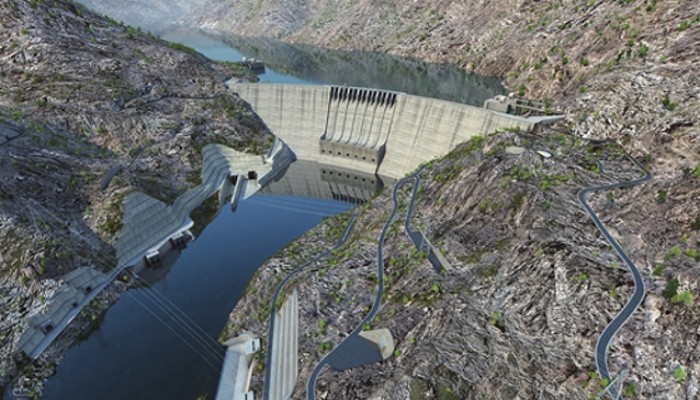
The Diamer Bhasha Dam power generation update has taken a dramatic turn this week. A report published on August 28 claimed that Islamabad has quietly cancelled the dam’s 4,500-megawatt power-generation component. The government has since rejected the claim, insisting the plan for electricity generation at the site remains unchanged.
Background
The Diamer-Bhasha Dam is a multipurpose project on the Indus River, built to store water, control floods and generate electricity at the same time. Construction formally began in 2020 after decades of delay, financing disputes and disagreements over its location in Gilgit-Baltistan. The Diamer Bhasha Dam location, roughly 40 kilometres downstream of Chilas, places it in a strategically important stretch of the Indus.
Since then, the Diamer-Bhasha Dam progress has moved in stages. River diversion was completed in December 2023, and preparatory work on abutments, tunnels and crushing plants has continued across more than a dozen work fronts. The Diamer Bhasha Dam project details show a scale rarely attempted in Pakistan, with a planned height of 272 metres that would make it the tallest roller-compacted concrete dam in the world.
The New Claim: A Leaked Memo and Cancellation Report
The latest twist centres on an investigative report from the outlet Brief, which said it had reviewed a leaked internal memorandum from the Economic Affairs Division. According to that report, the memo shows the Power Division recommending that the dam’s generation and transmission works be dropped in favour of building the site purely as a water reservoir for now.
The report’s cited justification is that Pakistan already carries surplus generating capacity, alongside the roughly $2 billion cost of the transmission infrastructure needed to evacuate power from the site. The memo reportedly asked other ministries to confirm this position so the matter could be closed at the Prime Minister’s Office level.
The report also raised a technical concern from unnamed hydropower engineers: if intake structures, isolation gates and tunnel stubs are not built now, while the reservoir is still dry, adding them later could become an extremely difficult and costly undertaking, verging on impractical.
Diamer Bhasha Dam Power Generation and Capacity
Despite this report, the Diamer Bhasha dam capacity that appears in every official document remains unchanged. WAPDA’s public project figures still list an installed capacity of 4,500 megawatts, delivered through two underground powerhouses with twelve turbines, supplying an estimated 18 billion units of electricity annually to the national grid.
The Diamer Bhasha Dam power generation wikipedia entry and WAPDA’s own publications both continue to describe the same 4,500MW design. Pakistan’s draft 2025–35 generation expansion plan also still schedules all twelve Diamer-Bhasha turbine units for induction between 2032 and 2035, which the government points to as evidence the project has not been shelved on paper.
The tension in this story is between what is written in long-term planning documents and what critics say is happening on the ground, where financing and construction priority for the power component has not been visibly secured.
Government Response
Officials have pushed back firmly against the cancellation claim. Following the report’s publication, government sources described the story as inaccurate and said no formal decision has been made to remove the power-generation component from the Diamer-Bhasha project.
This is not the first time the power ministry has been asked to explain its position on the dam’s electricity plans. Power Minister Awais Leghari has previously acknowledged that adding the project’s power generation and transmission costs directly to consumer tariffs would be expensive, warning that doing so could push the national tariff up by close to five rupees per unit. He has, however, stopped short of publicly announcing a cancellation.
Separately, Planning Minister Ahsan Iqbal has criticised WAPDA’s management of the dam, noting that a revised cost and feasibility document for the project has remained pending for several years. He has directed WAPDA’s leadership to submit updated paperwork and improve oversight of the project.
Diamer Bhasha Dam Completion Date
The Diamer Bhasha Dam completion date continues to be set around 2028 for the main civil works, according to WAPDA’s official timeline. Roller-compacted concrete work on the main dam structure began in early 2026 following the completion of trials and foundation excavation, a milestone officials have described as central to keeping the broader schedule on track.
What remains unclear, and is now the centre of the dispute, is the completion timeline for the power-generation component specifically. Official long-range plans place power induction between 2032 and 2035, well after the dam structure itself is expected to be finished, which critics argue leaves room for the generation works to be quietly delayed indefinitely.
Impact on Pakistan’s Energy Sector
The dispute lands at a sensitive moment for Pakistan’s power sector. The country has reported large electricity shortfalls this year, driven by disrupted gas supplies and reduced water releases from existing dams, even as official statistics show tens of thousands of megawatts of installed capacity on paper.
Supporters of completing the dam’s power component argue that indigenous hydropower would reduce Pakistan’s exposure to imported fuel shocks, unlike gas- or oil-based capacity that depends on shipments arriving on schedule. Critics of scrapping the plan also point to the cost already being paid by displaced communities in Diamer district, arguing the public would lose the project’s main long-term energy benefit while still bearing its social and financial costs.
On the other side, officials weighing the decision have cited excess declared capacity and tight financing as reasons to prioritise water storage first and revisit the power component later, once demand and funding conditions are clearer.
Conclusion
The Diamer Bhasha Dam power generation story is now split between two competing accounts: a report alleging a quiet cancellation driven by internal cost concerns, and an official government denial insisting the 4,500MW plan is still intact. With RCC work on the main dam underway and a 2028 target for the core structure, the coming months are likely to bring further clarity, or further dispute, over whether the powerhouses will actually be built as originally designed.
Given how consequential this decision is for Pakistan’s energy mix, expect continued scrutiny from lawmakers, engineers and civil society until WAPDA and the Power Division release clearer, documented plans for the generation component.
Frequently Asked Questions
What is the power generation capacity of the Diamer Bhasha Dam?
The Diamer Bhasha Dam is officially designed with an installed power generation capacity of 4,500 megawatts, according to WAPDA’s project documents. Once fully operational, it is expected to supply around 18 billion units of electricity to Pakistan’s national grid every year through two underground powerhouses containing twelve turbines. A recent report has questioned whether this component will actually be built, though the government maintains the figure remains the official plan.
Which dam is the largest in Pakistan by power generation?
Tarbela Dam currently holds the largest installed hydropower capacity among Pakistan’s operational dams, at over 4,700 megawatts after its various extensions. If the Diamer-Bhasha Dam is completed with its planned 4,500-megawatt capacity, it would rank among the very largest hydropower projects in the country, though its exact future depends on resolving the current dispute over its power-generation component.
Why is Diamer Bhasha Dam not completed?
The Diamer-Bhasha Dam has faced repeated delays due to financing gaps, rising construction costs, disputes over its location in Gilgit-Baltistan, and slow progress on land acquisition and resettlement for displaced communities. Planning authorities have also flagged management and oversight issues at WAPDA, along with a long-pending revised cost estimate. More recently, questions have emerged over whether the power-generation portion of the project is being deprioritised in favour of finishing the dam purely as a water-storage structure, which the government denies.