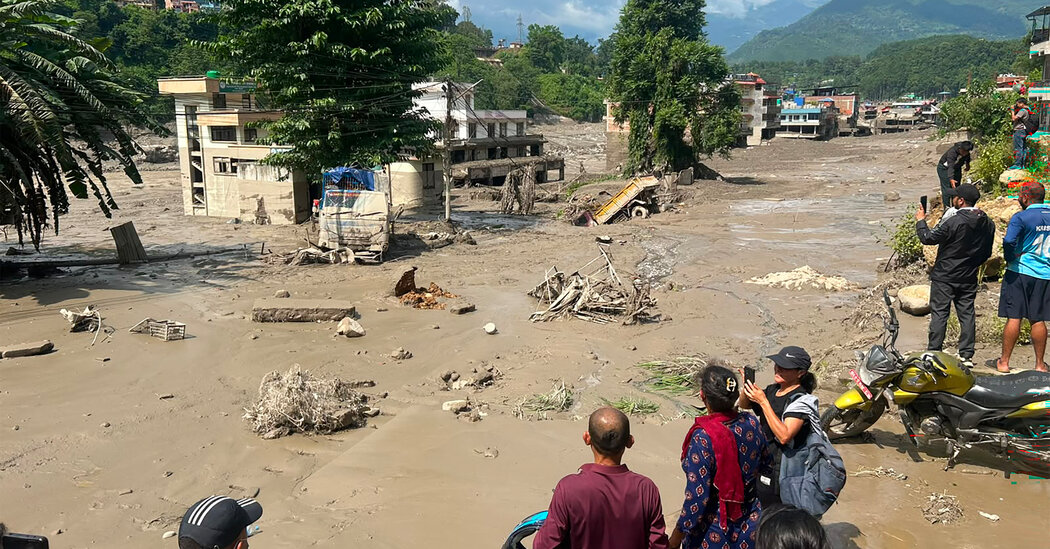
The Nepal China flood disaster has left nearly 3,000 people missing days after a catastrophic wall of water and debris tore through the Himalayan border region. Rescuers on both sides of the frontier are still clawing through thick mud in a desperate search for survivors, even as fears grow over a second wave of flooding from a newly formed lake.
Background
The disaster struck on the morning of August 26, when a sudden torrent of ice, rock and mud swept down from the mountains along the Nepal-China border. The flood hit Nepal’s Rasuwa district and Gyirong County on the Chinese side of Tibet, flattening buildings, sweeping away bridges and burying entire settlements under layers of debris.
Villages near the Bhote Koshi river, known as the Lhende river on the Chinese side, were among the hardest hit. Entire hydropower project sites were damaged, cutting a significant share of Nepal’s electricity supply and trapping workers inside underground tunnels as the water surged through.
Details: The Scale of the Nepal China Flood
By Saturday, official figures from both countries put the number of missing close to 3,000, with 633 bodies recovered so far. Nepal’s disaster authority reported that hundreds of hydropower workers had been added to the missing persons list, alongside trekkers and Hindu pilgrims who were travelling toward Tibet’s sacred Mount Kailash when the flood struck.
More than 3,700 people have already been rescued in Nepal, according to the country’s disaster-management authority, though the number of unaccounted-for people has continued to climb as more local residents are added to the tally. On the Chinese side, state media reported hundreds of people missing in Gyirong, including large numbers of foreign nationals.
Rescue operations have been repeatedly complicated by thick, waist-deep mud that covers entire towns, making even basic movement through the disaster zone extremely difficult for search teams. In Rasuwa, the Nepali army has been working to drill through debris to reach more than 100 workers believed trapped inside a tunnel at the Trishuli hydropower project, with a specialised Indian tunnel rescue unit brought in to assist.
Adding to the danger, a new lake formed high in the mountains after the initial glacial collapse, and experts warned it had begun to overflow. Nepali police issued fresh alerts after receiving reports that a dam on the Tibetan side had burst again, ordering rescue teams to move to safer ground as a precaution.
Quotes From Rescuers and Officials
Kawan Koirala, a rescue worker with the Nepal Scout Disaster Response Team, described the conditions as some of the worst he has ever seen, saying that families simply want their loved ones’ bodies back but that the deep, thick mud is making the search nearly impossible.
Rasuwa’s most senior local official, Narendra Pariyar, said the water level in the river was visibly rising after the barrier lake began to overflow, though it remained unclear exactly how large or how high the lake’s water level had become.
In Gyirong, Chinese rescue team leader Liu Maolin told state broadcaster CCTV that buildings within the mudslide’s impact zone had been almost completely flattened, leaving no recognisable outline of the original structures, though rescue teams said they would not give up as long as any hope remained.
Impact on the Region
The Nepal China flood has affected an area that is home to significant energy infrastructure, with multiple hydropower projects damaged and hundreds of megawatts of electricity supply disrupted. The Red Cross estimated that as many as 93,000 people may have been affected in total, warning that the death toll is likely to rise further as search operations continue.
Survivors who managed to escape say they have lost everything, from homes to basic belongings, and now face an agonising wait to learn the fate of missing family members. Food and water supplies have been reported running low in some of the worst-affected zones, complicating relief efforts alongside the ongoing search for survivors.
The disaster has also had a cross-border and even wider regional impact, with authorities in India recovering bodies believed to have been swept downstream along rivers originating in Nepal, highlighting how the flood’s effects have reached well beyond the immediate border area.
Conclusion
With the missing toll nearing 3,000 and confirmed deaths still rising, the coming days are likely to be critical for rescue teams racing against time, mud and the continued threat of secondary flooding. Both Nepal and China have signalled they intend to continue search operations, even as experts warn that climate-driven glacial instability in the Himalayas makes similar disasters more likely in the future.
Further updates on the death toll, rescue progress and the flood-risk lake are expected in the coming days as authorities assess the full scale of the damage.
Frequently Asked Questions
How did Nepal’s flood happen?
The flood was triggered by a glacial collapse high in the Himalayas near the Nepal-China border, where a mass of ice and rock broke away and slid into a mountain stream. This created a debris-laden torrent that surged into the Bhote Koshi river, catastrophically overflowing its banks and sweeping through villages, bridges and hydropower infrastructure in Nepal’s Rasuwa district. Experts have also pointed to a possible glacial lake outburst as a contributing factor, a phenomenon that is becoming more common across the Himalayas as global warming accelerates glacier melt.
What happened at the Nepal-China border?
The flood struck both sides of the border simultaneously, devastating Nepal’s Rasuwa district and Gyirong County in China’s Tibet region. The Miteri Bridge connecting the two countries was swept away, cutting off a key crossing point, while buildings and infrastructure on both sides were buried under thick layers of mud and rubble. China temporarily paused its rescue operations in the hardest-hit area of Gyirong due to fears of renewed flooding from a newly formed barrier lake, though operations later resumed as the immediate risk eased.
How many have died in Nepal?
As of the latest figures, Nepal’s disaster-management authority reported 626 confirmed deaths, with nearly 2,500 people still unaccounted for. Combined with figures from the Chinese side, the total number of people missing across both countries has climbed close to 3,000. Officials have cautioned that the death toll is likely to rise further as rescue teams continue clearing mud and debris from the affected areas and recover more bodies.