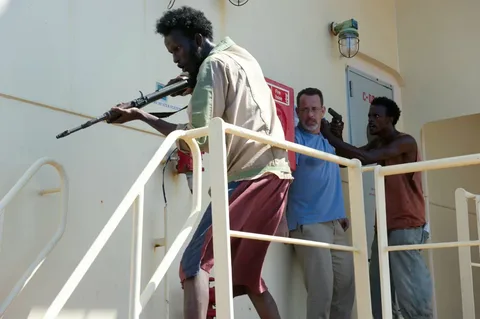
The 2013 film “Captain Phillips” turned a real 2009 hijacking off the coast of Somalia into one of the most talked-about maritime dramas of the decade. More than a decade later, the same waters are making headlines again, as a fresh wave of Somali piracy has left Pakistani sailors held hostage and reignited global concern about the war on piracy.
Background
The original Captain Phillips pirate attack took place on April 8, 2009, when four Somali pirates boarded the American-flagged container ship MV Maersk Alabama in the Indian Ocean. It marked the first time pirates had successfully taken over a US-flagged vessel since the early 1800s, and the incident quickly drew international attention.
The pirates, led by a young man named Abduwali Muse, held the ship’s captain, Richard Phillips, hostage in a lifeboat after the crew managed to retake control of the Maersk Alabama itself. What followed was a tense five-day standoff at sea that ended only after US Navy SEAL snipers intervened, an episode later dramatized in Paul Greengrass’s film starring Tom Hanks.
Modern pirates of the African coast have not disappeared in the years since. Somali piracy declined sharply after 2012 due to coordinated international naval patrols, but it never vanished entirely, and recent years have seen a troubling resurgence tied to instability along Somalia’s coastline and in the wider Gulf of Aden.
Details
In the real Captain Phillips pirate attack, the hijackers first tried to seize the entire ship before Phillips and his crew regained control, forcing the pirates to flee in an enclosed lifeboat with the captain as their hostage. The USS Bainbridge, a US Navy destroyer, tracked the lifeboat for days as negotiators attempted to resolve the standoff peacefully.
The Navy SEALs rescue of Captain Phillips came on April 12, 2009, when three Navy snipers, positioned aboard the Bainbridge, fired simultaneously and killed three of the four pirates holding Phillips at gunpoint. Muse, who had left the lifeboat earlier to negotiate aboard the Navy vessel, was the sole surviving pirate and was later arrested and flown to New York to face trial.
The film’s antagonist, a shore-based pirate commander known in the movie as Garaad, was based loosely on the organizers who financed and directed pirate crews operating from the Somali coast, though public reporting on the real-life figures behind such operations has remained limited compared to the well-documented fate of Muse himself.
Muse pleaded guilty in 2010 to six felony counts, including hijacking, kidnapping, and hostage-taking, and was sentenced in February 2011 to just under 34 years in federal prison. He is currently incarcerated in the United States and is not due for release until 2038.
Searches for Captain Phillips real images and details about Abduwali Muse’s teeth point to lingering public curiosity about the case more than a decade later. That said, most verified reporting on Muse since his sentencing has stuck to his prison conditions and legal appeals rather than his physical appearance.
The Maersk Alabama hijacking helped trigger a major international war on piracy, with naval coalitions from the US, EU, NATO, and other nations deploying warships to patrol the Gulf of Aden and the wider Indian Ocean throughout the following decade, a campaign credited with sharply reducing successful hijackings by the mid-2010s.
Quotes
Colin Wright, a former third officer aboard the Maersk Alabama who testified at Muse’s sentencing hearing, said at the time that the nearly 34-year sentence seemed short given the pain and trauma caused by the hijacking, and given that Muse’s actions had also led to his three accomplices being killed.
US District Judge Loretta Preska, who handed down Muse’s sentence, said the pirates appeared to have relished their most violent acts, adding that a lengthy sentence was necessary to send a clear deterrent message to other would-be hijackers.
More recently, Pakistani rapper Talha Anjum has become a prominent voice highlighting the resurgence of Somali piracy, publicly criticizing his own government’s response after Pakistani sailors aboard the tanker MT Honour 25 were seized by Somali pirates in April 2026. He said the crew members are not just statistics, and that many families are still waiting for real answers about their loved ones.
Impact
The renewed hijackings show that Modern pirates of the African coast remain a real threat to global shipping, even after years of relative calm. The MT Honour 25 hijacking, which saw Somali pirates seize a crew of 17 sailors including 10 Pakistani nationals, has drawn comparisons to the Maersk Alabama case and renewed pressure on governments to respond faster to hostage situations at sea.
For the families involved, the toll has been deeply personal. Relatives of the Pakistani crew have described weeks of uncertainty, limited communication, and frustration with what they see as a slow official response, echoing many of the same emotions Captain Phillips’s own family described during his ordeal in 2009.
Globally, the resurgence has renewed debate over how committed international navies remain to the war on piracy compared to a decade ago, when far larger coalition patrols operated continuously off the Horn of Africa. Naval deployments in the region have shrunk since then, and ongoing instability in Somalia has left gaps that pirate networks seem ready to exploit again.
Conclusion
More than fifteen years after the original Captain Phillips pirate attack, the underlying conditions that produce Somali piracy, poverty, weak governance, and limited law enforcement along the coastline, remain largely unresolved. Cases like the MT Honour 25 hijacking suggest that without renewed international attention, further hijackings involving Modern pirates of the African coast are likely.
For now, advocates like Talha Anjum continue pushing for stronger government support for hostage families, while naval planners weigh whether a larger, more sustained international presence is needed to prevent the war on piracy from becoming an ongoing, unresolved problem once again.
Frequently Asked Questions
Did Captain Phillips actually happen?
Yes, the film is based on a real event: the April 2009 hijacking of the MV Maersk Alabama by four Somali pirates, followed by a five-day hostage standoff and a US Navy SEAL rescue operation that killed three of the pirates and freed Captain Richard Phillips. While the film took some creative liberties, including how it portrayed pirate leader Abduwali Muse’s fate after the hijacking, it stayed largely faithful to the broader timeline of events, the ship’s real crew, and the eventual outcome. Phillips himself later wrote a memoir about the ordeal, which formed the basis for the screenplay.
Did pirates take hostages?
Yes, taking hostages for ransom has long been a central tactic used by Somali pirates, both in the 2009 Maersk Alabama case and in more recent incidents. In the original hijacking, pirates held Captain Phillips alone after the crew retook the ship itself, while more recent cases, such as the 2026 hijacking of the MT Honour 25, have involved pirates holding an entire multinational crew, including Pakistani, Indonesian, Sri Lankan, Myanmar, and Indian nationals, for weeks while negotiating with the ship’s owners for their release.
What did Somali pirates do to Jessica Buchanan?
Jessica Buchanan, an American aid worker, was kidnapped by armed men linked to Somali piracy networks in October 2011 while working in Somalia for a Danish demining organization, along with a Danish colleague. The pair were held captive for three months under harsh conditions before US Navy SEALs, the same elite unit involved in the Maersk Alabama rescue, carried out a nighttime raid that freed both hostages unharmed and killed several of their captors. Buchanan later wrote a memoir about her captivity and rescue, which drew renewed public attention to the broader risks civilians and aid workers face from piracy and kidnapping networks operating along the Somali coast.