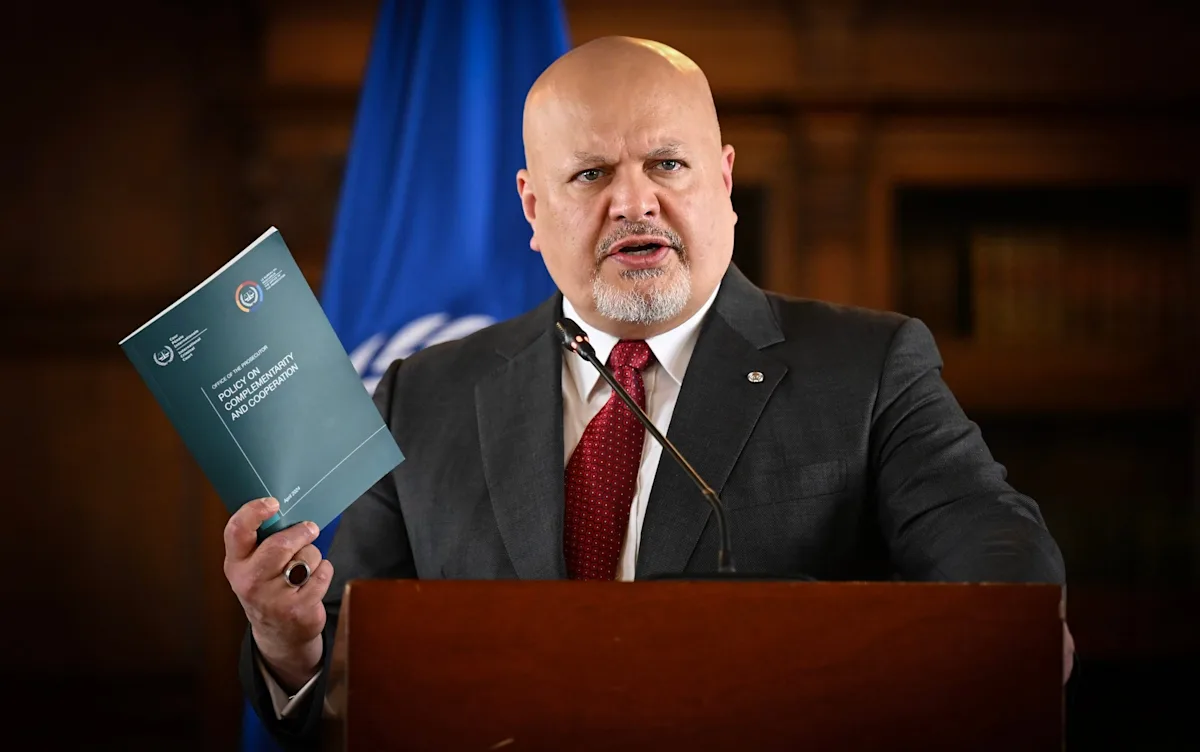
Diplomats from around the world gathered at the United Nations headquarters in New York on Friday for a historic ICC decision today, voting by secret ballot on whether to permanently remove chief prosecutor Karim Khan over sexual misconduct allegations. The vote marks an unprecedented moment in the 20-plus year history of the International Criminal Court.
Background
Karim Khan, a 56-year-old British barrister, has served as the ICC’s chief prosecutor since 2021, overseeing some of the court’s most closely watched investigations, including its case tied to the war in Gaza. He took a leave of absence last year after allegations emerged that he engaged in unwanted sexual contact with a female aide over the course of roughly a year.
Khan has consistently denied any wrongdoing. A judges’ panel that reviewed the allegations reportedly found that Khan did engage in non-consensual sexual contact, but concluded the evidence did not meet the legal threshold required for formal misconduct proceedings, a finding his legal team has pointed to as part of their broader argument against removal.
The case sits against a wider backdrop, since Khan’s office has pursued some of the ICC’s most politically sensitive war crimes cases on record. In 2024, the court issued arrest warrants for Israeli Prime Minister Benjamin Netanyahu and former Defense Minister Yoav Gallant over alleged crimes against humanity, a decision that drew fierce criticism from Israel and the United States and marked one of the ICC cases on war crimes to directly target a sitting leader of a major Western ally.
Details
Friday’s vote requires an absolute majority among the ICC’s 125 member states to remove Khan permanently from his post. He was formally suspended from his duties in June after the court’s executive committee acted on the misconduct findings, and he will not be present at the closed-door meeting himself, since he remains barred from entering the United States after being sanctioned by the Trump administration earlier this year.
The Netherlands, which hosts the ICC in The Hague, has publicly confirmed it will vote for Khan’s removal, according to a letter its foreign minister sent to parliament. France has also announced it will back removal, a significant shift given its position as a permanent UN Security Council member and a key ICC state party.
Khan’s defense team has argued the entire removal process is procedurally flawed and politically motivated, pointing specifically to pressure from the Trump administration’s sanctions. His accuser, identified publicly only as Sarah, has said her original complaint was genuine but has since been used by outside parties pursuing their own political agendas.
Researchers studying international law have noted the unusual political entanglement surrounding the case. Iva Vukusic, a researcher at Utrecht University who has followed the proceedings closely, pointed out that this is the first time an ICC prosecutor has pursued arrest warrants against officials from a major Western ally, adding a layer of political complexity rarely seen in the court’s history.
Khan’s suspension has already affected ongoing cases. The court removed him from handling the case against former Philippine president Rodrigo Duterte in October last year, citing a potential conflict of interest, with deputy prosecutor Mame Mandiaye Niang stepping in to lead that case instead. Niang has himself since been targeted by US sanctions tied to the court’s Gaza investigation.
Quotes
Former EU foreign affairs chief Josep Borrell weighed in ahead of the vote, arguing that the Trump administration and Israeli Prime Minister Netanyahu share a common goal of ensuring no international court can hold soldiers, border agents, or political leaders accountable.
Iva Vukusic told the Associated Press that political considerations have become deeply folded into the case, particularly because it marks the first instance of an ICC prosecutor pursuing warrants against officials from a Western-aligned state.
Khan himself has previously warned publicly against what he called a “sledgehammer approach to justice,” a phrase his defense team has used to characterize the broader campaign they say is driving the push for his removal.
Impact
The outcome of the ICC decision today carries significant weight for the court’s future credibility. A successful removal vote would mark the first time in the ICC’s history that member states have voted out a sitting chief prosecutor, setting a precedent that could shape how future prosecutors approach politically sensitive investigations involving powerful states.
Beyond Khan’s individual case, the vote arrives at a moment when the broader question of how many ICC convictions the court has actually secured remains a point of scrutiny. Since its founding in 2002, the ICC has secured a relatively small number of convictions compared to the number of cases it has opened, a track record critics often cite when questioning the court’s overall effectiveness.
Among the ICC’s most cited convictions are cases like Thomas Lubanga Dyilo, convicted in 2012 for recruiting child soldiers in the Democratic Republic of Congo, and Ahmad Al Faqi Al Mahdi, convicted in 2016 for destroying religious and historic sites in Timbuktu, Mali. These sit alongside a longer list of famous ICC cases still pending, including outstanding arrest warrants for Sudan’s Omar al-Bashir and Uganda’s Joseph Kony, both of whom remain at large years after charges were filed.
Some of the most widely recognized international criminal court cases examples, such as the genocide convictions of Bosnian Serb commander Ratko Mladić, were actually handled by separate UN tribunals like the International Criminal Tribunal for the former Yugoslavia, rather than the ICC itself. That distinction often gets blurred in public discussion of ICC genocide cases.
Conclusion
Whatever the outcome of Friday’s secret ballot, the case has already exposed deep fractures among ICC member states over how to balance judicial independence with accountability for the court’s own leadership. If Khan is removed, the court will need to move quickly to select new leadership capable of steering its most sensitive war crimes investigations forward.
If he survives the vote instead, questions about the process itself, and the political pressure surrounding it, are unlikely to go away, leaving the ICC in an uncomfortable spot regardless of which way the ballot falls.
Frequently Asked Questions
Is the ICC prosecutor suspended?
Yes, Karim Khan has been formally suspended from his duties as ICC chief prosecutor since June 2026, after the court’s executive committee acted on findings from an internal misconduct investigation. He had already taken a voluntary leave of absence roughly a year earlier, once allegations of sexual misconduct against a female aide first became public. Friday’s vote by ICC member states will determine whether that suspension becomes permanent removal from office or whether Khan is eventually reinstated.
Where is Karim Khan now?
Khan’s current location has not been widely publicized, though reporting confirms he is barred from entering the United States after being sanctioned by the Trump administration earlier in 2026, a restriction that prevented him from attending Friday’s removal vote in person at UN headquarters in New York. Khan normally is based at the ICC’s headquarters in The Hague, Netherlands, where the court itself is located, though his suspension means he has not been carrying out his official prosecutorial duties there since stepping aside.
Who is the ICC chief prosecutor?
As of the ongoing removal proceedings, Karim Khan remains the ICC’s formally elected chief prosecutor, though he has been suspended from actively performing the role since June 2026. In his absence, deputy prosecutors have taken over key responsibilities, with Mame Mandiaye Niang notably assuming lead responsibility for the high-profile case against former Philippine president Rodrigo Duterte. If member states vote to remove Khan permanently, the ICC’s Assembly of States Parties would need to begin a new selection process to appoint his successor.