Artificial intelligence clones are moving from science fiction into everyday life, with digital versions of real people now appearing in workplaces, classrooms, medical settings and retail environments.
The technology is attracting growing interest because AI-powered digital doubles can replicate a person’s appearance, voice and interactions. But as these systems become more realistic, concerns are also emerging over privacy, identity theft, misinformation and the possibility of unauthorized clones.
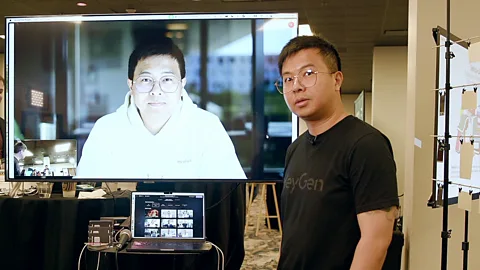
During a recent visit to Los Angeles, technology writer and founder David Nussbaum demonstrated what it is like to meet an AI version of yourself.
Nussbaum, founder and executive chairman of Proto Hologram, stood beside a life-sized digital version of himself that reproduced many of his physical characteristics.
The virtual double featured similar hair, glasses and facial hair and was capable of responding to people in real time.
The demonstration showed how quickly AI technology is advancing beyond simple chatbots and into systems capable of creating interactive digital representations of humans.
Proto Hologram develops interactive, AI-powered holographic projections designed for use in locations such as doctors’ offices, classrooms and retail stores.
During the demonstration, Nussbaum’s digital counterpart appeared behind a transparent panel and used an integrated camera to detect people in front of it.
When asked what it could see, the AI clone responded by describing the people standing nearby in a slightly robotic version of Nussbaum’s voice.
The interaction illustrates how AI clones can combine visual recognition, voice synthesis and conversational AI to create the impression of interacting with a real person.
The technology could eventually allow businesses and individuals to create digital versions of themselves capable of answering questions, delivering presentations or interacting with customers.
For companies, AI clones could potentially operate around the clock without requiring the physical presence of an employee.
However, the rapid development of these systems is also creating difficult questions about who controls a person’s digital identity.
One of the biggest concerns is the creation of unauthorized digital doubles.
If someone’s face or voice can be reproduced using AI, criminals could potentially use a convincing clone to impersonate that person, spread false information or deceive others.
The technology could also create problems in workplaces if digital versions of employees are used without clear consent or if people cannot easily distinguish between a real employee and an AI-generated representation.
AI clones require access to large amounts of information about a person, including photographs, recordings and potentially personal communication patterns.
That raises questions about consent, ownership and data protection.
As the technology becomes more sophisticated, governments and technology companies may face increasing pressure to establish clear rules governing the creation and use of digital replicas.
Despite the impressive demonstrations, AI cloning remains an emerging technology.
Developers are still working to make digital doubles more natural, accurate and useful while addressing concerns surrounding privacy and misuse.
The arrival of increasingly realistic AI clones suggests that the boundary between humans and their digital representations is becoming less distinct — making responsible development and clear safeguards increasingly important.