Pakistan New Provinces Debate: Why Empowering 160 Districts May Be a Better Alternative to Creating 12 Provinces
(By: Mian Iftikhar Ahmad)
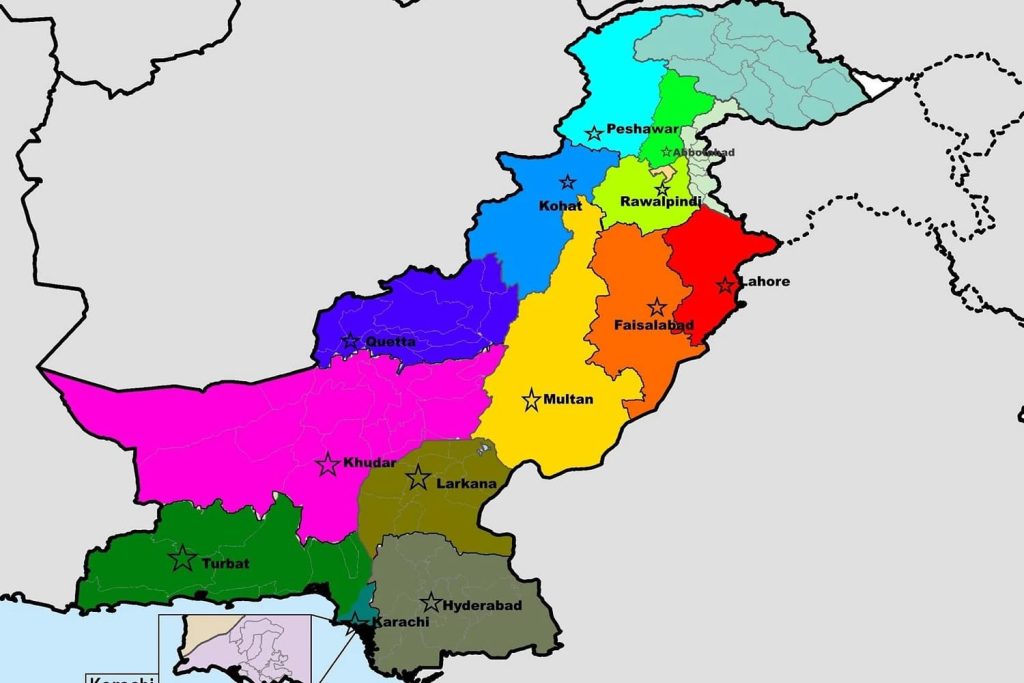
A comprehensive debate has currently erupted across Pakistan’s politics, parliament, and state institutions, which, if implemented, would prove to be the largest administrative and geographical transformation in the country’s history since the 1973 Constitution and the 18th Constitutional Amendment, in a country whose population is approaching roughly 260 million, a proposal is under consideration to divide the existing four provinces into twelve, or twelve to fifteen, new administrative units, under which a blueprint is being presented to divide Punjab into four, Khyber Pakhtunkhwa and Balochistan into three each, and Sindh into two parts, proponents of this proposed change and government circles maintain that the population of Punjab alone has reached approximately 128 million, and governing such a massive population, or geographically vast Balochistan, from a single provincial capital, namely Lahore or Quetta, has now become practically extremely difficult, advancing this debate, federal ministers and government circles argue that after the 18th Amendment, billions of rupees in funds and powers transferred from the federation to the provinces have remained confined within the four major provincial capitals, Lahore, Karachi, Peshawar, and Quetta, and their benefits are failing to reach citizens at the grassroots level, according to the government’s stance, the creation of new administrative units should be purely for administrative efficiency and public convenience rather than on ethnic or linguistic grounds, however, even within the ruling party, Pakistan Muslim League-Nawaz, differing viewpoints and a cautious strategy are visible regarding this matter, while some federal ministers have floated the proposal of twelve to fifteen new provinces, an alternative model of granting complete financial and administrative autonomy to all one hundred and sixty districts of the country has also been put forward, meanwhile, government circles are well aware of the constitutional reality that under Article 239 of the Constitution of Pakistan, establishing any new province or altering boundaries requires a two-thirds majority in both houses of the federal parliament, namely the National Assembly and the Senate, as well as a two-thirds majority vote in the provincial assembly of the concerned province, keeping this constitutional restriction in view, federal government officials have clarified that no unilateral step can be taken without the consent of all coalition partners and a broader national consensus, on the other hand, sharp differences and conflicting interests among the federal government’s coalition partners have openly surfaced on this sensitive issue, the largest ally in the federal coalition, the Pakistan Peoples Party, has emerged as the biggest political and constitutional obstacle to this proposed map, the PPP leadership holds a categorical stance that while it supports making South Punjab and Gilgit-Baltistan separate provinces, the division of Sindh will not be accepted under any circumstances, the Sindh Assembly has already passed a formal resolution rejecting any potential division of Sindh, and PPP leaders state that under constitutional requirements, when the concerned provincial assembly itself refuses, provincial boundaries cannot be altered by the federation or merely through a nationwide referendum, in stark contrast, another key coalition partner, the Karachi-based Muttahida Qaumi Movement-Pakistan, is an enthusiastic supporter of this proposal, and the MQM leadership has long demanded that Pakistan’s economic hub, Karachi, be granted the status of a separate province or distinct administrative unit so that resources generated from the city can be spent on its own development and civic amenities, similarly, the Istehkam-e-Pakistan Party also supports the creation of new provinces, terming it a public necessity, examining the opposition camp reveals deep skepticism and a cautious approach as well, although the past manifestos of Pakistan Tehreek-e-Insaf included support for new provinces on administrative grounds, particularly South Punjab, in the current political climate, the PTI leadership and the opposition alliance have viewed any potential government move with suspicion and demanded an All-Parties Conference, opposition circles fear that under the guise of forming new provinces, the current government wants to alter electoral delimitations and the existing balance in the upper house, the Senate, to its own political advantage, similarly, Jamaat-e-Islami’s principled stance is that new provinces should be created purely on administrative grounds rather than linguistic ones, based on the recommendations of an empowered national commission, though their foremost priority remains the enforcement of an empowered local government system under Article 140-A of the Constitution, meanwhile, Jamiat Ulema-e-Islam-Fazl considers any such constitutional tampering at this time unnecessary and a cause of political instability for the federal structure, furthermore, the reaction from nationalist parties and leaders in Sindh, Balochistan, and Khyber Pakhtunkhwa is intensely sharp, as they are calling this proposed plan a reverse of the 1955 One-Unit experiment, the leadership of the Balochistan National Party, Pakhtunkhwa Milli Awami Party, and Awami National Party has made it clear that they will not accept any plan that breaks historical, cultural, and national units merely to draw administrative lines, leaders of the Pakhtunkhwa Milli Awami Party maintain that if a reorganization of provinces is inevitable, it should be based on linguistic, historical, and geographical grounds rather than carving up existing provinces to further strengthen the center, likewise, Sindhi nationalist parties interpret the division of Sindh as a partition of their historical identity and view it as an attempt to roll back the provincial autonomy achieved under the 18th Constitutional Amendment, thus, on the political front, this issue is no longer just an administrative proposal, but has taken the shape of a major clash between federalism, provincial autonomy, electoral politics, and regional identity, with every stakeholder lined up to protect their political and constitutional interests.
Think-Tank Research, Pros and Cons, and Districts vs. Provinces Comparison
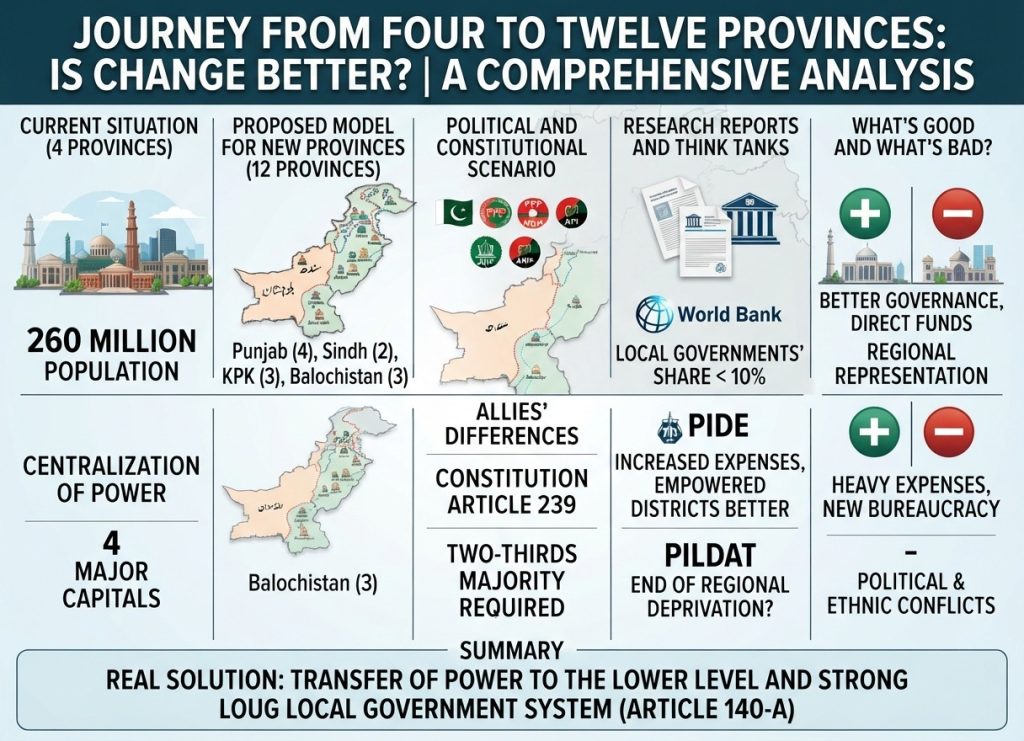
Moving beyond political statements and constitutional debate, when the proposed change in Pakistan’s map is examined in light of reports from domestic and international research institutions, this scenario appears to revolve around economic data and the practical requirements of governance rather than emotional slogans, in recent research reports, the July 2026 report of the World Bank points out a highly important reality according to which the share of local governments in total public expenditure in Pakistan has fallen from ten percent in 2005 to below five percent in 2026, World Bank analysts state that the country’s fundamental problem is not merely a small number of provinces, but fiscal centralization, meaning powers and funds leave the federation and get concentrated in provincial capitals and chief ministers’ offices, failing to devolve to the district, tehsil, or city level, similarly, research by the Pakistan Institute of Development Economics, or PIDE, emphasizes that merely creating new provinces does not automatically improve everyday governance, rather it causes a significant increase in non-development expenditures because structures for new governor houses, chief minister secretariats, provincial assemblies, chief secretaries, police leadership, and high courts have to be built for every new province, according to PIDE research, empowering cities and districts, namely the city-governments and empowered districts model, can prove to be much lower-cost and practically more effective, meanwhile, PILDAT governance reports indicate that a wide gap exists in human development indicators between central Punjab and South Punjab, or among different urban and rural areas of Sindh, which increases public deprivation, while research by the Sustainable Development Policy Institute, or SDPI, indicates that digital governance and monitoring of public services in smaller administrative units can be up to forty percent more effective provided their economic structure is sustainable, in addition, global observers and analysts associated with the World Economic Forum believe that standing up eight new provincial systems would prove to be a severe fiscal test for an economy constrained by strict economic reforms, an IMF program, and heavy debt burdens, when this entire debate is weighed in terms of what would be good and what would be bad, it becomes clear that if twelve provinces are formed, citizens would not have to travel hundreds of kilometers away to Lahore, Karachi, or Quetta for routine administrative tasks and judicial matters, backward areas such as South Punjab, Makran, Hazara, and Thar could receive direct development funds and a separate identity, which could help reduce the local economy’s stagnation and the perception of numerical dominance by a large province, and new regional leadership could also emerge, however, on the contrary, if powers remain confined to the bureaucracy of the new provincial capitals, citizens will get no real relief, billions of rupees in new non-development expenditures on new assemblies and administrative structures could burden the economy, severe disputes could erupt over demarcation of boundaries, distribution of river water, and shares of resources, and the risk of flaring linguistic and ethnic tensions could also arise, in this same context, when a comparative review is conducted between the model of twelve new provinces and the model of granting full financial and administrative powers to the existing one hundred and sixty districts, this reality emerges that for the immediate improvement of everyday public services such as sanitation, drainage, clean drinking water, basic health units, primary schools, and local infrastructure, the model of one hundred and sixty empowered districts is faster, lower-cost, and less controversial because a local government system is already mentioned in Article 140-A of the Constitution and new buildings or provincial assemblies are not required, however, this model also has the weakness that provincial governments and members of assemblies often hesitate to transfer their powers and funds to the lower level, and strong coordination is required for large inter-district projects, on the other hand, the twelve-province model certainly has the potential to alter the broader federal balance and representation of backward regions, but due to the strict requirement of a two-thirds majority under Article 239 of the Constitution, heavy financial cost, and political and ethnic sensitivity, its implementation appears long-term and extremely difficult.
Successful Local Government Systems Around the World, Global Lessons, and the Logical Conclusion of This Debate
If Pakistan reaches the conclusion that instead of, or prior to, a long and complex constitutional battle over new provinces, the existing one hundred and sixty districts and cities should be empowered, the successful local and district experiences of several countries around the world show a clear practical path for Pakistan, the study of global history and modern governance proves that in countries where public services such as sanitation, clean drinking water, sewerage, basic healthcare, education, and local roads improved, powers, financial resources, and public accountability were first transferred to the lowest tier, namely the city, town, district, and neighborhood, a bright example of this is Brazil, and particularly the experience of its city Porto Alegre, where along with giving strong financial and administrative autonomy to municipal institutions, a system of participatory budgeting was introduced, under this system, local citizens and neighborhood committees themselves decided which water, sewerage, road, or school project in their area should be completed first, and the result of this public participation was that citizens’ trust in local government increased, tax compliance improved, and basic facilities reached backward settlements more rapidly, similarly, Japan’s administrative model is also an exemplary precedent where local government autonomy is constitutionally protected, and along with prefectures, city and town municipalities play a central role in education, health, urban planning, and public welfare while maintaining a clear balance between their powers and financial resources, in neighboring India, through the 73rd and 74th Constitutional Amendments, Panchayati Raj at the rural level and municipal corporations at the urban level were linked to formal constitutional status, timely elections, and provision of funds through state finance commissions, bringing the monitoring of local schools, health centers, and urban sanitation closer to public representatives, similarly, in the systems of Sweden and South Africa as well, municipalities and metropolitan councils hold key authority in public expenditure and delivery of civic services, enabling prompt decisions according to local needs, from these global experiences, five core lessons emerge for Pakistan by acting upon which the country’s governance crisis can be resolved, the first lesson is that a mere constitutional clause or paper law is not enough, rather along with powers, funds and practical control of government departments must also be transferred to the district and city level, the second lesson is that just as provinces receive their share from the federation under the NFC Award, similarly the share going from provinces to districts and cities should be transferred on time under the Provincial Finance Commission according to an automatic and transparent formula so that elected mayors and district heads do not remain dependent on provincial bureaucracy, the third lesson is linking local tax collection with civic accountability because when citizens see that their property tax or municipal fee is being spent on the street, sewerage, sanitation, or park of their own neighborhood, the inclination to pay taxes increases and accountability of local leadership is also ensured, the fourth important lesson is establishing a separate and strong city government model for large metropolitan cities such as Lahore, Karachi, Faisalabad, Rawalpindi, Peshawar, and Quetta because the complex problems of large cities cannot be solved through the traditional system of rural districts, and the fifth lesson is equipping local government institutions, alongside granting powers, with modern e-governance, e-tendering, and transparent audit systems so that wastage of resources and corruption at the lower level can be prevented, the overall takeaway of this entire discussion and all political, constitutional, and research aspects is that Pakistan’s real ailment is far more the non-transfer of powers and resources to the lower level than a small number of provinces, in large federal countries of the world, new administrative units and provinces have indeed been formed over time, but there the local government system was first built on strong foundations, therefore, wisdom and statesmanship demand for Pakistan that first, by implementing Article 140-A in its true spirit, financial and administrative autonomy be given to the one hundred and sixty districts and major cities, and if a need for new provinces is felt in the future, it should be taken forward in phases through an impartial national commission, transparent economic feasibility, and broader national consensus rather than political haste or confrontation, because drawing new lines on a map is easy, whereas strengthening institutions and keeping all units of the federation united in confidence is true statecraft.