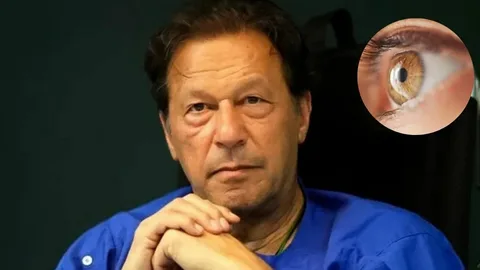
Jailed former Pakistani prime minister Imran Khan has been at the center of fresh headlines after reports confirmed serious damage to his right eye while he remains locked up at Adiala Jail in Rawalpindi. A medical report placed before the Supreme Court this month said his vision has shown marked improvement following treatment, easing some of the alarm that spread after earlier reports described near total loss of sight in one eye. Alongside the health concerns, Imran Khan cases continue to move through Pakistan’s courts, with some convictions overturned and others still keeping him behind bars more than three years after his first arrest.
Background
Imran Khan was removed from the office of prime minister in April 2022 through a no confidence vote in parliament, a move he has always described as a foreign backed conspiracy against his government. He was first briefly detained on May 9, 2023, an event that triggered nationwide riots and a sweeping crackdown on his party. He was arrested again on August 5, 2023, and has remained in custody since that date. Since his imprisonment began, Imran Khan has faced well over one hundred and fifty separate legal cases spanning corruption, leaking official secrets, incitement during protests, and terrorism related charges. His supporters argue the cases were engineered by the military establishment to keep him out of active politics, an allegation the government and army have repeatedly denied. It is against this backdrop that the recent Imran Khan eye condition news has drawn fresh global attention to his prison conditions.
Details
Concerns about Imran Khan’s right eye first became public in February 2026, when a court appointed lawyer, acting as amicus curiae for the Supreme Court, met him inside Adiala Jail and later described him as visibly distressed and wiping his eyes with tissue paper throughout their conversation. The lawyer’s written report told the court that Khan had lost the vast majority of vision in his right eye and had been complaining of blurred and hazy sight since October 2025, months before any meaningful medical attention was arranged. A medical examination dated February 6, 2026, diagnosed the condition as right central retinal vein occlusion, commonly abbreviated as CRVO. This condition occurs when a blood clot blocks the vein carrying blood away from the retina, which can lead to swelling, bleeding, and permanent vision damage if it is not treated quickly. Doctors from a leading government hospital in Islamabad confirmed the diagnosis after examining him inside his prison cell. Following the diagnosis, Khan was taken under guard to the Pakistan Institute of Medical Sciences in Islamabad, where an ophthalmologist carried out a short procedure inside an operating theatre with his consent. The Supreme Court, alarmed by the findings, ordered jail authorities to set up a full medical board to assess his eye and directed that he be allowed a phone call with his two sons, who live in the United Kingdom. Both instructions carried a strict deadline of February 16, 2026. In the months that followed, Adiala Jail authorities submitted repeated updates to the Supreme Court documenting his ongoing treatment. A recent report covering checkups between November 2023 and August 2026 listed thirty nine separate medical consultations by different specialists, along with routine monitoring of his food, water, and daily health. That same report told the court that the affected eye had improved to a condition described as almost normal following the anti VEGF treatment he received. Despite that improvement, Imran Khan’s party, Pakistan Tehreek e Insaf, has continued to reject the framing of these examinations as adequate care. Party leaders say the checkups were conducted behind closed doors, without his personal physicians or family members present, and have formally asked the Supreme Court to allow him to be shifted to a private hospital for treatment by a retina specialist of his own choosing.
Quotes
Barrister Salman Safdar, the amicus curiae appointed by the Supreme Court, told the court in his written submission that any further delay in treatment posed a serious risk to Khan’s wellbeing and recommended an immediate independent examination involving Khan’s own doctors. He also noted in his report that Khan appeared deeply distressed during their meeting, describing his eyes as watery throughout the two hour conversation. A PTI lawmaker, speaking at a rally held to protest the handling of Khan’s treatment, said the party was demanding that a panel of doctors chosen by Khan himself be allowed to examine and treat him, rather than relying solely on jail appointed physicians. Jail superintendent reports submitted to the Supreme Court, meanwhile, have consistently maintained that Khan is examined regularly by government doctors and that his food and health are checked multiple times each day.
Impact
The reports around Imran Khan’s eye condition have added a humanitarian dimension to what was already one of the most closely watched political and legal sagas in South Asia. Human rights organizations, including groups that have already raised concerns about his prolonged solitary style confinement, pointed to the delayed medical response as evidence of inadequate prison healthcare for high profile detainees. This has amplified international scrutiny of Pakistan’s judicial and prison systems at a moment when the country is already dealing with intense political polarization. Domestically, the health update has reenergized PTI’s street mobilization, with supporters holding rallies in multiple cities calling for his release and for unrestricted access to doctors of his choosing. Political analysts note that while individual case outcomes continue to shift in his favor, such as suspended or overturned convictions, his overall release is likely to depend on a broader political understanding between his party and the country’s powerful military establishment, rather than on courtroom decisions alone.
Regarding Imran Khan Cases
Imran Khan’s legal troubles remain layered and complicated even after several partial victories in court. He is currently serving a fourteen year sentence in the Toshakhana case, which centers on allegations that he illegally sold state gifts received during his time in office and concealed details of those transactions from official records. His wife, Bushra Bibi, received a seven year sentence in the same case. In December 2025, both Khan and his wife were handed an additional seventeen year sentence in a separate case connected to state gifts, a ruling that added significantly to the time he is expected to spend behind bars if the conviction stands on appeal. At the same time, Khan has secured relief in some of the cases against him. In January 2025, he was acquitted in the cipher case, which had accused him of mishandling a classified diplomatic cable, as well as in a case tied to his marriage under Islamic Iddat rules. Beyond these headline cases, Khan continues to face numerous other proceedings connected to the violent protests that followed his May 2023 arrest, along with a further wave of cases stemming from a PTI led demonstration in November 2024. Appeals against several of his convictions remain pending before higher courts, meaning his legal status could shift again in the coming months depending on how those appeals are decided.
Conclusion
For now, Imran Khan remains in custody at Adiala Jail, with his right eye reported to be recovering under continued medical supervision even as his party pushes for independent treatment and broader access to family and lawyers. The Supreme Court bench overseeing his health and prison conditions is expected to keep monitoring the situation closely, and further hearings are likely in the weeks ahead as the court weighs whether existing arrangements at the jail are sufficient or whether more decisive intervention is required. The coming months are likely to bring several parallel developments rather than a single resolution. On the medical side, the court appears set to keep demanding regular updates on his right eye and overall health, and PTI is expected to continue pressing for outside specialists to be involved directly in his care rather than relying solely on jail appointed doctors. Any sign of relapse or renewed vision loss would almost certainly trigger another wave of urgent hearings and public pressure, given how closely this issue has already been tracked by rights groups and international media. On the legal front, the pending appeals against his corruption related convictions and the more recent state gifts case are the developments most likely to shape his actual release timeline. A favorable ruling in any of these appeals could shift the picture quickly, much as the earlier acquittals in the cipher and Iddat cases did. At the same time, observers following Pakistani politics caution that formal court outcomes may not be the only factor at play, since the broader standoff between PTI and the military establishment continues to hang over almost every stage of this process. Whether the recent improvement in his vision translates into any change in his overall detention, or whether his numerous pending appeals eventually lead toward his release, remains uncertain and will depend heavily on decisions still to come from Pakistan’s higher courts, alongside how the political relationship between his party and the state evolves in the months ahead. Readers following this story should expect incremental updates rather than a single dramatic turning point, with the Supreme Court’s ongoing oversight likely to remain the most consistent source of new information in the near term.
Frequently Asked Questions
What is the new update about Imran Khan?
The most recent update concerns a detailed medical report submitted by Adiala Jail authorities to the Supreme Court of Pakistan, which stated that Imran Khan’s right eye, previously affected by a serious blood clot condition known as central retinal vein occlusion, has shown significant improvement and is now close to a normal condition following months of specialized treatment. The report also laid out a long history of medical checkups conducted since November 2023, listing thirty nine separate consultations by different specialists over that period, along with information about how often his food, water, and general wellbeing were checked by jail medical staff. Alongside the health details, the report also covered his meetings with family members and legal representatives inside the jail, including confirmation that his wife has been allowed a weekly visit under existing jail rules. This update follows several months of serious concern after earlier reports, including one from a court appointed lawyer who met him in person, suggested Khan had lost a very large portion of vision in that eye due to delayed medical action, with some accounts putting his remaining sight in the affected eye as low as fifteen percent. The Supreme Court had responded to those earlier reports by ordering an urgent medical board and setting strict deadlines for treatment, and the latest report is essentially the court receiving confirmation that those directions were followed and that his condition has since stabilized and improved considerably.
What is the condition of Imran Khan now?
According to the latest jail authority report placed before the Supreme Court, Imran Khan’s right eye has improved considerably after receiving specialized treatment, including a short procedure carried out at a government hospital in Islamabad under his own consent. He continues to undergo regular medical checkups, with jail officials stating that his food, water, and general health are monitored multiple times each day and that records of every consultation are being maintained and shared with the court whenever requested. The report described the affected eye as having returned to what officials called an almost normal state, a notable shift from the alarming picture painted by earlier submissions to the court. His party, however, maintains that the true state of his health cannot be fully confirmed without independent doctors of his own choosing being allowed to examine him directly, arguing that checkups conducted solely by government appointed physicians behind closed doors do not offer the same level of assurance or transparency. PTI has continued to press the Supreme Court for greater medical access, including a formal request that he be shifted temporarily to a private hospital in Islamabad so that a retina specialist selected by his own family can assess and confirm his current condition, a request that remains under consideration by the court.
Where is Imran Khan now today?
Imran Khan remains incarcerated at Adiala Jail in Rawalpindi, the high security prison where he has been held continuously since his arrest on August 5, 2023, making this more than three years of uninterrupted detention. He is currently serving sentences connected to corruption related cases involving state gifts, most notably the Toshakhana case and a separate case from December 2025 that added a further lengthy sentence, while several other cases against him continue to move through Pakistan’s courts on appeal with outcomes still pending. His wife, Bushra Bibi, is being held on related charges arising from the same set of cases, and the couple is permitted limited scheduled meetings under jail rules, including a weekly visit that has now taken place on dozens of occasions since his imprisonment began. Beyond those family visits, his legal team and the court appointed amicus curiae have also been granted periodic access to discuss both his ongoing cases and his medical treatment, though PTI leaders continue to describe his overall living conditions inside the jail as isolating and in need of further court oversight.