The Pakistan Cricket Board has announced its PCB central contracts 2026/27 list, naming 38 men’s cricketers under a completely redesigned structure. The announcement was made on Saturday at Gaddafi Stadium in Lahore. The new deals run from November 1, 2026 to June 30, 2027.
The biggest change is that the old A to D grading ladder is gone. Contracts are now divided by the formats a player is expected to play. Several well known names, including Mohammad Rizwan, Shan Masood and Saim Ayub, are missing from the list.
Background: Why the Board Changed the System
The previous cycle covered 30 players and ended in June. That list was already controversial because no player was placed in the top category and senior names such as Babar Azam and Rizwan were moved down. Many fans and analysts felt the grading system rewarded reputation more than current role.
Since June, a number of players have had no central contract at all. The board has now moved to a model that links each deal to a player’s expected role. The idea is to give cricketers and the team management a clearer picture of who is being prepared for which format.
Details: How the Five Track Contract Structure Works
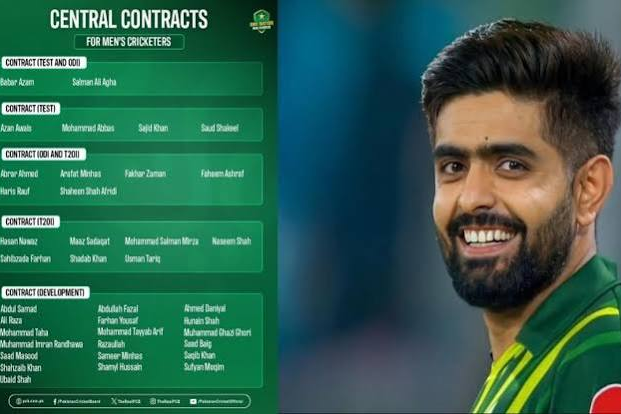
Under the new central contract system, players fall into five tracks. The AB track covers Test and ODI players, while A is for Test specialists. BC covers ODI and T20I cricketers, C is for T20I players, and D is the development track for emerging talent.
The full list includes eight more players than last season. The development track alone has 19 cricketers, which shows how strongly the board wants to build depth. Notably, no player has been given a deal covering all three formats.
Babar Azam and Salman Ali Agha are the only two players contracted for both Tests and ODIs. The Test specialist group includes Azan Awais, Mohammad Abbas, Sajid Khan and Saud Shakeel. The ODI and T20I group features Abrar Ahmed, Fakhar Zaman, Faheem Ashraf, Haris Rauf and Shaheen Shah Afridi, among others.
The T20I only track includes Naseem Shah, Shadab Khan, Sahibzada Farhan and Hasan Nawaz. In the development category, Tayyab Arif, Mohammad Taha, Ghazi Ghori and Saqib Khan stand out because they recently featured in the Test series against Sri Lanka. Readers can follow that series in our Pakistan vs Sri Lanka second Test report from Rawalpindi.
Who Missed Out on the List
The most discussed omissions are former captain Mohammad Rizwan, Shan Masood and Saim Ayub. Other notable names left out include Hasan Ali, Abdullah Shafique, Mohammad Haris, Mohammad Nawaz, Noman Ali, Hussain Talat, Khurram Shahzad, Abbas Afridi and Mohammad Wasim Jnr.
Missing out on a contract does not end a career. The board has clarified that players outside the list can still be picked for national duty. Even so, the absence of such experienced names will keep the debate alive among supporters.
Official Statements: What the PCB Said
Aaqib Javed, a selection committee member and the board’s director of high performance, explained the thinking behind the Pakistan cricket central contracts list. He said the goal was to reward players who are already active across all three formats, along with those the selectors and head coach expect to play a particular format by the end of June next year.
He also stressed that a contract is not a guarantee of selection. According to him, the categories will not stop players from featuring in other formats or taking part in franchise leagues. He gave Babar’s involvement in the International League T20 as an example of a commitment that remains unaffected.
Head coach Mike Hesson said the model gives players clearer roles and helps the management plan preparation. He pointed out that many Pakistan players are still in a development phase after recently entering international cricket. He added that the team is working to shrink its selection pool to around 20 players through multi team matches in Multan and the upcoming ODI Cup.
On Shaheen Shah Afridi, Hesson welcomed his return to regular first class cricket and confirmed that talks had taken place about his red ball role. Shaheen has been contracted for ODIs and T20Is for now. Test specialists who take on extra commitments will be encouraged to prioritise four day cricket.
Impact: What This Means for Pakistan Cricket
The new structure could change how Pakistan builds its squads. By linking deals to formats, the board is trying to create specialists instead of keeping the same group in every team. This may help bowlers and batters focus on one skill set and manage workload better.
Money and responsibility have also been adjusted. The board has increased player remuneration, although it did not reveal the percentage. Match fees are doubled for wins against higher ranked opponents, and contracted players who appear in domestic four day cricket will receive half the Test match fee. Fitness testing and domestic participation are now part of contract obligations.
For young cricketers, the development track is a clear opening. For senior players left out, it is a challenge to return through performance. Rizwan’s recent domestic form and the ongoing talk around Babar’s game, including our look at Babar Azam bowling and the allrounder debate, show how closely the public follows every selection move.
Conclusion
The PCB central contracts 2026/27 mark a clear break from the past. The board has chosen role clarity, youth development and domestic accountability over the old grading model. Whether this plan produces better results will depend on how the players perform in the coming months.
The next signs will come from the domestic season, the multi team matches in Multan and the ODI Cup. Selectors have said the door remains open to players outside the list. For more cricket coverage, visit the Pakistan Chronicle sports section.
Frequently Asked Questions
How many players received PCB central contracts for 2026/27?
The board has awarded contracts to 38 men’s cricketers, which is eight more than the previous cycle. Of these, 19 players are in the new development category. The contracts are valid from November 1, 2026 to June 30, 2027, so they cover the main part of the coming international and domestic calendar.
What is new in the PCB central contract system this year?
The old A, B, C and D grading has been replaced by five tracks based on formats. These are AB for Test and ODI players, A for Test specialists, BC for ODI and T20I players, C for T20I players and D for developing talent. The aim is to give players clear roles instead of ranking them mainly by salary levels.
Which players are contracted for both Tests and ODIs?
Babar Azam and Salman Ali Agha are the only two cricketers who have been contracted for both Tests and ODIs. No player has been given a deal that covers all three formats. Several other players have been placed in two format groups, such as ODI and T20I, which reflects how selectors plan to use them in the months ahead.
Does a player without a central contract lose the chance to play for Pakistan?
No. The board has said that central contracts do not guarantee selection, and the reverse is also true. Players who are not on the list remain eligible for national duty if they perform well. This includes Mohammad Rizwan, who was specifically mentioned as being available for selection despite not receiving a contract this time.
Can contracted players still play franchise leagues and other formats?
Yes. Aaqib Javed clarified that the contract categories do not stop players from appearing in other formats or taking part in franchise leagues. Test specialists who accept extra playing commitments will be encouraged to give priority to four day cricket. Players must also meet fitness testing and domestic participation requirements under their agreements.