
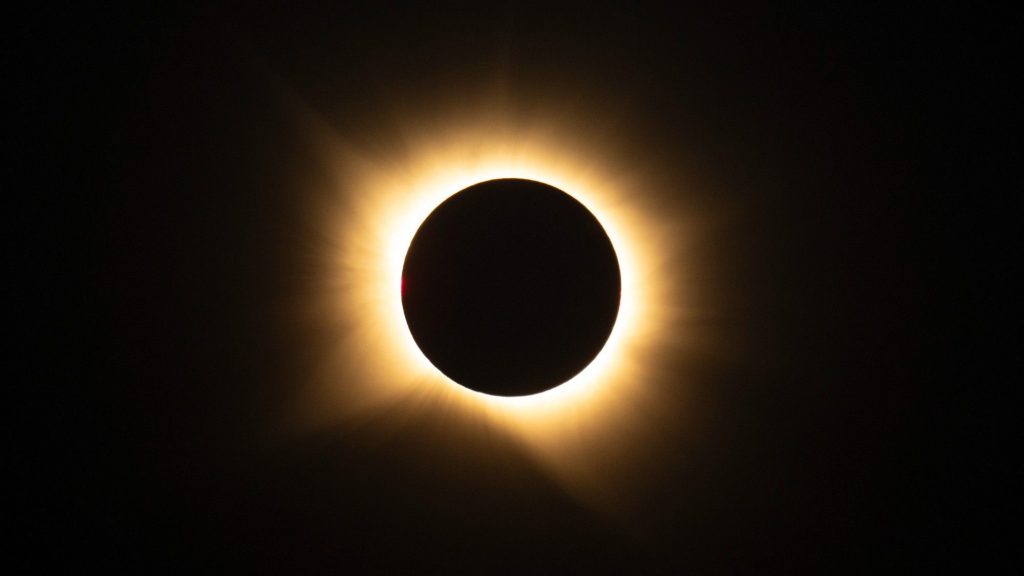

Spain witnessed a rare celestial spectacle on Wednesday evening as the total solar eclipse 2026 path swept across the northern half of the country, turning daylight into darkness for over a minute in several major cities. It was the first total solar eclipse to touch mainland Europe since 1999, and the first ever recorded over Spanish soil in more than a hundred years.
Crowds gathered on rooftops, beaches, and hillsides from Galicia to the Balearic Islands to catch a glimpse of the moon completely blocking out the sun, an event astronomers and casual skywatchers alike had been anticipating for months.
Background of the Total Solar Eclipse 2026 Path
A total solar eclipse happens when the moon passes directly between the Earth and the sun, briefly covering the sun’s disc entirely and casting a shadow across a narrow strip of the planet’s surface. This particular eclipse began far to the north, moving across the Arctic Ocean, Greenland, and Iceland before curving down toward the Iberian Peninsula.
Because the eclipse arrived so close to sunset over Spain, it produced an especially dramatic effect, with the sky darkening low on the horizon rather than overhead. Spain also sat right at the tail end of the eclipse’s path, which made the viewing window shorter but no less striking for the millions who stepped outside to watch.
Total Solar Eclipse Spain 2026 Timing and Route
The total solar eclipse Spain 2026 timing varied slightly depending on location, but totality generally struck the country between roughly 8:27 pm and 8:32 pm local time. The path of totality entered Spain through Galicia, moving from west to east across the northern half of the peninsula.
Cities including A Coruña, Oviedo, Santander, León, Bilbao, Zaragoza, Valencia, and Palma de Mallorca all fell within the direct path and experienced full totality. Totality lasted longest in places like León and Burgos, stretching close to two minutes, while cities such as Bilbao saw a much shorter window of under thirty seconds.
Madrid and Barcelona, notably, sat just outside the path of totality. Residents in both cities still witnessed well over 99 percent of the sun covered, producing a near-total darkening effect even without a full blackout.
Total Solar Eclipse Spain 2026 Map and Location
According to the total solar eclipse Spain 2026 map released by Spain’s National Geographic Institute, the band of totality cut diagonally across thirteen autonomous communities. The shaded strip on the total solar eclipse 2026 map ran from the northwest coast through central-northern Spain and out toward the Balearic Islands, giving a clear total solar eclipse Spain 2026 location reference for skywatchers planning their viewing spots.
Regions outside that narrow band still saw a partial eclipse, with the percentage of coverage dropping the further a location sat from the central path. The Canary Islands, for instance, saw the sun’s disc covered by somewhere between 66 and 74 percent.
Several observatories and science outlets also published a solar eclipse 2026 interactive map ahead of the event, allowing people to type in their city and check exact timing down to the minute. These digital tools proved especially popular in the days leading up to the eclipse as interest in the event spread quickly across social media.
Expert and Official Reaction
Astronomers described the event as a once-in-a-generation opportunity for European observers. Officials involved in Spain’s eclipse preparations had spent months coordinating public safety guidance, reminding the public repeatedly that looking directly at the sun without certified eclipse glasses can cause permanent eye damage, even during the partial phases.
Tourism authorities in northern Spain reported a sharp uptick in visitors ahead of the eclipse, with hotels in towns along the path of totality filling up weeks in advance. Scientific teams, including researchers coordinating a global livestream, set up equipment in rural locations near Burgos to capture the moment for a wider international audience.
Impact of the Eclipse
Beyond the spectacle itself, the eclipse carried real economic and scientific weight for Spain. Astro-tourism brought a noticeable boost to towns along the path, many of which organized public viewing events, festivals, and educational programs in the run-up to the big day.
Scientifically, the eclipse gave researchers a valuable window to study the sun’s corona, the faint outer atmosphere that only becomes visible to the naked eye during totality. Data gathered during these brief minutes can help scientists better understand solar activity and space weather patterns that affect satellites and communication systems back on Earth.
The event also renewed public interest in astronomy across Spain and much of Europe, with schools and science museums using the eclipse as a teaching moment for younger audiences.
What Comes Next: Solar Eclipse Spain 2027
The excitement is far from over. A solar eclipse Spain 2027 is already on the calendar, with a total solar eclipse expected on August 2, 2027. That path will shift further south, crossing southern Spain before continuing on toward North Africa and reaching as far as Saudi Arabia and Yemen.
A third eclipse in this remarkable run will follow on January 26, 2028, an annular eclipse visible from Portugal and Spain. Together, astronomers have nicknamed this run of three consecutive events the “Iberian trio,” a rare stretch that places Spain at the center of Europe’s eclipse-watching community for three years running. After that, the country will not see another total solar eclipse until 2053.
Conclusion
Wednesday’s total solar eclipse 2026 path gave Spain a rare front-row seat to one of nature’s most striking phenomena, drawing crowds across the northern half of the country and reviving international attention on astro-tourism in the region. With two more eclipses already scheduled for 2027 and 2028, Spain looks set to remain a focal point for skywatchers well into the next decade.
FAQs
Which countries will see the solar eclipse in 2026?
The August 12, 2026 total solar eclipse followed a path crossing the Arctic Ocean, Greenland, and Iceland before reaching northern Spain and the extreme northeastern edge of Portugal, where totality was visible. As a partial eclipse, it was also seen across a much wider stretch, including northern parts of North America, most of Europe, and western Africa, though observers in these areas witnessed the sun only partially covered rather than a full blackout.
Where in Europe will the solar eclipse be visible?
Spain was the primary European country to experience full totality during this event, with the path crossing thirteen autonomous communities from Galicia in the northwest through to the Balearic Islands in the east. Iceland also fell within the path of totality, making it the first time the country had seen a total eclipse since 1954. The rest of mainland Europe experienced a partial eclipse, with visibility and coverage percentage varying depending on how close each location sat to the main path.
What time is the solar eclipse in Spain?
Totality moved across Spain roughly between 8:27 pm and 8:32 pm local time on August 12, 2026, though exact timing shifted slightly by city. Galicia was among the first regions to experience totality, while the Balearic Islands marked the final stretch of the path before the eclipse moved out over open water.