

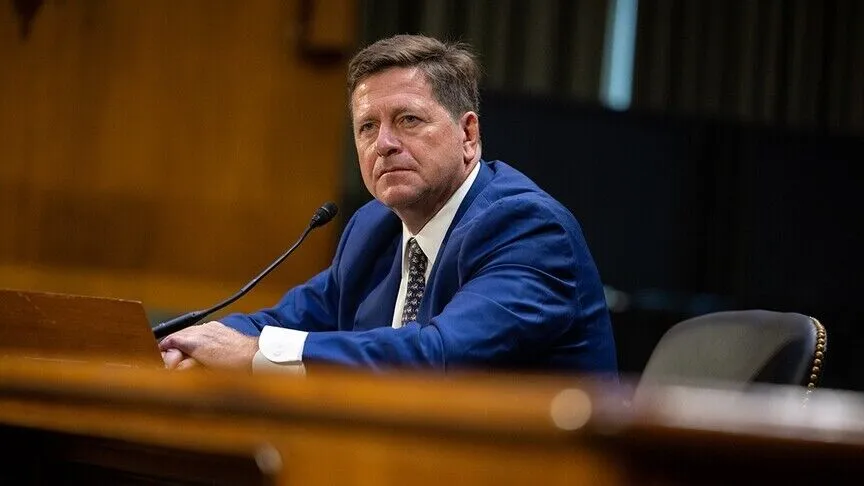

The US Senate confirmed Jay Clayton as President Donald Trump’s director of national intelligence on Tuesday, placing the former securities regulator in charge of America’s 18-agency intelligence community. The 51-47 party-line vote ended weeks of uncertainty following a contentious confirmation hearing.
Background
Jay Clayton’s path to the nation’s top intelligence post is unusual by historical standards. He built his career mainly as a corporate lawyer and financial regulator rather than through military, diplomatic, or intelligence service, which is part of why people keep searching for Jay Clayton’s education, career, and personal background.
Clayton served as chairman of the Securities and Exchange Commission from 2017 to 2020 during Trump’s first term, where he focused on modernizing market regulation and expanding investment opportunities for retail investors. He later returned to government service in 2025 as US Attorney for the Southern District of New York, one of the most prominent federal prosecutor posts in the country.
Trump nominated Clayton for director of national intelligence in June 2026, following the resignation of previous DNI Tulsi Gabbard. The role had been filled on an interim basis by Bill Pulte, a housing finance official whose brief tenure was marked by multiple rounds of staff cuts and public controversy.
Details
Anyone searching Jay Clayton Wikipedia entries or biography pages will find a resume shaped heavily by Wall Street rather than Washington’s usual national security pipeline. Born Walter Joseph Clayton III in Newport News, Virginia, he built an academic record that combined engineering, economics, and law long before entering public service.
Jay Clayton’s education included a Bachelor of Science in Engineering from the University of Pennsylvania, earned summa cum laude, followed by a BA and MA in Economics from the University of Cambridge as a Thouron Scholar. He then completed a Juris Doctor at the University of Pennsylvania Law School, graduating cum laude and earning membership in the Order of the Coif.
Before entering government, Clayton spent more than two decades at law firm Sullivan & Cromwell, where he advised major companies including Goldman Sachs, Volkswagen, and SoftBank on mergers, securities offerings, and regulatory matters. He worked on high-profile deals such as Alibaba’s initial public offering and the sale of the Atlanta Hawks.
Jay Clayton’s net worth has drawn scrutiny given his rapid rise to a top national security post. Financial disclosures place his family’s net worth between $10 million and $50 million, built largely through decades of high-paying private legal work, investment income, and property holdings that include residences in Manhattan, Philadelphia, and the New Jersey shore.
On Jay Clayton’s wife, records show he is married to Gretchen Butler Clayton, a Virginia native who worked as a wealth manager at Goldman Sachs before stepping down shortly after her husband’s 2017 Senate confirmation as SEC chairman, a move made to avoid potential conflicts of interest. Detailed public information about Jay Clayton’s children remains limited, as the family has largely kept their personal life out of the media spotlight throughout his years in government.
Questions about Jay Clayton’s political party affiliation have also circulated, though he has not been widely reported as a formally registered party member in the way many career politicians are. He has instead built his public profile through Republican-appointed government posts under Trump, and his confirmation votes have consistently split along party lines, with Republicans supporting him and Democrats opposed. Similarly, no detailed public reporting addresses Jay Clayton’s religion, and he has not spoken publicly on the subject during his confirmation hearings or previous government service.
Quotes
Trump celebrated the confirmation on Truth Social, writing that Clayton was “outstanding in every way” and would do a “spectacular job as Director.”
Senate Majority Leader John Thune praised Clayton’s background ahead of the vote, saying that amid a heightened threat environment, having a proven leader in the role was especially important and that Clayton fit that mold.
Senate Intelligence Committee Vice Chair Mark Warner offered a more cautious assessment, saying Clayton now had both the opportunity and the responsibility to demonstrate that intelligence work would remain independent from political pressure.
Impact
Clayton inherits an intelligence community still adjusting to leadership turnover and controversial staff reductions carried out under his predecessors. His confirmation also unlocks progress on Section 702 of the Foreign Intelligence Surveillance Act, a surveillance authority that lapsed weeks earlier amid a standoff between the parties.
The Jay Clayton Epstein connection has added an additional layer of scrutiny to his appointment. As US Attorney for the Southern District of New York, Clayton oversaw an office long associated with the prosecution of Jeffrey Epstein and Ghislaine Maxwell, and he faced criticism after federal prosecutor Maurene Comey, who had worked on the Epstein and Maxwell cases, was fired from the office. Reports also indicated Clayton sought to unseal Epstein-related grand jury records amid public pressure over the case.
His confirmation hearing further exposed friction over his responses regarding the 2020 election, where he repeatedly described Joe Biden as having been “certified” as president rather than directly affirming that Biden won, a distinction Democrats argued raised concerns about his willingness to resist political pressure in his new role.
Conclusion
With Clayton now confirmed, attention turns to how he manages an intelligence community still shaken by recent leadership changes, and to whether his tenure eases tensions over surveillance authority reauthorization. Lawmakers on both sides say his handling of politically sensitive matters, including the ongoing Epstein-related scrutiny, will shape how his independence is judged in the months ahead.
Frequently Asked Questions
Who is Trump’s head of intelligence?
Jay Clayton is President Trump’s current director of national intelligence, confirmed by the Senate in July 2026 following his nomination earlier that summer. He succeeded Tulsi Gabbard, who resigned from the post, and interim director Bill Pulte, a housing finance official who briefly held the role and drew criticism over mass staff reductions. Clayton previously served as chairman of the Securities and Exchange Commission during Trump’s first term and, more recently, as the US Attorney for the Southern District of New York, giving him a background rooted in financial regulation and federal prosecution rather than traditional intelligence work.
Who is the director of national intelligence?
The director of national intelligence is the head of the United States intelligence community, a position created after the September 11, 2001 attacks to improve coordination and information-sharing across the country’s 18 intelligence agencies. As of Jay Clayton’s July 2026 confirmation, he now holds this position, overseeing agencies such as the CIA, NSA, and FBI’s intelligence functions from a central coordinating role within the executive branch. The position requires Senate confirmation and reports directly to the president on matters of national security and foreign intelligence.
Who is Trump’s CIA director?
The CIA director is a distinct position from the director of national intelligence, though both work closely together within the broader intelligence community structure. The director of national intelligence, currently Jay Clayton, oversees and coordinates across all 18 intelligence agencies, while the CIA director specifically manages the Central Intelligence Agency’s own operations and personnel. For the most current information on who specifically holds the CIA director position, readers should check the latest official announcements, since cabinet-level and agency leadership appointments can change through nominations, confirmations, or resignations over the course of an administration.