

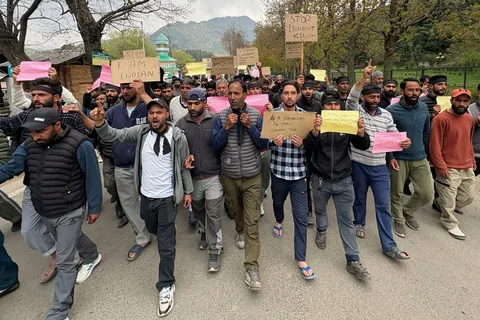

On 22 April 2025, a deadly terrorist attack struck Pahalgam in Indian-administered Jammu and Kashmir, killing 26 civilians, mostly tourists. The attack sparked a crisis between India and Pakistan, drawing international attention as both countries adopted diplomatic and military measures in response.
India wasted no time in pointing fingers at Pakistan, making sweeping allegations without presenting any verified or credible evidence. Islamabad categorically denied any involvement and demanded a fair, independent investigation into the tragic incident.
The Pakistani government, through its Ministry of Foreign Affairs, responded swiftly and firmly. The Pakistan statement on the Kashmir attack made one thing crystal clear Islamabad will not be blamed for something it had no hand in, and it will not back down in the face of unsubstantiated Indian pressure.
Pakistan’s Official Statement on the Kashmir Attack
Pakistan’s MOFA issued a formal Pakistan statement on India, rejecting what it called baseless, inflammatory, and politically motivated accusations. The MOFA spokesperson stated clearly that “till date, India has not been able to produce any credible and verifiable evidence of Pakistan’s involvement in the attack,” and once again rejected any attempt to link the Pahalgam attack to Pakistan.This MOFA Kashmir statement was not just a denial. It was a comprehensive rebuttal of India’s narrative, backed by facts and grounded in international law. Pakistan also raised serious questions about India’s intentions, calling the entire episode a dangerous attempt to manufacture a pretext for military aggression.
Pakistan’s MOFA further noted that “the world knows that India attacked Pakistan without any verifiable evidence or a credible investigation into the Pahalgam Attack.” These are not the words of a defensive government they are the words of a state that believes it is being targeted unjustly and is ready to defend its position before the entire world.
Pak Deputy PM Statement: Ishaq Dar Addresses the World
Deputy Prime Minister and Foreign Minister Senator Mohammad Ishaq Dar stepped forward to deliver Pakistan’s position directly to the international community, including diplomats, foreign ministers, and global media.
The Pak Deputy PM statement was unambiguous. He briefed Islamabad-based ambassadors from across the world on the sequence of events following the Kashmir attack. He stated that “on 26 April 2025, the Prime Minister of Pakistan proposed a transparent and independent probe into this tragic incident through neutral investigators,” but India chose to ignore this constructive offer and instead pursued a path of belligerence and aggression.
Senator Dar also invoked the UN Charter in his Pak Deputy PM statement, asserting that Pakistan, in accordance with Article 51, reserves the right to respond to any aggression at a time and place of its choosing. He made clear that Pakistan is committed to defending its sovereignty and territorial integrity with full force if necessary.
In his address to the diplomatic corps, the Deputy PM reaffirmed that “Pakistan remains committed to peaceful resolution of disputes and issues with India, but will not compromise on the existential rights of its people.”
India Launched Strikes Pakistan Responded
The situation escalated dramatically when India refused to pursue the diplomatic path. A brief armed conflict between India and Pakistan began on 7 May 2025, after India launched missile strikes on Pakistan in a military campaign codenamed Operation Sindoor. India said the operation was in response to the Pahalgam attack in Indian-administered Jammu and Kashmir.
Pakistan did not stand idle. Prime Minister Shehbaz Sharif declared that “Pakistan has every right to respond forcefully to this act of war imposed by India, and a forceful response is being given.” The Pakistani military confirmed that it was responding both from the air and on the ground.
India and Pakistan agreed to a ceasefire on May 10, after three days of military operations and as the countries stood on the precipice of war. The crisis between the two nuclear-armed countries demonstrates how rapidly tensions can escalate to dangerous levels
Kashmir PM and Regional Leadership Speak Out
Beyond Islamabad, the broader Kashmir Pakistan leadership and voices from across the political spectrum joined in condemning India’s behavior. The Kashmir PM and political leadership in Azad Jammu and Kashmir rallied behind Pakistan’s stance, calling on the international community to treat Kashmir Pakistan as a genuine human rights and political dispute, not simply a bilateral security matter.
The Kashmir PM’s office echoed the sentiments expressed by Islamabad, urging the United Nations and global powers to revisit the unresolved status of Jammu and Kashmir and push for implementation of long-standing international commitments.
MOFA Kashmir: Pakistan’s Consistent Position at Every Forum
Pakistan’s MOFA Kashmir position has remained rock-solid for decades. Every year, at every international platform from the United Nations General Assembly to the Human Rights Council Pakistan’s foreign policy leadership raises the issue of Kashmir with clarity and conviction.
Pakistan has repeatedly stated that it “will continue to draw attention to the grave human rights violations by the Indian occupation forces in the Indian Illegally Occupied Jammu and Kashmir (IIOJK).”
This MOFA Kashmir posture is not reactive it is strategic, principled, and deeply rooted in international law. Pakistan believes that the people of Kashmir have been denied their right to self-determination for over seven decades, and that silence on this issue would be a betrayal of both international norms and human rights.
Kashmir Pakistan: A Dispute That Cannot Be Buried
The Kashmir Pakistan relationship goes back to the very foundation of both nations in 1947. When British India was partitioned, the fate of Jammu and Kashmir was left undecided, and that unresolved question has defined South Asian geopolitics ever since.
As Deputy PM Ishaq Dar stated on Kashmir Black Day 2025: “The recent hostilities between Pakistan and India have once again demonstrated how the Indian intransigence on the Jammu and Kashmir dispute and its defiance of international law pose a grave threat to peace and stability in South Asia. It is in the shared interest of all regional states and the international community that the dispute be peacefully and urgently resolved in accordance with the UN Security Council resolutions.”
Pakistan’s position on Kashmir Pakistan has always been one of principle that Kashmiris deserve to choose their own future through a free and fair plebiscite, as promised by the international community decades ago.
Kashmir Dispute: A Wound That Has Never Healed
The Kashmir dispute is often called the world’s most dangerous unresolved territorial conflict, and for good reason. Two nuclear-armed nations have fought multiple wars over it, and tensions continue to flare regularly. The human cost for ordinary Kashmiris living under military occupation has been enormous.
Pakistan’s Foreign Ministry has noted that “the human tragedy in IIOJK has even worsened in the last six years following India’s illegal actions,” referring to New Delhi’s decision in August 2019 to revoke the special constitutional status of Jammu and Kashmir.That move was widely condemned internationally, and Pakistan raised its voice at every global forum in response. The Kashmir dispute today is not just about land it is about millions of people whose voices have been suppressed, whose rights have been violated, and whose political future remains in the hands of an occupying force.
List of UN Resolutions on Kashmir
The list of UN resolutions on Kashmir is one of the strongest arguments in Pakistan’s diplomatic arsenal. These resolutions are not symbolic they are binding decisions of the United Nations Security Council, adopted at a time when India itself had approached the UN seeking international mediation.
The UN Security Council Resolution of 21 April 1948 one of the principal UN resolutions on Kashmir stated that “both India and Pakistan desire that the question of the accession of Jammu and Kashmir to India or Pakistan should be decided through the democratic method of a free and impartial plebiscite.” Subsequent UNSC resolutions reiterated the same position.
Here is a key list of UN resolutions on Kashmir that Pakistan cites regularly in its diplomatic arguments:
- Resolution 39 (1948) — Called for a ceasefire and established the UN Commission for India and Pakistan (UNCIP)
- Resolution 47 (1948) — Addressed the dispute between India and Pakistan concerning the State of Jammu and Kashmir and established a framework aimed at restoring peace and determining the future status of the territory through a democratic process, including a free and impartial plebiscite
- UNCIP Resolution of 13 August 1948 — Called for a ceasefire and outlined a phased plan for demilitarization
- UNCIP Resolution of 5 January 1949 — Reaffirmed the right of the people of Jammu and Kashmir to determine their future through a plebiscite
- Resolution 80 (1950) — Continued to press for implementation of earlier resolutions
- Resolution 91 (1951) — Reaffirmed the commitment to a free and impartial plebiscite
- Resolution 96 (1951) — Urged continued efforts toward a resolution
- Resolution 122 (1957) — Reaffirmed that the final disposition of Kashmir must be determined by the will of the people
Pakistan has always remained committed to the sanctity and centrality of these UN Security Council resolutions on Jammu and Kashmir, consistently emphasizing the critical role of the international community in securing a just and lasting solution to this long-festering dispute.
India’s refusal to honor this list of UN resolutions on Kashmir, resolutions it once helped draft, remains one of the most glaring contradictions in its foreign policy posture.
Global and Regional Impact
The Kashmir attack and its aftermath sent shockwaves far beyond South Asia. Both countries engaged in tit-for-tat diplomatic moves, including cancelling visas for each other’s nationals, as war rhetoric intensified and the two sides exchanged fire across the Line of Control.
The crisis reminded the world that the Kashmir dispute is not a frozen conflict it is a live, dangerous, and deeply human problem that can spiral into full-scale war between two nuclear powers with alarming speed. The international community, including the United Nations, the United States, and regional organizations, scrambled to push both sides back from the brink.
Pakistan’s MOFA emphasized that the responsibility for de-escalation must not fall only on Islamabad’s shoulders. India’s refusal to pursue neutral, transparent investigation mechanisms, and its decision to launch military strikes, were actions that endangered not just South Asia but the entire world.
Conclusion: Pakistan Will Not Back Down
Pakistan’s position on the Kashmir attack is grounded in evidence, international law, and decades of principled diplomacy. From the Pakistan statement on India to the Pak Deputy PM statement, from MOFA Kashmir press briefings to the President’s address at the United Nations, every official voice in Islamabad has delivered the same message with unwavering consistency.
Pakistan has reaffirmed its “unwavering political, moral and diplomatic support to the just struggle of Kashmiri people” and pledged to “continue to raise its voice at every international forum until the realization of Kashmiris’ legitimate right to self-determination.The Kashmir dispute will not be resolved through military strikes or political pressure. It will only be resolved when the international community finds the courage to enforce the list of UN resolutions on Kashmir that it passed over seven decades ago. Until that day, Pakistan’s commitment to the Kashmir cause to Kashmir Pakistan will not waver.
Frequently Asked Questions (FAQs)
What did Jinnah say about Kashmir?
Muhammad Ali Jinnah, the founder of Pakistan, famously called Kashmir the “jugular vein” of Pakistan, and he believed deeply that the Muslim-majority state had a natural and rightful place within the newly born nation. He argued that under the logic of the two-nation theory — the very basis upon which British India was partitioned a Muslim-majority state like Jammu and Kashmir should have acceded to Pakistan rather than India. Jinnah pursued the Kashmir case diplomatically and pushed for it to be brought before the United Nations, where Pakistan successfully obtained Security Council resolutions calling for a free and impartial plebiscite. He passed away in September 1948, before the Kashmir question could be resolved, but his words about Kashmir being Pakistan’s lifeline have shaped Pakistani foreign policy and national consciousness for generations. Even today, Pakistani leaders quote Jinnah’s vision when speaking about the Kashmir dispute at international forums.
Why does Pakistan want Kashmir?
Pakistan’s desire for Kashmir is rooted in history, religion, geography, and international law, and it cannot be reduced to a simple territorial ambition. The overwhelming majority of the population in Jammu and Kashmir is Muslim, and at the time of partition in 1947, Pakistan’s founders believed that this majority made Kashmir’s accession to Pakistan logical and just under the two-nation theory. Beyond the religious and cultural dimensions, Pakistan also has critical strategic and water security interests in the region the rivers that flow through Kashmir and into Pakistan are lifelines for its agriculture and population. Additionally, Pakistan points to the binding list of UN resolutions on Kashmir, which clearly establish that the people of Kashmir were promised a plebiscite to decide their own future, a promise India has refused to honor.
What is the current status of the Kashmir conflict?
The Kashmir conflict remains one of the most dangerous and unresolved territorial disputes in the world, with no political settlement in sight as of 2025. The situation worsened dramatically following India’s decision in August 2019 to revoke the special constitutional status of Jammu and Kashmir, a move Pakistan and many international observers condemned as illegal. In April and May 2025, the conflict entered a new and extremely dangerous phase when a terrorist attack in Pahalgam, Indian-administered Kashmir, killed 26 civilians and triggered a military standoff between India and Pakistan that nearly escalated into full-scale war. India launched missile strikes on Pakistan under Operation Sindoor, Pakistan responded militarily, and a ceasefire was brokered on May 10, 2025.