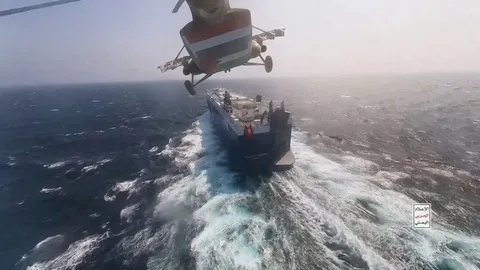
Yemen’s Iran-backed Houthi group launched a major missile and drone strike on two Saudi oil tankers in the Red Sea on July 22, 2026, marking one of the most serious escalations in the region this year. The tankers, named Encelia and Layla, were struck after the Houthis declared a full maritime blockade on Saudi Arabia just two days earlier. The attacks have sent shockwaves through global energy markets and raised serious fears about the safety of one of the world’s most critical shipping routes.
Background: Who Are the Houthis and Why Are They Fighting?
The Houthis, officially known as Ansar Allah, are a Yemeni Shia armed movement that has controlled large parts of northern Yemen, including the capital Sanaa, since 2014. They are backed politically, financially, and militarily by Iran and have been engaged in a brutal conflict with a Saudi-led coalition for over a decade.
The group originally launched their maritime campaign in late 2023, targeting ships they claimed were linked to Israel in response to the war in Gaza. Those attacks on Red Sea shipping caused massive disruption to global trade, forcing hundreds of vessels to reroute around Africa. The campaign was eventually paused after a Gaza ceasefire was announced last October, but the current US-Iran conflict has triggered a dangerous new chapter of Houthi attacks in 2026.
The Houthi Blockade: What Happened and Why
On July 20, 2026, the Houthis officially declared a naval blockade on Saudi Arabia. Their military spokesperson announced it as a direct retaliation, using the phrase “an eye for an eye,” following what they described as a Saudi airstrike on Sanaa’s international airport that was meant to prevent an Iranian official from landing.
“The Houthis disrupted global commerce when they began attacking ships around the Bab al-Mandeb Strait following the launch of Israeli attacks on Gaza in 2023,” Al Jazeera noted, adding that the group has now expanded its targets to include Saudi-flagged and Saudi-linked vessels.
The Houthis declared they would “no longer permit Saudi Arabian ships passage through the Red Sea into the Bab el-Mandeb Strait,” effective immediately upon the announcement. The Bab el-Mandeb is one of the world’s most critical chokepoints a narrow 29-kilometer-wide passage between Yemen and the Horn of Africa connecting the Red Sea to the Gulf of Aden.
Experts warned that a closure of the Bab el-Mandeb Strait could halt Saudi oil exports to Asia while slashing global oil supply by around seven percent. That is not a small number. It means roughly one in every fourteen barrels of oil moving globally could disappear from the market if the blockade is fully enforced.
Houthi Attacks Today: Encelia and Layla Struck by Missiles and Drones
On July 22, the Houthis made clear the blockade was not just a warning. They struck.
Houthi military spokesperson Yahya Saree announced: “We targeted two Saudi oil tankers, named Encelia and Layla, for their violation of the blockade decision issued by the armed forces.” The Saudi Press Agency confirmed that the Encelia was hit, stating all crew members were safe.
The Houthis claimed on Telegram that “the operation involved a number of ballistic and cruise missiles, as well as drones,” adding that “the strikes were accurate and caused a large fire on both vessels.”
The UK Maritime Trade Operations center, which monitors shipping in the region, separately confirmed that a tanker had been struck by an unknown projectile that caused a fire onboard, with crew members working to bring it under control. According to Saudi authorities, the attacks constitute a clear “violation of international laws and conventions that guarantee the safety of commercial vessels and their crews.”
Traffic data from Kpler showed that shipping movement “declined sharply across both chokepoints on July 21, with Strait of Hormuz crossings down 31 percent day-on-day and Bab al-Mandeb down 34 percent,” as vessel operators became increasingly cautious.
Houthi Attacks Red Sea Timeline: From 2023 to 2026
Understanding today’s crisis requires looking at how this campaign developed over the years. Here is a clear timeline of major Houthi attacks on ships in the Red Sea:
Late 2023 — The Campaign Begins
Following the outbreak of the Israel-Gaza war in October 2023, the Houthis began targeting commercial vessels they claimed were connected to Israel. Within weeks, they had attacked over fifteen ships in the southern Red Sea, using drones, anti-ship missiles, and sea-based explosives.
2024 — Attacks Peak, Global Shipping Reroutes
The attacks intensified throughout 2024, with dozens of vessels struck. Major shipping companies began avoiding the Red Sea entirely, rerouting around the Cape of Good Hope at enormous cost. In July 2025, Houthis attacked MV Eternity C, a bulk carrier, with sea drones and rocket-propelled grenades. The vessel was seriously damaged, abandoned, and sank. Four Filipino crew members were killed.
September 2024 — Saudi Tankers Targeted
US Central Command confirmed the Houthis attacked two crude oil tankers, the MV Blue Lagoon I and the Saudi-flagged MV Amjad, using ballistic missiles and drones in the southern Red Sea.
October 2025 — Attacks Paused
Following the Gaza ceasefire announcement, the Houthis declared a pause in their maritime campaign. Global shipping cautiously began returning to Red Sea routes.
July 2026 — The New Escalation
Iran-backed Houthi rebels in Yemen, who had been attacking commercial ships in the Red Sea from 2023 through 2025, resumed their campaign. This time, the targets are no longer just Israel-linked ships Saudi Arabia has become the primary focus, with the Houthis enforcing a declared blockade using missiles, drones, and armed skiffs.
Missiles and Drones Deployed at Bab el-Mandeb
The latest Houthi attacks today are being backed by a significant weapons deployment.
Houthi militants have deployed missiles and drones near the Bab el-Mandeb Strait, the Joint Maritime Information Center confirmed, citing sources close to the group. Several tankers with Saudi cargo turned around before even reaching the strait.
The Joint Maritime Information Center stated that “sources close to the group indicated the Houthis have completed preparations to attack shipping, including the deployment of missiles and drones” near the Bab el-Mandeb’s southern end of the Red Sea.
This is not a bluff. The infrastructure for attack is in place, and the strikes on the Encelia and Layla today are the opening shots of what could be a prolonged campaign against Saudi shipping.
Quotes: What Officials and Experts Are Saying
Houthi Military Spokesperson Yahya Saree declared on July 22:
“We targeted two Saudi oil tankers named Encelia and Layla for their violation of the blockade decision issued by the armed forces. The operation involved ballistic and cruise missiles as well as drones, and the strikes caused large fires on both vessels.”
Saudi Press Agency, citing the Saudi Transport General Authority:
“These attacks constitute a violation of international laws and conventions that guarantee the safety of commercial vessels and their crews.”
Houthi Armed Forces Statement on the Blockade:
“A maritime embargo against the criminal Saudi enemy, based on the equation of ‘an eye for an eye’, effective immediately.”
A Houthi Supporter at the Sanaa Rally, speaking to Democracy Now:
“The decision is wise in response to the Saudi aggression and its blockade. They have blockaded us for 12 years. So we say to them: a blockade for blockade, airports for airports and ports for ports.”
Global and Regional Impact: Why the World Is Watching
The consequences of the latest Houthi attacks today go well beyond Yemen or even the Middle East. Here is what is at stake for the rest of the world:
Global Oil Supply Threat
By stopping Saudi oil exports to Asia, the Houthi blockade could reduce global oil supply by 7 percent, according to Reuters calculations. In a world already rattled by the ongoing US-Iran conflict and the effective closure of the Strait of Hormuz, losing another major oil corridor would have immediate and severe consequences for fuel prices worldwide.
Energy Market Turbulence
Confirmed maritime attacks around the Strait of Hormuz and now the Bab el-Mandeb are “reinforcing concerns that uncertainty across both regional chokepoints could reshape routing decisions, increase freight costs, and sustain higher geopolitical risk premiums for energy markets,” according to Kpler.
Saudi Arabia’s Exposure
Saudi Arabia had been diverting millions of barrels of oil per day through pipelines to its Yanbu port on the Red Sea in an effort to minimize energy shortages caused by hostilities in the Persian Gulf. Now, with the Houthis targeting the Bab el-Mandeb route as well, Riyadh’s options are shrinking fast.
The Wider US-Iran War
Today’s Houthi attacks are not happening in isolation. The escalation came after one of the deadliest periods in the war for US troops, with the Pentagon identifying soldiers killed in an Iranian strike on a base in Jordan. The US has now bombed Iran for ten consecutive nights, and the Houthis as Iran’s most active regional proxy are widening the battlefield by targeting Saudi shipping and threatening a chokepoint that affects the entire world.
The Bab el-Mandeb has become even more important for Saudi Arabia now that the Strait of Hormuz has been effectively closed off by the US-Iran war. Any Houthi blockade will rattle energy markets already shaken by that war and will likely raise energy prices further.
Shipping Industry Response
Vessels are already turning back. Two oil tankers carrying Saudi crude to Asia reversed course in the Red Sea on Tuesday after threats from Yemen’s Iran-aligned Houthis, as a widening Middle East conflict disrupted shipping through two of the world’s most critical energy chokepoints.
What Comes Next: The Road Ahead
The situation as of July 22, 2026 remains deeply unstable. The Houthis have demonstrated both the will and the capability to follow through on their blockade. Saudi Arabia and its coalition partners have promised a forceful response. The United States, already stretched across multiple fronts in its war with Iran, may be forced to return to active naval operations in the Red Sea as it did during the height of the 2023-2025 Houthi campaign.
Iran had pressed the Houthis to close the Bab el-Mandeb gateway to the Red Sea if the US continued to attack Iranian power infrastructure. That pressure appears to have worked. With diplomatic contacts still active but fragile, the next 48 to 72 hours will be critical in determining whether this escalation leads to a full-blown maritime war in the Red Sea, or whether back-channel negotiations can pull both sides back from the edge.
What is certain is that the world’s shipping lanes, energy markets, and regional security are all hanging in the balance.
Frequently Asked Questions (FAQs)
What are Houthis fighting for?
The Houthis, formally known as Ansar Allah, are an Iran-backed Yemeni Shia rebel movement that has been fighting for political and religious control of Yemen since the mid-2000s. They seized the capital Sanaa in 2014 and have been at war with a Saudi-led coalition ever since. The group frames its struggle as a fight against what it calls Saudi and Western imperialism, Zionism, and the corrupt Yemeni government. In recent years, they have also positioned themselves as a front-line defender of Palestinians, using the Gaza conflict as justification for their attacks on international shipping. Their goals are both ideological rooted in Zaidi Shia political theology and strategic, aiming to secure Yemen’s northern territories, gain international recognition, and assert Iran’s regional influence through proxy warfare.
Why did the US attack the Houthis?
The United States began striking Houthi targets in Yemen in response to a relentless campaign of attacks on commercial and military vessels in the Red Sea that began in late 2023. The Houthis targeted ships they claimed were linked to Israel in retaliation for the war in Gaza, but their missiles and drones frequently struck vessels with no Israeli connection whatsoever, endangering international crews and disrupting a waterway that carries roughly twelve to fifteen percent of global trade. US strikes were initially framed as defensive operations to protect freedom of navigation and deter further attacks. In 2026, with the US engaged in a broader conflict with Iran, the strikes on Houthi targets have intensified as part of a wider campaign against Iranian proxy forces across the region.
Did the Houthis attack Saudi Arabia?
Yes, and they have done so repeatedly over the course of the Yemen conflict, which began in 2015. The Houthis have fired hundreds of ballistic missiles and drones at Saudi cities, airports, military installations, and oil facilities over the years. In 2019, they carried out a dramatic strike on Saudi Aramco’s oil processing facilities at Abqaiq and Khurais, temporarily knocking out about five percent of global oil supply. They have also attacked Saudi oil tankers in the Red Sea on multiple occasions, including in 2018, 2024, and now again in July 2026. The most recent attack on July 22, 2026 targeted the Saudi oil tankers Encelia and Layla, causing fires on both vessels using ballistic missiles, cruise missiles, and drones. The Houthis declared a full maritime blockade on Saudi Arabia on July 20, 2026, calling it retaliation for what they described as Saudi aggression against Yemen, including a strike on Sanaa airport.