
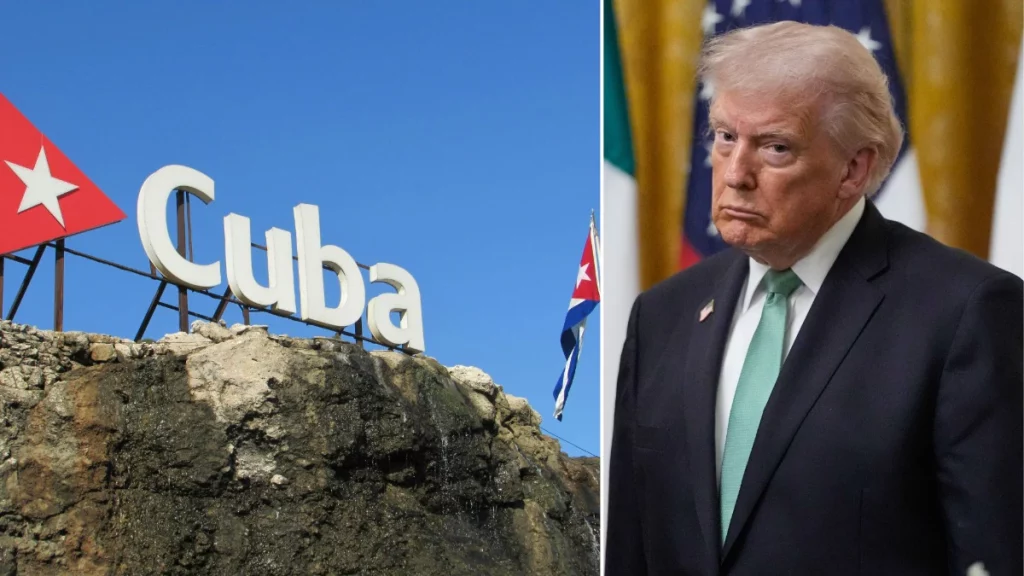

Trump and Cuba are at the center of a major geopolitical storm. The U.S. Department of Justice indicted former Cuban President Raúl Castro on May 20, 2026, in connection with the 1996 downing of civilian aircraft. President Trump called it a “very big day” while ruling out any military escalation against the island nation.
Background: Why Is Trump After Cuba?
The current Trump-Cuba conflict did not begin overnight. Since returning to the White House, President Trump has taken an aggressive stance toward the communist-run island. Cuban Trump tensions began escalating in January 2025, when the administration kept Cuba on the U.S. State Sponsors of Terrorism list.
The U.S.-Cuba relationship has been strained for over six decades. Washington severed diplomatic ties with Havana in 1961 following Fidel Castro’s communist revolution. While President Obama briefly reopened relations, Trump reversed those moves during his first term and has come back stronger in his second.
Cuba’s government has long aligned itself with countries the U.S. considers hostile, including Russia and China. This geopolitical positioning is a key reason why Trump Cuba tensions continue to dominate headlines.
The Trump Cuba Executive Order: A National Emergency Declared
The Trump Cuba executive order story began in earnest on January 29, 2026, when President Trump signed Executive Order 14380. The order declared a national emergency, stating that Cuba’s actions posed “an unusual and extraordinary threat” to U.S. national security and foreign policy.
This Trump Cuba emergency order gave Washington the power to impose tariffs on any country that supplies oil to Cuba a move designed to strangle the island’s already collapsing economy.
Then on May 1, 2026, Trump escalated further by signing Executive Order 14404, titled “Imposing Sanctions on Those Responsible for Repression in Cuba and for Threats to United States National Security and Foreign Policy.” This Cuba executive order created an entirely new sanctions architecture, targeting:
- Cuban government officials and military figures
- Foreign companies operating in Cuba’s energy, defense, and financial sectors
- Foreign banks that process transactions with sanctioned Cuban entities
The May executive order on Cuba also introduced secondary sanctions, meaning non-U.S. banks could lose access to American financial markets if they continue doing business with Cuban government entities.
Breaking News Cuba Today: Raúl Castro Indicted
In breaking news Cuba watchers were not fully expecting, the U.S. Department of Justice on May 20, 2026, unveiled a 27-page federal indictment against former Cuban President Raúl Castro, now 94 years old, and five other Cuban nationals.
The charges stem from the February 24, 1996 shootdown of two unarmed civilian planes operated by the Cuban-American exile group Brothers to the Rescue. The indictment includes:
- Conspiracy to kill U.S. nationals
- Destruction of aircraft
- Four counts of murder
Cuban military MiG jets shot down the planes over international waters, killing three U.S. citizens and one U.S. resident. Cuban officials have historically denied ordering the attack, but U.S. lawmakers including Florida representatives Maria Elvira Salazar and Carlos Gimenez — have long pressed for accountability.
This is some of the most significant Trump Cuba news today, and it marks a historic escalation in U.S. legal action against the Cuban government.
What Does Trump Want from Cuba?
So, what does Trump want from Cuba exactly? The answer is multifaceted. Trump has floated the idea of a “friendly takeover” of Cuba on multiple occasions, including as recently as May 2026. His administration has confirmed that regime change in Cuba is an active policy goal.
More specifically, the Trump administration wants:
- An end to communist rule and transition to democratic governance
- Cuba to stop hosting foreign adversary intelligence operations targeting the U.S.
- Cuba’s cooperation on counterterrorism the island was criticized for non-cooperation
- Freedom for political prisoners held by the Cuban regime
- Cuba to cut ties with Russia, China, and other U.S. adversaries
Secretary of State Marco Rubio, whose family fled Cuba, has been a driving force behind the administration’s Cuba policy. CIA Director John Ratcliffe also reportedly visited Cuba just days before the Castro indictment was announced.
Trump Speaks Out: “No Escalation” After Castro Indictment
Despite the dramatic legal move, President Trump told reporters at Joint Base Andrews that he did not expect military escalation. When asked whether Cubans should brace for further pressure, Trump replied:
“No, there won’t be escalation. I don’t think there needs to be. Look, the place is falling apart. It’s a mess, and they’ve sort of lost control.”
Trump praised Acting Attorney General Todd Blanche for the indictment and said the U.S. has “Cuba on our mind very important.” He called the indictment “a very big moment” for Cuban Americans and those who wish to return to their homeland.
Trump also added that the U.S. has many people operating inside Cuba, including CIA personnel, and hinted that behind-the-scenes efforts are ongoing.
Impact: What This Means for Cuba and the World
The Trump Cuba emergency and the Castro indictment send a clear message not just to Havana, but to the world. Here is the broader impact:
On Cuba: The island is already suffering a severe economic crisis marked by food shortages, medicine scarcity, fuel deficits, and daily power blackouts. The tightening Cuba executive order and new sanctions risk pushing Cuba deeper into collapse.
On Foreign Banks: Any financial institution outside the U.S. that continues processing payments for Cuba’s sanctioned entities now risks being cut off from U.S. markets. This creates enormous global pressure.
On Russia and China: Both countries have maintained ties with Cuba. The Trump Cuba emergency order implicitly warns them that supporting Havana has costs.
On Cuban Americans: The Castro indictment has been celebrated in Miami’s Cuban exile community as a long-awaited act of justice. Trump’s moves enjoy strong political support among this key voting bloc.
On Latin America: The Cuban Trump standoff signals that Washington is willing to use aggressive economic and legal tools throughout the hemisphere, following its actions in Venezuela.
Conclusion: What Comes Next in Trump-Cuba Relations?
The Trump Cuba relationship is entering uncharted territory. With a Cuba executive order declaring a national emergency, secondary sanctions targeting global banks, and now a federal indictment of a 94-year-old former head of state, the U.S. has raised the stakes dramatically.
Cuba’s government, already weakened and facing internal unrest, has limited options. Whether the pressure leads to regime change, negotiation, or deeper crisis remains uncertain.
What is clear is that for the Trump administration, Cuba is not just a regional issue it is a national security priority, a political symbol, and a test of American resolve. As Trump himself said: “We have Cuba on our mind.”
FAQs
Why don’t the U.S. have relations with Cuba?
The U.S. severed diplomatic relations with Cuba in 1961 after Fidel Castro’s communist revolution. Washington imposed a trade embargo, and Cuba’s alignment with the Soviet Union deepened the divide. While President Obama briefly restored limited ties in 2015–2016, Trump reversed much of that progress. Cuba remains on the U.S. State Sponsors of Terrorism list, making full normalization extremely difficult.
Why is Cuba so LGBT friendly?
Cuba’s shift toward LGBT rights has been gradual and notable for a communist state. Mariela Castro, daughter of Raúl Castro, championed LGBT causes within the government for years. Cuba legalized same-sex marriage in a 2022 referendum. However, human rights groups note that political freedoms remain severely restricted even as social policies have liberalized.
Who is Cuba’s biggest trading partner?
Cuba’s biggest trading partners include Venezuela, China, Spain, Canada, and Russia. Venezuela has historically supplied Cuba with oil in exchange for Cuban medical workers. However, Venezuela’s own crisis and U.S. sanctions pressure have disrupted this relationship. China remains an important economic partner, which is one reason the Trump administration views Cuba as a strategic concern.