
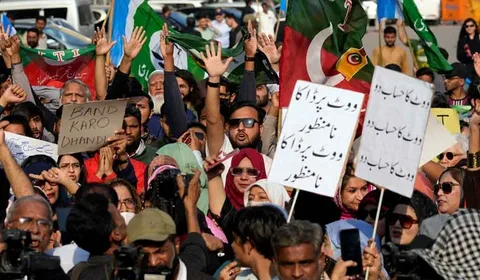

The political situation in Pakistan today has taken a dramatic turn after Khyber Pakhtunkhwa Chief Minister Sohail Afridi and Imran Khan’s sister Aleema Khan alleged that shots were fired at sit-in participants near Islamabad’s Chungi No. 26. The incident has intensified the already fragile political instability in Pakistan, with PTI announcing fresh countrywide protests. The current political situation of Pakistan reflects a deepening confrontation between the ruling coalition and the opposition.
Background: Understanding Pakistan’s Political Crisis
To write a current political situation of Pakistan essay, one must first understand the roots of the ongoing crisis. Pakistan has long struggled with a cycle of political instability driven by military influence, weak democratic institutions, judicial pressures, and economic mismanagement. These political issues in Pakistan are not new, but they have grown sharply more acute since the removal of former Prime Minister Imran Khan from power in 2022.
The question of whether Pakistan is a democracy or a dictatorship has been widely debated in academic circles, policy forums, and on the streets. While Pakistan holds elections and maintains a parliament, critics argue that real power rests outside elected institutions. This tension between civilian governance and establishment influence is one of the defining political issues of Pakistan that continues to fuel unrest.
PTI Pakistan Tehreek-e-Insaf remains a powerful force despite its leadership being imprisoned and its party workers facing widespread legal action. The party’s persistent street mobilisation represents one of the most significant political instability in Pakistan articles worth examining in 2026.
Details: The Adiala Sit-In and What Happened
On Tuesday, a caravan led by KP Chief Minister Sohail Afridi, which was on its way to Rawalpindi’s Adiala Jail to meet Imran Khan, was stopped from entering Islamabad, prompting participants to stage a sit-in at the intersection of Srinagar Highway and G.T. Road locally known as Chungi No. 26.
The blocked caravan and the subsequent sit-in are symbolic of the broader political situation in Pakistan today a state where even elected provincial leaders claim they cannot freely move within the country or visit a political prisoner.
Addressing a press conference on Wednesday, CM Afridi alleged that shots were fired on Tuesday night to disperse the protesters, and that Khyber Pakhtunkhwa was supplying gas to the entire country while its representatives were being met with bullets and its wheat supplies were being blocked.
During the press conference, Afridi and Aleema Khan showed a video in which shots were allegedly fired at different participants in the sit-in. The government has not confirmed these claims, and the situation remains contested. These events, however, further deepen the political issues in Pakistan that have kept the country on edge.
Political Issues in Pakistan: The Broader Crisis
The political instability in Pakistan stems from multiple overlapping issues. The imprisonment of a former prime minister, allegations of judicial manipulation, provincial resource disputes, and a struggling economy have all combined to create a volatile atmosphere. Anyone writing a political instability in Pakistan essay or political instability in Pakistan PDF for academic purposes would find the current moment particularly instructive.
CM Afridi said that today there is “no democracy,” and that judges are writing letters complaining that they are being monitored a statement that goes to the heart of the debate over whether Pakistan is a democracy or a dictatorship.
Afridi also claimed the current government lacks any coherent economic policy, and that whenever funds are required, it simply raises petroleum prices a charge that speaks directly to the political issues of Pakistan and their link to economic hardship for ordinary citizens.
Quotes: What Leaders Are Saying
CM Afridi stated: “We have only one demand that Imran Khan be treated at Shifa International Hospital. He has lost 85 per cent of his vision in one eye. We will come here again and again, and no one can stop us.”
Aleema Khan claimed that the judiciary had been “managed” and that no judge was now willing to independently hear Imran’s cases, adding: “My brother had said that there would either be respect or death.”
Aleema also alleged that Imran’s meetings with family and supporters had been banned for 14 months, and that he had been held in solitary confinement for the past seven months. These claims have not been independently verified but continue to drive public anger and are central to understanding the current political situation of Pakistan.
Impact: Regional and National Consequences
The political situation in Pakistan today has consequences far beyond Islamabad. The standoff between the federal government and KP a province governed by PTI threatens to widen existing fault lines between the centre and the provinces. The blocking of wheat supplies to KP, as alleged by CM Afridi, raises serious questions about the use of resources as a political weapon, which is a recurring theme in political issues in Pakistan literature.
The opposition alliance Tehreek Tahaffuz Ayeen-e-Pakistan (TTAP) and PTI announced countrywide protests on Friday against Imran’s imprisonment, rising inflation, and other issues — with CM Afridi confirming that protesters would return the following Tuesday to intensify their demonstrations.
The political instability in Pakistan also has an economic dimension. Investor confidence remains fragile, the rupee is under pressure, and the International Monetary Fund programme requires political stability for continued disbursements. Every round of street protests and government crackdowns adds uncertainty to an already stressed economic outlook. These are precisely the kinds of political issues in Pakistan PDF and research papers that economists and political scientists have been documenting for years.
The political instability in Pakistan articles circulating internationally have also drawn attention from foreign governments, human rights organisations, and press freedom bodies. The treatment of opposition politicians and the restrictions on protests are being watched closely by countries that have bilateral and multilateral interests tied to Pakistan’s stability.
Is Pakistan a Democracy or a Dictatorship?
This question sits at the heart of the current political situation of Pakistan essay debate. Pakistan is constitutionally a parliamentary democracy. It holds elections, has an independent judiciary in name, a free press under significant pressure, and a functioning parliament. However, repeated military interventions, allegations of engineered election results, imprisoned political leaders, and blocked protests raise serious questions about the quality of democratic governance.
The events at Chungi No. 26 are just the latest chapter in a long history of political instability in Pakistan. When a sitting Chief Minister is prevented from visiting a former Prime Minister in jail, and when shots are allegedly fired at parliamentarians participating in a legal sit-in, the line between democracy and authoritarianism becomes difficult to locate. This is why analysts who study political issues of Pakistan say the country exists in a “hybrid regime” neither a full democracy nor an outright dictatorship.
Conclusion: What Comes Next
The political situation in Pakistan today is unlikely to stabilise quickly. PTI has vowed to continue its agitation, with fresh protests planned across the country. The federal government, for its part, appears determined not to yield on the question of Imran Khan’s medical treatment or release. Both sides are escalating, and the space for dialogue appears narrow.
For students, journalists, and researchers writing a political instability in Pakistan essay or compiling a political issues in Pakistan PDF, the events of May 2026 offer a case study in how economic despair, institutional erosion, and political repression feed into each other in a dangerous spiral. The resolution of Pakistan’s political instability will require genuine dialogue, judicial independence, and respect for democratic norms none of which appear imminent in the current climate.
The coming weeks will test whether Pakistan’s institutions can manage the pressure or whether the streets become the dominant arena of politics once again.
FAQs
Which city is richest in Pakistan?
Karachi is the richest city in Pakistan and its financial capital. It contributes the largest share of national tax revenue and hosts the Pakistan Stock Exchange, the headquarters of major banks, and the country’s busiest seaport. Lahore is the second-largest economic hub, particularly strong in trade, manufacturing, and services. Islamabad, while smaller, has the highest per-capita income due to the concentration of government workers, diplomats, and multinational companies. Despite being the wealthiest city, Karachi also faces deep inequality, infrastructure deficits, and political issues that reflect the broader political situation in Pakistan today.
Is Pakistan safe to visit now?
Pakistan’s safety situation varies significantly by region. Major tourist areas including Lahore, Islamabad, Gilgit-Baltistan, and the northern mountain regions such as Hunza and Skardu are generally considered safe for tourists and attract growing numbers of international visitors. However, parts of Khyber Pakhtunkhwa bordering Afghanistan, Balochistan’s remote areas, and some tribal districts carry elevated security risks. The current political instability in Pakistan, including street protests and law enforcement responses, can affect travel in urban centres. Visitors are advised to check their government’s travel advisory before planning a trip, stay updated on the political situation in Pakistan, and avoid protest areas.
What is the biggest cause of death in Pakistan?
According to health data, cardiovascular diseases including heart attacks and strokes are the leading cause of death in Pakistan, responsible for a large proportion of all adult mortality. Respiratory diseases, particularly among children, are the second major killer, worsened by severe air pollution in cities like Lahore and Karachi. Neonatal conditions and infections remain significant killers among infants and young children due to gaps in healthcare access. Road traffic accidents are also a major cause of preventable deaths. These public health challenges are compounded by the political issues in Pakistan that divert government attention and resources away from healthcare infrastructure development.