The US arrests Soleimani relatives in a bold political move — placing Hamideh Soleimani Afshar and her daughter in ICE custody after Secretary of State Marco Rubio revoked their green cards during the ongoing Iran war.
The United States has taken the extraordinary step of arresting two members of the family of slain Iranian Revolutionary Guard Corps commander Qassem Soleimani, placing them in ICE custody Soleimani family members had not anticipated when they settled in California. The move to US arrests Soleimani relatives came late on the night of April 3, 2026 — the same day an American F-15E fighter jet was shot down over Iran — and represents one of the most personally targeted escalations of the US-Iran conflict since Operation Epic Fury began on February 28.
The State Department confirmed on Saturday that the US arrests Soleimani relatives operation targeted Hamideh Soleimani Afshar — Qassem Soleimani’s niece — and her unnamed daughter, described as Soleimani’s grandniece. The department said the Qassem Soleimani relatives arrested action followed Secretary of State Marco Rubio’s decision to terminate their Lawful Permanent Resident status, stripping them of green cards they had held as residents of Los Angeles. “Hamideh Soleimani Afshar and her daughter are now in the custody of US Immigration and Customs Enforcement,” the State Department confirmed, without specifying the detention location.
Why Hamideh Soleimani Afshar was targeted
The US arrests Soleimani relatives decision was not presented by Washington as arbitrary. The State Department provided a specific rationale for why Hamideh Soleimani Afshar became the central target of the ICE custody Soleimani operation: her own social media activity.
According to the State Department, Hamideh Soleimani Afshar had used her Instagram account — now deleted — to post content openly supporting the Iranian government and the IRGC while living a “lavish lifestyle in Los Angeles.” Officials described Hamideh Soleimani Afshar as “an outspoken supporter of the totalitarian, terrorist regime in Iran,” citing press reporting and her own posts as evidence. The State Department said Hamideh Soleimani Afshar had celebrated attacks on US military personnel in the Middle East, praised the IRGC — which the United States designates as a foreign terrorist organisation — and publicly endorsed the rise of Mojtaba Khamenei as Iran’s new Supreme Leader following his father’s assassination in the February 28 strikes.
“Afshar Soleimani pushed this propaganda for Iran’s terrorist regime while enjoying a lavish lifestyle in Los Angeles,” the department’s statement said, in language that underscored the political dimension of the decision to place the Qassem Soleimani relatives arrested in ICE custody Soleimani family members now find themselves in.
In addition to the ICE custody Soleimani family arrest, the State Department confirmed that Hamideh Soleimani Afshar’s husband has also been barred from entering the United States. Separately, the department announced that the daughter and son-in-law of another slain Iranian official — security chief Ali Larijani — have also had their legal status terminated as part of what appears to be a broader sweep of Iranian regime-linked individuals with American residency.
Rubio’s strategy: immigration as a weapon of war
The decision to use immigration law to carry out what amounts to a political act of war against the families of Iranian military figures reflects a broader strategy under Secretary of State Marco Rubio. The US arrests Soleimani relatives action is the most dramatic example yet of the Trump administration using revocation of lawful permanent resident status as a national security tool against individuals with ties to Iran’s leadership.
The State Department praised the Department of Homeland Security and ICE for their “quick work” in executing the ICE custody Soleimani arrests, framing the operation as part of the administration’s policy that the US “will not permit foreign nationals who support designated terrorist organisations to maintain legal status within the country.”
Rights advocates and civil liberties groups have raised concerns about due process and free speech, noting that the US arrests Soleimani relatives operation appears to criminalise political opinion expressed on social media. Many immigration lawyers have noted that courts have in the past ordered the release of individuals detained by ICE following similar revocations of legal status. The path forward for Hamideh Soleimani Afshar and her daughter — the Qassem Soleimani relatives arrested and placed in ICE custody Soleimani family members are now experiencing — remains unclear, though the State Department indicated removal proceedings are being pursued.
The timing of the US arrests Soleimani relatives action — at the height of the 2026 US-Iran war and on the very day American aircraft were being shot down over Iran — makes it impossible to separate from the broader conflict. The administration has made clear it is reviewing additional files, with Rubio’s office suggesting more names could be targeted in the coming weeks.
Who was Qassem Soleimani?
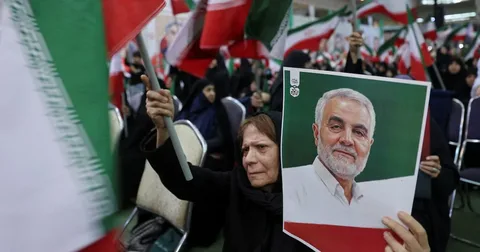
Understanding why the US arrests Soleimani relatives action carries such symbolic weight requires understanding who Qassem Soleimani was — and the extraordinary impact he had on US-Iran relations before the 2020 Baghdad drone strike that ended his life.
Soleimani was the commander of the Quds Force, the external operations arm of Iran’s Islamic Revolutionary Guard Corps. He led the Quds Force from 1997, building it into the most powerful instrument of Iranian regional influence in the Middle East. He directed military support for Hezbollah in Lebanon, the Assad government in Syria, Shia militias in Iraq, and Hamas in Gaza. US analysts described him as “the military centre of gravity of Iran’s regional hegemonic efforts” — a figure second only to Supreme Leader Ali Khamenei in real power inside Iran. He was personally sanctioned by the United Nations and the European Union, and was designated a terrorist by the United States as early as 2005. He had been responsible, according to US officials, for attacks that killed hundreds of American service members across multiple conflicts.
On January 3, 2020, at 1:00 a.m. Baghdad time, a US MQ-9 Reaper drone struck Soleimani’s convoy as it left Baghdad International Airport. Soleimani was killed instantly, along with Abu Mahdi al-Muhandis — the deputy commander of Iraq’s Popular Mobilisation Forces — and several other Iranian and Iraqi officials. President Donald Trump, in his first term, had authorised the killing in June 2019 and ordered it executed following Iranian-backed militia attacks on a US base near Kirkuk and a siege of the US Embassy in Baghdad. The ICE custody Soleimani family action in 2026 is in many ways the long shadow of that 2020 decision, with the Qassem Soleimani relatives arrested now paying a personal price for their family name in the context of a full-scale war.
FAQs
Why did the US assassinate Soleimani?
The Trump administration cited an imminent threat to American lives as justification for the 2020 Baghdad drone strike that killed Qassem Soleimani. Secretary of Defense Mark Esper said Soleimani “was actively developing plans to attack American diplomats and service members in Iraq and throughout the region.” The killing came days after an Iranian-backed militia attack on a US base near Kirkuk killed an American contractor, and after Kata’ib Hezbollah supporters besieged the US Embassy in Baghdad. However, a UN special rapporteur later found that “no evidence has been provided that General Soleimani specifically was planning an imminent attack” that would justify the strike, calling the killing a violation of Iraq’s sovereignty and international law. The debate over justification remains unresolved. The current US arrests Soleimani relatives action in ICE custody Soleimani family members now face is a direct extension of the political logic that led to his killing six years ago.
What impact did Soleimani have on the US?
Qassem Soleimani’s impact on the United States was profound and long-lasting. Under his command, the Quds Force coordinated Iranian-backed militia attacks that killed hundreds of American service members in Iraq over two decades. He built the network of proxy forces — Hezbollah, Hamas, the Houthis, and Iraq’s PMF — that has directly confronted US interests across the region. His assassination reshaped the region by eliminating the single most important architect of Iran’s expansionist strategy, but it also triggered immediate retaliation: Iran fired more than a dozen ballistic missiles at US bases in Iraq within days, injuring over 100 American troops. Longer term, the Soleimani killing accelerated Iranian nuclear development, hardened Iranian public opinion against America, and set in motion a chain of escalation that critics argue contributed to the conditions that produced the 2026 Iran war — and the ICE custody Soleimani family arrests that are now unfolding.
How did Iran respond to the killing of Soleimani?
Iran’s immediate response to the killing of Qassem Soleimani — whose Qassem Soleimani relatives arrested in the US news cycle now echoes six years later — was a ballistic missile strike on two Iraqi air bases housing US forces on January 8, 2020. Supreme Leader Ali Khamenei called the strikes a “slap in the face” to America, though he acknowledged they were insufficient retaliation. No Americans were killed in the missile attack, though over 100 suffered traumatic brain injuries. In the tense days that followed, an IRGC operator mistakenly shot down a Ukrainian passenger jet over Tehran, killing all 176 aboard. Iran declared 40 days of national mourning for Soleimani and elevated him to the status of national martyr. Over the following years, Iranian-backed militias continued attacks on US forces across the region. In 2022, Iranian President Ebrahim Raisi declared that Trump and Pompeo must be brought to trial or Iran would seek revenge. The 2026 war itself — and the US arrests Soleimani relatives action placing Hamideh Soleimani Afshar in ICE custody Soleimani family members now endure — can be seen as another chapter in the long, unresolved reckoning that began in Baghdad on January 3, 2020.