(Publish from Houston Texas USA)
(By Iftikhar Ahmed)
Iran enforces permit system in Strait of Hormuz as global shipping traffic declines sharply
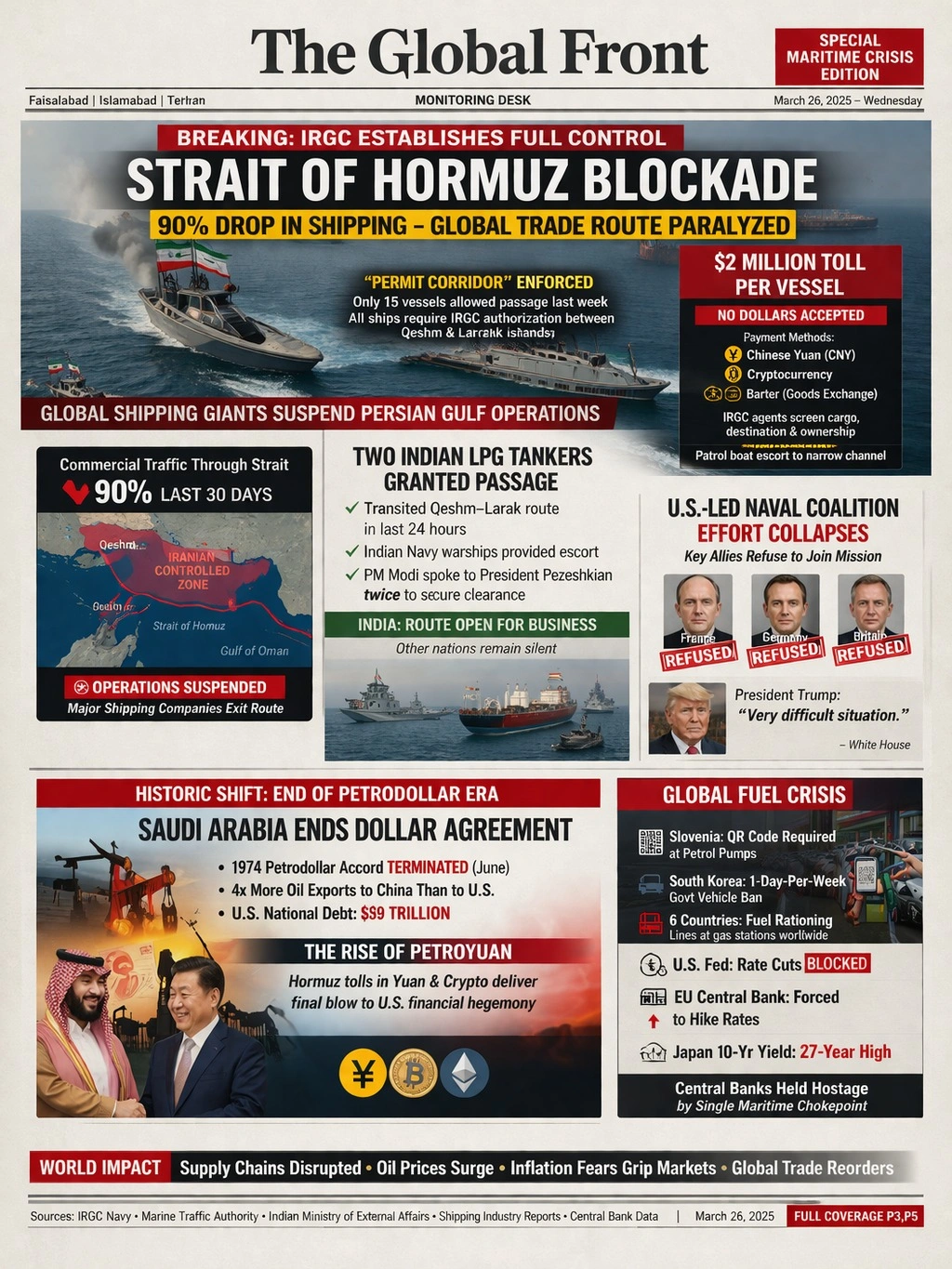
Iran’s Islamic Revolutionary Guard Corps has established full control over the Strait of Hormuz. Over the past month, commercial vessel traffic through this waterway has declined by 90 percent. Global shipping companies have suspended their operations in the Persian Gulf. The Iranian navy has now transformed the strait into a permit corridor where ships can only pass after obtaining authorization. Only fifteen vessels were granted passage last week. All ships must obtain clearance from the IRGC Navy to navigate through Iranian territorial waters between the islands of Qeshm and Larak.
Two Million Dollar Toll Per Vessel, Payment Not Accepted in Dollars: Iran has imposed a toll tax of two million dollars on every commercial ship transiting the Strait of Hormuz. This tax is not being accepted in US dollars, with payments instead collected only in Chinese yuan, cryptocurrency, or through a barter system in exchange for goods. Approved agents of the Iranian Revolutionary Guard conduct thorough screening of all vessel documentation, including cargo, destination, and owner details. After clearance is granted, Guard patrol boats escort the vessels safely through the narrowest section of the strait. At least one operator successfully passed through after paying this toll a few days ago.
Indian Ships Transit Successfully, Global Powers Remain Silent: India has successfully moved its commercial vessels through after accepting Iran’s new system. Two Indian LPG tankers passed through the route between Qeshm and Larak islands and entered the Gulf of Oman over the past twenty-four hours. Indian navy warships escorted these tankers. The Indian prime minister personally contacted the Iranian president twice by telephone to secure passage for these vessels. On the other side, efforts led by the United States to form a naval coalition failed, as major allies including France, Germany, and Britain refused to join the mission.
Saudi Arabia Ends Dollar Agreement, Era of Petroyuan Begins : According to economic experts, the developments in the Strait of Hormuz mark the beginning of the end for the petrodollar. The agreement established in 1974 that set oil trade in US dollars was formally terminated by Saudi Arabia in June. Saudi Arabia now exports four times more oil to China than it does to the United States. This shift in the global financial system comes as US debt has reached thirty-nine trillion dollars. When vessels passing through the Strait of Hormuz pay tolls in yuan or cryptocurrency instead of dollars, they are driving the final nails into the coffin of American financial supremacy.
Fuel Shortages Worldwide, Central Banks Held Hostage: The direct effects of the Strait of Hormuz blockade are now visible across the world. Slovenia is requiring QR code scans at petrol pumps to dispense fuel, while South Korea has imposed a one-day-per-week ban on government vehicles. Fuel rationing has begun in six countries. The US Federal Reserve cannot cut interest rates while the European Central Bank is forced to raise them. Japan’s ten-year bond yield has reached its highest level in twenty-seven years. Central banks worldwide have become hostages to this single strait, where authority no longer rests with the US naval fleet or international law, but with a VHF radio call and the approval of Iran’s Revolutionary Guard.
For more information please visit our International news.