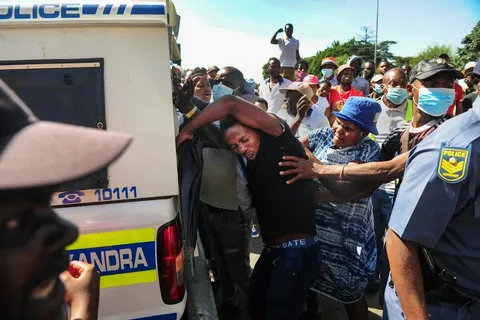
Xenophobia in South Africa 2026 has turned into one of the country’s most pressing crises after anti-migrant groups, among them March and March and Operation Dudula, set an unofficial deadline of June 30 for undocumented foreigners to leave the country. That deadline has driven real fear through migrant communities, particularly in Johannesburg and Durban, where weeks of protests and attacks have already left people dead and thousands fleeing.
The South African government has been explicit that this deadline carries no legal weight, but that hasn’t stopped the fear on the ground. Police have stepped up deployments nationwide, and thousands of migrants have spent recent weeks camped outside consulates or waiting at border posts, hoping to get out before the date arrives.
Background
South Africa has lived through repeated waves of xenophobic violence over the past two decades. The country draws workers and refugees from across the continent because its economy is comparatively stronger, but that same economic pull has, time and again, turned into resentment when unemployment and inequality bite hard at home.
A lot of South Africans believe undocumented migrants are competing with them for jobs, housing, healthcare, and public services. Researchers studying this for years point to something different: these tensions trace back to inequality, slow growth, and weak service delivery, with migrants absorbing blame that’s really aimed at deeper structural failures.
Major outbreaks hit in 2008, then again in 2015 and 2016, and then in 2019, when attacks on foreign-owned businesses and migrants drew international attention. What’s happening now in 2026 has revived all of those same fears, and in some ways has gone further: this is the most organized anti-migrant mobilization the country has seen since 2019.
What Is Happening in South Africa in 2026?
Anti-migrant demonstrations have been building for weeks across several provinces. Groups led by figures like Operation Dudula and March and March, the latter founded by Jacinta Ngobese-Zuma, have pushed an ultimatum: undocumented foreigners leave by June 30, or face consequences.
Organizers describe this as pressure on government policy rather than a threat against people. For migrants on the receiving end, the line hasn’t felt that clean. Fake notices mimicking official government documents have circulated, falsely claiming undocumented foreigners face arrest and deportation if they don’t leave by the deadline. The government has confirmed these notices are fabricated.
At Johannesburg’s Yeoville Market, traders have described growing anxiety as rumors moved through the community faster than facts could keep up. Some migrants stopped working. Others packed up entirely, preparing to leave before the deadline arrived rather than wait to find out what would happen.
Government officials have repeated, more than once, that no legal deadline exists, and have urged people not to take immigration enforcement into their own hands.
South Africa Xenophobia News
Thousands of migrants from Zimbabwe, Malawi, Mozambique, Nigeria, and elsewhere have turned to their embassies for help. Several governments have organized transport home for citizens who want to leave voluntarily, and temporary shelters have gone up for families with nowhere else to go while the security situation is monitored.
Police have cancelled leave for officers and pushed additional personnel into high-risk areas, with a dedicated security operation reportedly costing tens of millions of dollars. Deportations have also risen sharply: from just under 58,000 in the 2024-2025 financial year to more than 109,000 by the end of March 2026, an increase of roughly 46 percent.
Government Response
President Cyril Ramaphosa has condemned the violence directly, saying attacks on foreign nationals don’t represent South Africans or government policy, and has placed blame on what he’s called opportunists exploiting genuine grievances under the cover of community activism.
The Department of Home Affairs has rejected the fake social media notices outright, confirming June 30 is a normal working day with no legal basis for any deadline. Officials have stressed that peaceful protest is constitutionally protected, but that intimidation, looting, or violence against migrants will be prosecuted.
That message hasn’t fully landed on the ground. Migrants camped outside consulates in the days before the deadline have said the distinction between political protest and personal threat feels academic when men are showing up at your door with an ultimatum.
Why Has Xenophobia Increased?
A handful of long-running pressures keep feeding this.
High Unemployment
South Africa’s unemployment rate sits above 30 percent, with youth unemployment over 60 percent. In communities living with numbers like that, the belief that foreigners are taking scarce jobs spreads fast, even where the data doesn’t support it.
Crime Concerns
Some political groups argue undocumented migration drives crime. Researchers caution against pinning crime committed by individuals on entire migrant communities, pointing instead to broader patterns of stagnation and weak governance.
Economic Inequality
Persistent poverty, strained public services, and slow growth have built up frustration that’s increasingly being directed at migrants rather than the institutions actually responsible for those conditions.
Political Debate
Immigration has become a major electoral issue, with several parties calling for tougher border controls and stricter enforcement ahead of upcoming local elections.
Xenophobia in South Africa Statistics
The numbers shift as the situation develops, but the scale is significant:
- Roughly 2.4 to 3 million documented and undocumented migrants are estimated to live in South Africa, around 5 percent of the population.
- More than 60 people were killed during the 2008 xenophobic attacks.
- At least 12 people died during the 2019 violence.
- Multiple deaths, including Malawian and Mozambican nationals, have already been reported in the lead-up to the 2026 deadline.
- Deportations rose from roughly 58,000 in 2024-2025 to over 109,000 by March 2026.
When Was the Last Xenophobia in South Africa?
The current wave is unfolding now, through June 2026, with anti-migrant demonstrations and security deployments intensifying in the run-up to the June 30 deadline.
Before this, the last major nationwide outbreak was in 2019, when attacks targeted foreign-owned businesses and migrant communities. Smaller, localized incidents have continued in the years since, but what’s happening now represents the largest organized anti-migrant mobilization the country has seen since then.
Xenophobia in South Africa 2019
The 2019 violence shocked people well beyond South Africa’s borders. Attacks spread across parts of Johannesburg and nearby areas, leaving people dead, injured, and displaced, and destroying foreign-owned businesses in the process. Several African governments criticized the violence and organized emergency evacuations for their citizens.
That episode strained South Africa’s diplomatic relationships with its neighbors and made clear how much work remained on community engagement and immigration reform, work that the events of 2026 suggest never fully happened.
Xenophobia in South Africa PDF
Universities, research organizations, and human rights groups have published detailed reports on the history and causes of xenophobia in South Africa. These typically cover historical background, immigration policy, economic inequality, human rights, social integration, government response, and conflict resolution.
The consistent recommendation across this research is that immigration management alone won’t fix this. It has to be paired with real economic development and public education, or the underlying resentment just resurfaces with the next economic downturn.
Xenophobia in South Africa Videos
News organizations continue to publish video coverage from Johannesburg’s markets, interviews with migrants, footage of police deployments, government briefings, community meetings, and humanitarian response efforts. That footage has been central to how this story has reached audiences outside South Africa, giving a more direct sense of conditions on the ground than written reporting alone can convey.
Xenophobia in South Africa Wikipedia
A lot of people search Xenophobia in South Africa Wikipedia for background and historical context, and it’s a reasonable starting point. Given how fast this situation is moving, though, it’s worth pairing that with official government statements, academic research, and established news organizations for anything current, since a static reference page can’t keep pace with a story still unfolding day to day.
Regional and Global Impact
This isn’t contained to South Africa. Zimbabwe, Malawi, Mozambique, Nigeria, and Ghana have all expressed concern for their citizens, and several have organized transport home for those who want to leave.
Businesses that depend on migrant labor are feeling the disruption too, and regional organizations continue pushing for peaceful dialogue and lawful enforcement rather than vigilante action. Human rights organizations have warned that continued violence risks real damage to South Africa’s international standing and its relationships across the region.
Expert Views
Researchers who study migration in South Africa point to a consistent pattern: unemployment, poverty, weak public services, and inequality create the conditions where migrants get blamed for problems that are structural, not migration-driven. Human rights groups, including Lawyers for Human Rights, have raised particular concern about vigilante and anti-rights groups carrying out racial profiling, noting that many of those targeted aren’t undocumented at all but hold legal refugee status.
The consistent call from these groups is the same: protect everyone living in South Africa regardless of nationality, and enforce immigration law through actual legal institutions rather than mobs deciding who belongs.
Conclusion
Xenophobia in South Africa 2026 is still very much a developing story, and the days immediately around the June 30 deadline are likely to be the most consequential. The government has rejected the deadline’s legitimacy and increased security, but that hasn’t been enough to calm the fear running through migrant communities who’ve already watched neighbors and family members targeted.
Whether this settles or escalates further depends on effective policing, responsible political leadership, and whether the loudest anti-migrant voices lose ground to calmer ones. International observers are watching closely, and so are millions of people in South Africa and across the region whose safety depends on what happens next.
FAQs
What is happening in South Africa about foreigners?
South Africa is in the middle of a serious wave of anti-migrant tension after groups demanded that undocumented foreigners leave the country by an unofficial June 30 deadline. The government has stated clearly that this deadline has no legal standing and has increased police deployments to try to prevent further violence. Thousands of migrants have sought help from embassies or temporary shelters, and several deaths have already been linked to the unrest.
How do I say “hi” in South Africa?
South Africa has 12 official languages, so the greeting depends on which one you’re using. Common ones include “Hello” in English, “Sawubona” in isiZulu, “Molo” in isiXhosa, “Dumela” in Setswana and Sepedi, and “Hallo” in Afrikaans. English remains the most widely used in business, government, and tourism settings.
What type of xenophobia exists today?
Modern xenophobia takes a range of forms: discrimination, hate speech, social exclusion, misinformation, workplace bias, and in some cases direct violence against foreign nationals. In South Africa right now, the central issue is hostility toward African migrants accused by some groups of taking jobs or driving crime. Human rights organizations are consistent in arguing these grievances need to be addressed through lawful policy, not violence or blanket blame against entire communities.