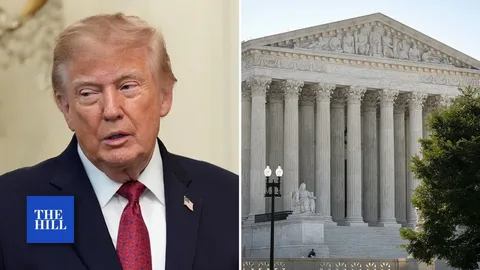
The US Supreme Court agreed on Thursday to hear a dispute over the Trump mandatory detention policy, which subjects millions of immigrants who entered the country illegally to detention during their deportation proceedings. The policy denies many of them a bond hearing, where a judge could decide if they can be released. The justices will decide if the Trump immigration policy is lawful. The ruling could shape immigration enforcement across the country.
Background: A Break From Decades of Practice
Immigrants arriving at the border have long been subject to mandatory detention while their cases are heard. People who were arrested inside the country, however, were typically allowed to ask for a bond hearing, unless they had certain criminal records. This was the practice under earlier administrations, including Trump’s first term, according to CNN.
After returning to power in 2025, Trump’s administration reinterpreted a 1996 immigration law. It argued that people who entered the country illegally have never been formally “admitted,” so they can be treated like new arrivals at the border. Under that reading, they must be held without bond while their cases continue, even if they have lived in the US for years.
The policy has become a central part of Trump’s mass deportation campaign. Challenges have flooded the courts. Plaintiffs’ lawyers say hundreds of district judges, along with most appeals courts, have rejected the government’s reading of the law.
Details: What the Supreme Court Agreed to Review
The justices will consider whether immigrants living in the US have a right to a hearing on whether they should stay detained. Appeals courts in nine of 11 federal circuits have found that detention without a bond hearing violates federal law, according to AP. The 5th and 8th circuits have sided with the government, which has created a split among the lower courts.
Administration lawyers say that split is “disrupting the orderly administration of immigration law” and has produced an inconsistent patchwork. They argue that people in some circuits face mandatory detention, while those in others get bond hearings and are often released. They asked the Supreme Court to settle the question.
The plaintiffs are immigrants represented by the American Civil Liberties Union. They say the administration is trying to deny bond hearings to immigrants arrested anywhere in the US, however long they have lived there. It takes at least four justices to agree to hear a case, and the court has now done so.
A Related Case Also in the Background
Separately, the administration had urged the court to take a different case, one dealing with broader constitutional questions about detention. Fox News reported that the earlier effort stalled after a pardon in New York, and the solicitor general said he would look for another case. The court took up the current dispute instead.
This shows how much the government wants a final answer. The court’s new term begins next week, and immigration is set to be a central theme. A decision would most likely come by the end of the term, which usually falls around late June.
Quotes: What Officials and Experts Said
Ariel Ruiz Soto, a senior policy analyst at the nonpartisan Migration Policy Institute, said the Supreme Court is going to have a “deciding voice” on how mandatory detention looks. He also warned that even if the court rules against the policy, the results would be hard to predict. Immigration judges could be required to hold bond hearings but might be under pressure to deny bond.
The ACLU has argued that the government cannot twist the law to hold people for months or years without a hearing. The administration, for its part, says its reading of the law is correct and that bond hearings can encourage delay tactics and raise the risk that some people abscond. A former Justice Department official, Chad Mizelle, made a similar argument, according to Fox News.
Impact: What the Ruling Could Change
For immigrants, the ruling could decide whether they can ask a judge for release while their cases proceed. If the court rejects the policy, many detained people could get bond hearings and perhaps be freed until their court dates. If it backs the government, mandatory detention could expand and the number of people in custody could grow.
For the immigration system, the effects would be large. Detention centres are already under pressure, and immigration courts have heavy backlogs. A ruling for the government could increase detention numbers, while a ruling against it could add thousands of bond hearings to court calendars.
Beyond the US, the case is watched by migrant families, governments and rights groups around the world. Many countries receive deported nationals, and detention policy affects how fast and how often removals happen. The decision may also influence how other countries think about due process for people facing deportation.
Conclusion: What Happens Next
The Supreme Court will schedule arguments in the coming months, and the justices will hear from both the administration and the ACLU. Until a ruling, lower court decisions will continue to vary by region. That means the outcome for a detained immigrant may depend on where they are held.
Whatever the decision, it will be one of the most important immigration rulings of the term. It will define how far the Trump immigration policy can go under existing law. Congress could also respond if the court’s reading of the 1996 statute leaves gaps.
Frequently Asked Questions (FAQs)
Can ICE detain a US citizen?
Legally, no. Immigration and Customs Enforcement has authority over non-citizens, and it has no power to detain US citizens for immigration reasons. In practice, mistakes do happen, and journalists and legal groups have documented cases in which US citizens were held by immigration agents, often because of errors in databases, doubts about documents or racial profiling. Citizens who are held can contact a lawyer, show proof of citizenship such as a passport or birth certificate, and file a habeas corpus petition in federal court. Anyone detained should ask for a lawyer and avoid signing documents they do not understand.
Which countries did Trump freeze immigration in?
The restrictions have grown in stages, and the details are complicated. A June 2025 proclamation limited entry from 19 countries. A December 16, 2025 proclamation expanded this to 39 countries plus travellers using Palestinian Authority documents, effective January 1, 2026. Nineteen countries face a full ban: Afghanistan, Burkina Faso, Burma (Myanmar), Chad, the Republic of the Congo, Equatorial Guinea, Eritrea, Haiti, Iran, Laos, Libya, Mali, Niger, Sierra Leone, Somalia, South Sudan, Sudan, Syria and Yemen. About 20 others face partial limits, including Cuba, Venezuela, Nigeria, Tanzania and Angola, though sources differ on some names. Separately, the State Department paused immigrant visa processing for nationals of 75 countries from January 21, 2026. Courts have also heard challenges, so check the State Department’s current list before relying on any one source.
Can ICE deport you if you are a US citizen?
No. A person who is a US citizen cannot lawfully be deported. Citizens by birth keep their status unless they formally renounce it. Naturalised citizens can lose citizenship only through a court process, usually when it was obtained by fraud or concealment, and only after that can removal proceedings begin. Some people believe they are citizens through a parent but face disputes over proof, so keeping documents like birth certificates and passports is important. If an agent claims a citizen can be removed, the person should ask for a lawyer immediately. Wrongful removals of citizens are unlawful and can be challenged in court.
Notes for you (not part of the article):
- Sources: the court details come from AP (via Boston Globe, Baltimore Sun, US News), CNN, Stateline and the Washington Times. The travel ban list comes from the CRS summary on Congress.gov, NAFSA, Fragomen and CFR.
- Conflicting lists: sources disagree on some “partial ban” countries, so the FAQ names only a few that appear in several lists. Please verify with the State Department before publishing.
- US citizen FAQs: these are general legal explanations, not legal advice. The point about documented wrongful detentions is attributed generally, since I did not pull a specific report.
- Dates: I did not name the case title or give an argument date, because they were not confirmed in the reports. The “decision by late June” line is a general statement about the court’s term.
- Quotes: I used only short quotes, in line with the copyright limits. The ACLU statement is paraphrased.
- Keywords: all four of your keywords appear several times. The headline differs from the Tribune title.
- Originality: the article is in fresh wording, not copied from Tribune or AP.
- Citations: if the citation markers do not copy into your CMS, remove them before pasting.