

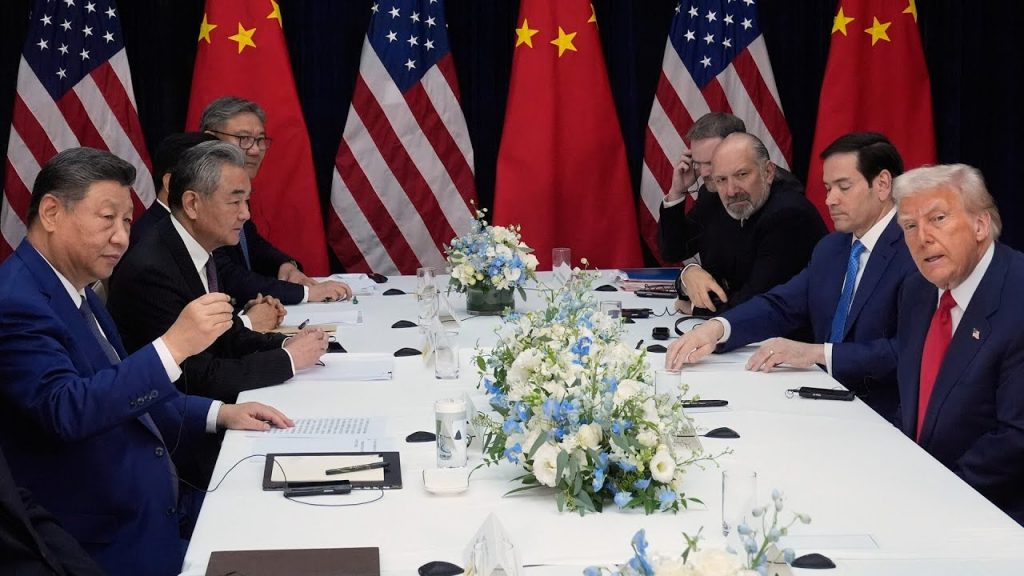

Trump-Xi Summit 2026: A High-Stakes Meeting Caught in Global Crosswinds
The most anticipated diplomatic event of 2026 a face-to-face meeting between U.S. President Donald Trump and Chinese President Xi Jinping in Beijing has been delayed, rescheduled, and surrounded by geopolitical uncertainty. The Trump China summit 2026 is now confirmed for May 14–15, after weeks of tension over the ongoing U.S.–Iran war and the critical Strait of Hormuz shipping route.
Background: How the Trump Visit to China Was Planned
Trump announced he had accepted an invitation from Chinese President Xi Jinping to visit China in April, and in turn invited Xi to the White House for a state visit later in 2026.
Trump’s trip to China would mark the first time a United States president had traveled to China since his own state visit to Beijing back in 2017. The announcement came after months of diplomatic groundwork, including tariff negotiations and a landmark bilateral meeting in Busan, South Korea.
During those earlier talks, China agreed to resume purchases of U.S. soybeans and halted its expanded curbs on the export of rare earth minerals, while the United States lowered tariffs on China by 10%. Both sides also agreed to hold off on the triple-digit tariffs that had threatened each country.
The Delay: Iran War and the Strait of Hormuz Derail Plans
Trump was originally scheduled to travel to Beijing from March 31st to April 2nd for his summit with Xi Jinping. On March 16th, however, Trump announced he was asking to delay the visit by roughly a month because of the war in Iran.
The China trip had been planned for months but began to unravel as Trump pressured Beijing and other world powers to use their military might to protect the Strait of Hormuz a critical waterway for the global flow of oil.Iran had been targeting energy infrastructure and traffic moving through the strait.
U.S. Treasury Secretary Scott Bessent, speaking to CNBC in Paris, said that if the meeting were delayed, it would not be because Trump demanded that China help police the Strait of Hormuz, but rather for logistical reasons such as the president choosing to remain in Washington to coordinate the war effort.
Trump later confirmed the delay directly. He told reporters he would be going to China in “five or six weeks” instead of at the end of the month, adding: “We’re working with China they were fine with it. I look forward to seeing President Xi.
U.S. and China: Behind-the-Scenes Tensions
Beneath the surface of the official diplomatic line, a more complex story was emerging: months of growing frustrations, mismatched expectations, unanswered proposals, and a distracted Trump administration all compounded by geopolitical crosswinds.The result was a web of concerns straining the lead-up to the summit long before missiles escalated tensions in the Middle East, leaving Beijing increasingly wary of the meeting and bracing for even lower expectations.
China’s Position on Iran and the Strait of Hormuz
China made clear it would not help the United States reopen the Strait of Hormuz as requested by President Trump, but analysts noted that Beijing was likely welcoming the delay in Trump’s visit while the U.S. risked getting drawn deeper into a Middle Eastern conflict.
With roughly 98% of Iranian oil exports bound for China, and the Trump-Xi summit just weeks away, Washington’s maximum pressure campaign on Iran risked destabilizing the fragile détente that the administration had carefully cultivated with Beijing.
Trump later claimed on Truth Social that China had agreed not to send weapons to Iran, and stated that the Strait of Hormuz was now “permanently open,” saying: “China is very happy that I am permanently opening the Strait of Hormuz I am doing it for them, and also for the world.”
Summit Rescheduled: May 14–15 in Beijing
The Trump-Xi summit has now been officially rescheduled for May 14th and 15th.The visit is seen as a defining moment for U.S.–China relations in 2026.
As the two leaders prepare to sit down, negotiations on deliverables and scheduling have accelerated, including a possible Trump visit to Beijing’s Temple of Heaven and attendance at a Chinese military parade, according to several people familiar with the planning process.The lead-up for such a consequential summit has been compressed and rather disjointed, given the Middle East war and Trump’s preference for making last-minute decisions.Experts caution that expectations should be managed carefully.
Expert Analysis: What Does This Mean for U.S.–China Relations?
Analysts from the Brookings Institution and Council on Foreign Relations have weighed in on what the delayed Trump China summit 2026 means for the broader bilateral relationship.
Experts note that Washington and Beijing are both signaling the postponed summit should not be read as a major setback, and that the delay is really about logistics rather than a rupture in ties.
One analyst noted that the Iran war essentially puts the United States on weaker footing relative to China a dynamic Beijing is well aware of.China has been positioning itself as a constructive global actor throughout the conflict.
Sun Yun, director of the China program at the Stimson Center, noted that Iran’s request for Chinese intervention is now less pressing for Beijing to fulfill, given the shifting dynamics of the war.
JD.com Takes on Amazon in Europe: China’s E-Commerce Goes Global
While diplomatic headlines dominated, a major business story also broke on the same day the summit delay was announced. JD.com launched its long-anticipated European online shopping platform, with its international brand Joybuy going live in six new markets, including the U.K. and Germany, banking on fast deliveries and high-quality products to gain an edge on rivals.
JD.com’s new European push is the largest international expansion the company has undertaken so far, and signals its intent to challenge e-commerce giant Amazon in key overseas markets.
While peers like AliExpress and Temu operate an asset-light model and ship goods directly from China, JD.com has its own local warehouses and logistics networks that enable it to minimize delivery times.
JD.com now operates more than 60 warehouses across the European region, covering about 300,000 square metres, and has installed over 49,000 parcel lockers for deliveries.The warehouses use automated systems and hundreds of robots imported from China.
At launch, the Joybuy marketplace includes more than 100,000 products from global brands including Apple and Samsung.JD.com hopes its combination of competitive pricing, global brand partnerships, and rapid delivery will win over European consumers.
E-commerce shopping continues to grow globally, accounting for 16% of retail sales in the closing quarter of 2025 a trend that makes Europe a highly attractive market for Chinese platforms expanding internationally.
Global Impact: What It All Means
The Trump China summit 2026 carries weight far beyond the bilateral relationship. A successful meeting could stabilize global trade, ease tariff pressures, and reduce tensions in East Asia. A failed summit, or another delay, could rattle markets and embolden rivals.
Meanwhile, JD.com’s European expansion reflects a broader trend: Chinese companies are going global with confidence, even as diplomatic tensions between Beijing and Washington simmer. The combination of state-level diplomacy and corporate expansion illustrates how deeply intertwined U.S. and China interests have become.
The Strait of Hormuz crisis added yet another dimension showing that no bilateral relationship today exists in isolation from wider global events.
Conclusion: All eyes are now on mid-May. The rescheduled Trump-Xi summit 2026 will be watched closely by policymakers, investors, and analysts around the world. Whether Trump’s Beijing visit produces a substantive breakthrough on trade, security, and Iran or remains a largely symbolic gesture will set the tone for U.S.–China relations for years to come.
On the economic front, JD.com’s bold entry into Europe signals that China’s global ambitions extend well beyond politics. As the China summit 2026 approaches, the world waits to see whether diplomacy can keep pace with commerce.
FAQs
Is China involved in the Iran War?
China has not directly participated in the U.S.–Iran military conflict. However, Beijing has been deeply engaged diplomatically, pledging a constructive role in easing tensions. China has also been under U.S. pressure to help reopen the Strait of Hormuz, which it declined to do militarily. Trump stated that China agreed not to send weapons to Iran as part of diplomatic communications ahead of the May summit.
Does China support Iran financially?
China is Iran’s largest oil customer, purchasing the vast majority of Iran’s oil exports. This trade relationship provides Iran with critical economic revenue. While China does not provide direct financial aid labeled as “support for Iran,” its continued purchase of Iranian oil even under U.S. sanctions has been a significant economic lifeline for Tehran. The U.S. has repeatedly raised this issue in its pressure campaign on Beijing.
Why is Iran so important to China?
Iran is a vital energy supplier for China. Analysts estimate that close to 98% of Iran’s oil exports go to China, making it a cornerstone of Beijing’s energy security strategy. Beyond oil, Iran sits at a strategic crossroads in the Middle East, and China has cultivated ties with Tehran as part of its broader Belt and Road Initiative and its effort to build influence across Asia and the Middle East. The Strait of Hormuz, which Iran effectively controls, is also critical to the flow of energy to China making stability in the region a top Chinese priority.