By Asghar Ali Tabassum
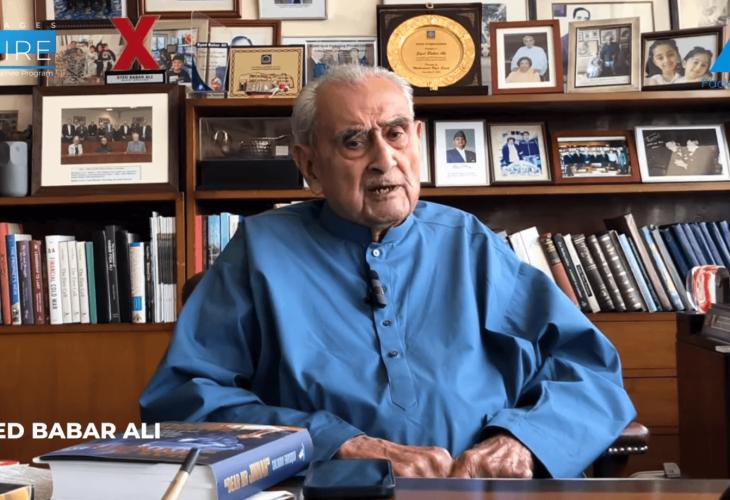
Syed Babar Ali recently entered his second century. It is a rare milestone, and rarer still is the clarity of thought and intellectual curiosity with which he has done so. Much has rightly been written about his contributions to Packages Limited and the Lahore University of Management Sciences (LUMS). These institutions have shaped Pakistan’s industry and education, and his role in building them is beyond dispute. Yet there is a chapter of his public service that remains largely unwritten: his leadership of the National Fertilizer Corporation (NFC). For those of us who served in the organisation during that period, this omission is not merely an oversight. It is a gap in the record of a life that has itself become part of Pakistan’s institutional history.

I witnessed that period from within. I served in NFC for many years and retired as Senior Manager Marketing. My recollections therefore rest not only on the historical record but on direct experience of the organisation during the years when Syed Babar Ali was its Chairman. His decision to accept the chairmanship of NFC was significant in itself. Zulfiqar Ali Bhutto’s nationalisation policies had affected his family’s industrial interests only a few years earlier. He did not allow that experience to stand in the way of accepting responsibility for a major public-sector enterprise. He brought his professional competence to NFC and placed it at the service of the country. When he assumed charge, NFC was still a fledgling organisation. Its initial production base consisted of four fertilizer factories at Multan, Daudkhel, Lyallpur and Jaranwala, capable of meeting only a fraction of national demand. The government subsequently committed substantial resources to expanding domestic production. Syed Babar Ali later recalled that approximately US$500 million was made available for new manufacturing facilities, with procurement conducted through competitive bidding and evaluation. Under his stewardship, NFC expanded rapidly. New fertilizer capacity was established, existing plants were upgraded, and major projects were undertaken. The NFC system eventually came to include Pak-Saudi Fertilizers, Pak-Arab Fertilizers, Pak-American Fertilizers, Pak-China Fertilizers and National Fertilizer Marketing Limited (NFML).
This was not simply a matter of production statistics. For an agricultural economy seeking to reduce its dependence on imported fertilizer, it was a question of national capacity. An equally important challenge was ensuring that fertilizer actually reached farmers. In 1976, National Fertilizer Marketing Limited was established as an NFC subsidiary. Its purpose was to create an organised mechanism for distribution across the country. A nationwide dealer network was developed, bringing fertilizer closer to farmers in every province. Having worked in NFC’s marketing operation myself, I remember this aspect particularly well. What may appear today as routine distribution data represented, at the time, a major effort to connect industrial development with the needs of Pakistan’s agricultural economy.
Syed Babar Ali’s later contributions, above all LUMS, understandably became far more widely known. LUMS grew into one of Pakistan’s leading universities. Packages remains closely associated with his industrial vision. In celebrating these highly visible achievements, however, his work at NFC has largely remained in the background. There is something distinctive about that chapter. At Packages, he was building a private enterprise. At LUMS, he helped translate an educational vision into an enduring institution. At NFC, he was entrusted with a national institution in the public sector. His task was to use his managerial ability in the service of the state. Over the years, NFC’s manufacturing plants were privatised. The corporation that had once been created to build national fertilizer-production capacity was gradually left without the industrial assets that had justified its creation. Syed Babar Ali himself later expressed disappointment at this outcome, observing that although the board and chairman remained, the factories were gone.
Yet the institutional legacy has not disappeared entirely. NFML continues to exist as a state-owned enterprise under the Ministry of Industries and Production. Its present role is different: following the privatisation of NFC’s production plants, it was assigned responsibility for distributing imported urea through its nationwide network when required, to help maintain availability and stabilise prices. Time has moved on. Lyallpur became Faisalabad. The fertilizer industry changed. NFC’s factories passed into other hands. Generations of officers and workers retired. Yet the question raised by that period remains strikingly current: can Pakistan still build strong institutions and, once built, allow them to endure?
Syed Babar Ali’s life suggests that it can — but only when professional competence is valued above patronage, public responsibility above personal grievance, and institution-building above short-term gain. We rightly remember him for LUMS, Packages and his many contributions to education and industry. But we should not allow the remarkable story of NFC to become a forgotten chapter. Some people build successful businesses. A much smaller number build institutions that outlive them. Syed Babar Ali belongs to the latter group. As Pakistan celebrates a century of his extraordinary life, the record would be incomplete without recognising his contribution to the National Fertilizer Corporation. It is an important, though too often overlooked, part of his legacy of service to Pakistan.