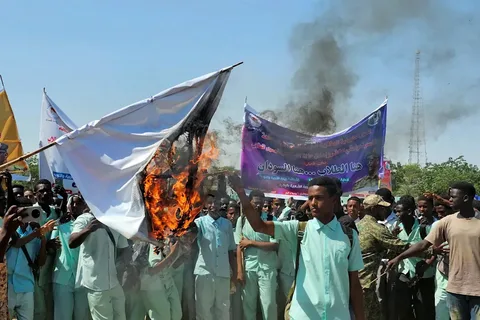
The Sudan war has entered another dangerous chapter as the city of El Obeid faces a tightening siege by the Rapid Support Forces. Drone strikes are hitting homes, markets, and hospitals almost daily. The United Nations has warned that hundreds of thousands of civilians could face the same fate that befell El Fasher last year.
This report brings together the latest developments in the Sudan conflict, explains who is fighting whom, and looks at what could happen next in North Kordofan and beyond.
Summary: What Is Happening in Sudan Right Now
El Obeid, the capital of North Kordofan state, is under growing pressure from RSF forces that have surrounded most routes leading in and out of the city. Only the eastern route remains partly open, and even that is under constant threat from drone attacks.
Roughly half a million residents live in El Obeid, alongside at least 100,000 people who fled earlier violence in Darfur and other Sudanese towns. Aid workers say the situation is deteriorating fast, and many fear a repeat of the mass killings seen in El Fasher just months ago.
Background: How Sudan Reached This Point
To understand today’s Sudan war latest news, it helps to look back at how the conflict began. Fighting broke out in April 2023 between two former allies: the Sudanese Armed Forces (SAF), Sudan’s national army, and the Rapid Support Forces (RSF), a powerful paramilitary group.
The two forces had previously worked together, including during Sudan’s post-revolution transition period. A power struggle over control of the state and its security apparatus eventually turned into open war across the country.
Since then, the war has displaced more than 13 million people inside Sudan and pushed millions more toward famine conditions. Large parts of Khartoum, Darfur, and now Kordofan have been reduced to battlegrounds, with civilians caught between two heavily armed sides.
Sudan War With Which Country: Understanding the Foreign Angle
Many readers searching for Sudan war latest news want to know whether this is a war between two nations. It is not. The Sudan war is fundamentally an internal power struggle between the Sudanese Armed Forces and the RSF, not a war against another country.
However, foreign involvement has shaped the conflict heavily. International investigators and human rights groups have repeatedly raised concerns about outside military support reaching the RSF, including reports of the United Arab Emirates backing the paramilitary group, along with allegations involving foreign private military contractors deployed to support RSF operations in Darfur.
The Sudanese government has also pointed to diplomatic pressure from Western nations and regional mediators attempting to broker peace, so far without lasting success.
Details: The Siege of El Obeid Explained
El Obeid sits roughly 550 kilometers northeast of Darfur and serves as the main gateway linking Khartoum to Sudan’s western regions. The city hosts an airbase, a major oil pipeline, and a large gum arabic market, making it strategically vital for both warring sides.
It is also home to the Sudanese Armed Forces’ 5th Infantry Division, known locally as Al-Hagana or the “Camel Corps,” which has made the city a key military stronghold for the government side.
Over the past three weeks, RSF drone strikes have hit markets, schools, water infrastructure, fuel stations, and civilian vehicles in and around the city. UN monitors documented at least 15 drone strikes in that period, killing at least 45 civilians.
Residents describe a worsening humanitarian emergency. Many are reportedly selling personal belongings just to afford transport out of the city, while others say the cost of fleeing has become impossible to bear. Reports from displacement routes describe patterns of abductions, torture, sexual violence, and looting targeting people trying to escape the encirclement.
Sudan War Latest Map: What the Frontlines Look Like
Following the Sudan war latest map helps explain why El Obeid matters so much. The RSF already controls large parts of Darfur following its capture of El Fasher in late 2025. North Kordofan, and El Obeid specifically, now forms the next major frontline, sitting between RSF-held western territory and the government-controlled center of the country.
If El Obeid falls, analysts warn it would hand the RSF a critical transport and supply hub, potentially extending the war further and cutting off another vital link between Khartoum and the west.
Who Is Winning the War in Sudan
There is no clear military victor at this stage of the Sudan conflict. The RSF has gained significant ground in Darfur, most notably with the fall of El Fasher, and now appears to be advancing on El Obeid in North Kordofan.
The Sudanese Armed Forces, meanwhile, continue to hold central Sudan and key military installations, including the 5th Infantry Division based in El Obeid itself. Both sides have faced accusations of targeting civilians, and neither has managed to secure a decisive nationwide advantage.
Diplomatic efforts, including a US-backed proposal to end the fighting, have so far failed to produce a breakthrough, with Sudan’s foreign ministry disputing recent characterizations of its response to that plan.
Quotes: What Officials and Experts Are Saying
UN High Commissioner for Human Rights Volker Türk described the situation in El Obeid as increasingly desperate, pointing to relentless drone attacks striking essential civilian infrastructure across the city.
Mona Rishmawi of the Independent International Fact-Finding Mission for Sudan said residents she had spoken with described a climate of pervasive fear as military activity intensified around the city.
International Organization for Migration official Mohamed Rifaat warned that El Obeid is approaching a total siege, one that would soon leave civilians unable to safely leave or return. He compared the emerging pattern directly to what happened before El Fasher fell.
Rights groups have also weighed in on past atrocities. Amnesty International recently concluded that the RSF committed crimes against humanity and ethnic cleansing during its 2024–2025 assault on El Fasher, citing testimony from survivors who described killings, torture, and sexual violence during that offensive.
Impact: Regional and Global Consequences
The humanitarian toll of the Sudan war already ranks among the worst displacement crises in the world, with more than 13 million people forced from their homes. A collapse of El Obeid could push that number even higher and deepen an already severe hunger crisis across the region.
Regionally, continued instability in Sudan threatens to spill over into neighboring countries already hosting large refugee populations, straining resources across East Africa and the wider Sahel region.
Internationally, the war has drawn renewed scrutiny of foreign arms flows and mercenary networks feeding the conflict, prompting calls at the UN Human Rights Council for an expanded arms embargo and wider International Criminal Court jurisdiction covering the whole of Sudan.
Conclusion: What Happens Next
The coming days are likely to prove decisive for El Obeid. A UN Human Rights Council resolution is expected to call for an immediate halt to atrocities by all parties, an end to external military support for the RSF, and an urgent international inquiry into the situation in the city.
Whether that pressure translates into action on the ground remains uncertain. For now, aid groups continue to warn that the window to prevent another mass-casualty event in Sudan is closing quickly, and that El Obeid could soon face a humanitarian catastrophe similar to what unfolded in El Fasher.
Frequently Asked Questions
What is the main problem of Sudan?
The central problem driving the Sudan war is a power struggle between the Sudanese Armed Forces and the Rapid Support Forces, two military bodies that once worked together but turned against each other in April 2023 over control of the state’s security structures. This conflict has since triggered one of the world’s largest displacement crises, pushing more than 13 million people from their homes, straining food supplies to the point of famine in several regions, and devastating basic services such as healthcare, water, and electricity in major cities including Khartoum, El Fasher, and now El Obeid.
Who is behind the conflict in Sudan?
The conflict is primarily fought between two Sudanese forces: the official Sudanese Armed Forces, representing the internationally recognized government, and the Rapid Support Forces, a paramilitary group with roots in earlier militia structures. Beyond these two main actors, international investigators and human rights organizations have raised concerns about foreign backing reaching the RSF, including reported military and logistical support connected to Gulf state networks and foreign private military contractors, which critics say have helped sustain the RSF’s battlefield capabilities throughout the war.
What is the main religion in Sudan?
Islam is the main religion in Sudan, practiced by the vast majority of the population, particularly across the northern and central regions of the country, including cities such as Khartoum, El Obeid, and El Fasher. Sudan also has smaller communities practicing Christianity and various traditional African belief systems, particularly in parts of the south and among certain ethnic groups, reflecting the country’s broader cultural and regional diversity even amid the ongoing conflict.